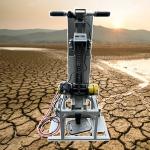
WDJD-4A: Uncompromised Geophysical Performance in the Planet's Most
Hostile Operating Conditions
From the frozen tundra of the Arctic to the scorching salt flats of
the Atacama, from the humidity-soaked rainforests of the Amazon to
the dust-choked deserts of the Sahara, the world's most valuable
subsurface resources often lie in its most inhospitable
environments. The WDJD-4A is engineered as an Extreme Environment Execution Platform, a system designed to deliver full-specification performance across the full spectrum of terrestrial operating conditions.
This instrument does not merely survive harsh environments; it
thrives in them, maintaining its measurement accuracy, data
integrity, and operational reliability where conventional equipment
fails. It enables exploration and engineering teams to pursue
opportunities in previously inaccessible frontiers with confidence
and consistency.
- Physical Architecture: Chassis constructed from high-impact, UV-stabilized polymer
composite that remains structurally sound from -40°C to +70°C
- Electronic Protection: Internal assemblies conformally coated with parylene-based
protective layer, rendering them impervious to condensation, salt
spray, and conductive dust
- Connector System: Gold-plated connectors with double-sealing O-rings, maintaining
IP68 protection even after repeated mating cycles
- Display Technology: High-brightness, sunlight-readable unit with integrated heating
element to prevent frost formation in sub-zero operation
- Thermal Management: Passive conduction paths and phase-change materials maintain
critical component temperatures without noisy fans that ingest dust
The operational software also adapts to extreme conditions. The
system continuously monitors internal and ambient temperatures,
humidity, and barometric pressure. When operating near temperature
limits, it automatically adjusts measurement parameters—increasing
stacking for thermal noise or reducing pulse width to manage
battery chemistry—to maintain data quality.
The battery management system includes low-temperature charging protection and cell-balancing
algorithms that extend battery life in extreme thermal
environments. The system can be configured for remote operation via
satellite link, allowing surveys to be conducted from a heated
shelter while the acquisition unit remains deployed in the
elements.
The WDJD-4A Extreme Environment Execution Platform thus removes the
environmental constraints on geophysical exploration, empowering
teams to go where the resources are, regardless of the climate.