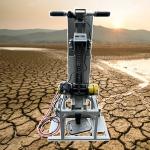
WDJD-4A: Automating Optimal Survey Geometry Through AI-Powered
Forward Modeling and Adaptive Planning
The quality of a geophysical inversion is fundamentally limited by
the quality of the survey design. A poorly designed acquisition
grid can obscure critical targets, waste field time, and yield
ambiguous results regardless of the instrument's precision. The
WDJD-4A addresses this foundational challenge as a Cognitive Survey Designer, a system that leverages artificial intelligence and automated forward modeling to generate optimal, target-specific survey plans. It moves beyond
static, rule-of-thumb survey layouts to provide dynamically optimized acquisition geometries that maximize the probability of detecting and resolving specific
subsurface features of interest while minimizing field effort. This
capability places the power of advanced survey design expertise
into the hands of every operator, ensuring that every campaign
begins with a plan mathematically tailored for success.
The cognitive design process begins with the definition of the investigation objective. Using an intuitive interface, the operator specifies the target:
"Map the geometry of a suspected aquifer at 50-80m depth," or
"Detect and delineate narrow, steeply dipping sulfide veins." The
system's AI engine then accesses a library of geological scenarios
and forward models. It rapidly simulates thousands of potential
survey designs—varying electrode array types, spacing, line
orientations, and measurement density—and evaluates each design's
theoretical ability to resolve the specified target under modeled
noise conditions. The result is not a single recommended design,
but a Pareto-optimal front of solutions that trade off between resolution, depth of investigation, and
survey time. The operator can then select the design that best
aligns with project priorities, confident that it represents a
mathematically optimal approach.
This capability delivers profound operational and technical
advantages. It democratizes expert-level survey design, ensuring that projects are not handicapped by the varying
experience levels of field crews. It eliminates the costly
guesswork of "standard" survey layouts that may be ill-suited to
the unique geological context of a site. Perhaps most importantly,
it enables rapid re-design in the field. If initial results reveal unexpected geology or a target at a
different depth than anticipated, the operator can re-run the
cognitive designer with the new information and generate an
optimized infill survey plan on the spot, without returning to the
office. This adaptive capability ensures that field time is always
directed by the most current subsurface understanding. The WDJD-4A
Cognitive Survey Designer thus transforms survey planning from a
static, one-time activity into a dynamic, iterative, and intelligence-driven process, guaranteeing that the data collected is always maximally
informative for the questions being asked.
Cognitive Design Specifications