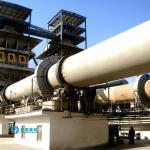
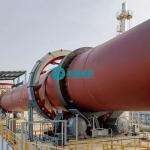
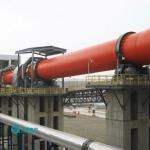
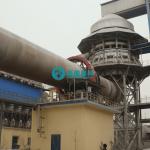
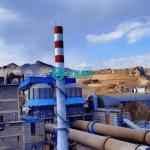
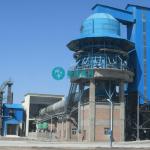
Hydrogen-fueled cement rotary kiln for zero carbon emission
1.Product Introduction Calcination Rotary Kiln
The Hydrogen-Fueled Cement Rotary Kiln is an innovative high-temperature calcination system specifically
designed to achieve net-zero carbon emissions in cement production. By replacing traditional fossil fuels with green hydrogen ($H_2$) and utilizing an intelligent temperature control system, the kiln
ensures high efficiency in the clinker sintering process while
significantly reducing the carbon footprint. The equipment features
an inclined cylinder and a slow-rotation structure to support
continuous, large-scale industrial cement manufacturing.
2.Application Calcination Rotary Kiln
- Low-Carbon Cement Production: Replaces coal or natural gas in the clinker calcination stage,
eliminating carbon emissions from fuel combustion to help the
cement industry reach carbon neutrality targets.
- Industrial Decarbonization Projects: Integrated into new or retrofitted production lines for
residential, commercial, and infrastructure engineering, enhancing
the market competitiveness of "green" building materials.
3.Working Principle Calcination Rotary Kiln
Hydrogen Fuel Supply: Green hydrogen is injected into the kiln head burner via
specialized piping. When mixed with air, it forms a
high-temperature flame providing the necessary thermal energy for
clinker sintering.
Material Reaction: Raw materials (such as limestone) tumble and move through the
kiln, undergoing dehydroxylation and phase transformation. The use
of hydrogen can potentially lower decomposition temperatures and
optimize thermal efficiency.
Emission Control: Exhaust gases are processed through a waste heat recovery system.
Any unreacted hydrogen can be recycled, achieving near-zero
pollutant emissions.
4.Advantages Calcination Rotary Kiln
High Energy Efficiency: The high calorific value of hydrogen improves energy utilization
and reduces energy consumption per unit of clinker while supporting
24/7 continuous operation.
Environmental Compliance: The sealed structure and advanced gas treatment technologies
significantly reduce dust and harmful gas leakage, meeting the
strictest international environmental standards.
Process Compatibility: Adaptable to existing cement industry frameworks, making it easy
to integrate into pre-calciner kilns or modern "new suspension
preheater" (NSP) dry-process production lines.
5.Technical Specifications
| Model | Speed (r/min) | Inclination (%) | Capacity (t/h) | Gearbox Model | Ratio | Motor Model | Motor Power (kW) | Motor Speed (r/min) | Thrust Roller Type | Support Count | Weight (t) |
| Φ1.9/1.6x36 | 0.53-1.59 | 4 | 2.5-3 | JZQ750-1 | 48.58 | JZT-72-4 | 30 | 1200/400 | Mechanical | 3 | 53 |
| Φ2.1/1.8x36 | 0.5-1.51 | 4 | 4 | UT2-110 | 163.38 | JZS-81 | 30/10 | 1410/470 | .. | 3 | 75 |
| Φ1.2x25 | 0.5-1.6 | 3 |
| PM650 | 40.17 | JZTY71-4 | 22 | 1200/120 | .. | 3 | 34 |
| Φ1.6x32 | 0.158-0.258 | 3 |
| PM750 | 48.57 | JZJY61-4 | 15 | 1200/120 | .. | 3 | 46.82 |
| Φ1.8x45 | 0.66-1.98 | 4 | 3.5 | UT2-110 | 163.38 | JZS-81 | 30/10 | 1410/470 | .. | 3 | 80 |
| Φ2.2x50 | 0.125-1.25 | 3.5 | 4 | ZS145-11 | 157 | YCT280-4A | 30 | 1320/132 | .. | 3 | 130.71 |
| Φ2.5x50 | 0.516-1.549 | 3.5 | 5.5 | ZS165-7 | 99.96 | YCT355-4A | 55 | 1320/440 | .. | 3 | 167.5 |
| Φ3x48 | 0.3309-3.309 | 3.5 | 35 | ZL130-14 | 32.11 | ZSN4-250-21B | 90 | 1000/100 | .. | 3 | 237 |
| Φ3.2x50 | 0.398-3.975 | 3.5 | 50 | ZL130-16 | 40.85 | ZSN4-280-11B | 190 | 1500/150 | .. | 3 | 263 |
| Φ3.3x52 | 0.391-3.91 | 3.5 | 50 | ZSY500-28 | 27.707 | ZSN4-315-082 | 190 | 1000/100 | .. | 3 | 280.8 |
| Φ4x60 | 0.396-3.96 | 3.5 | 104 | ZSY630-35.5 | 34.601 | ZSN4-355-092 | 315 | 1000/100 | Hydraulic | 3 | 487.5 |
| Φ4.2x60 | 0.4165-4.165 | 3.5 | 116 | ZSY710-35.5 | 35.526 | ZSN4-355-12 | 420 | 1000/100 | .. | 3 | 576.1 |
| Φ4.3x62 | 0.398-3.98 | 3.5 | 125 | ZSY710-35.5 | 35.714 | ZSN4-355-12 | 420 | 1000/100 | .. | 3 | 598.5 |
| Φ4.8x74 | 0.35-4 | 4 | 208 | JH710C-SW305-40 | 42.226 | ZSN4-400-092 | 630 | 1500/130 | .. | 3 | 841 |
6.Our Solutions