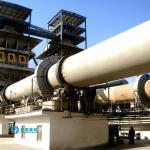
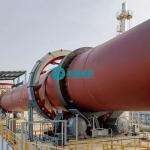
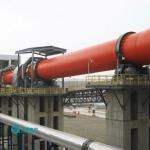
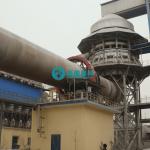
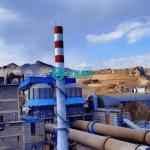
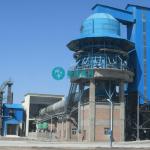
Spent catalyst regeneration rotary kiln furnace
1.Product Introduction Calcination Rotary Kiln
The Spent Catalyst Regeneration Rotary Kiln Furnace is a continuous
high-temperature thermal treatment system specifically designed for
the regeneration of deactivated catalysts used in the
petrochemical, oil refining, and automotive emission control
industries. The equipment consists of an inclined rotating
refractory steel cylinder, a multi-zone temperature control heating
system, an off-gas purification unit, and automated
feeding/discharging systems. It operates within a temperature range
of 800–950°C to achieve the complete oxidative removal of carbon
deposits (coke) from the catalyst surface while simultaneously
restoring the active structure of precious metals (such as
Platinum, Palladium, and Rhodium). Supporting atmosphere switching
between nitrogen and air, the furnace is suitable for regenerating
various spent catalysts with metal oxide or silica-alumina
carriers, featuring high throughput, low material loss, and
automated operation.
2.Application Calcination Rotary Kiln - Automotive Catalyst Recovery: Regenerating Platinum Group Metal (PGM) catalysts from Three-Way
Catalytic Converters (TWCs) for efficient recovery and reuse.
- Chemical Catalyst Cycling: Regenerating deactivated Vanadium or Molybdenum-based catalysts
used in nitric acid production or phthalic anhydride synthesis.
- Environmental Resource Disposal: Replacing landfilling or incineration with resource recovery,
complying with hazardous waste utilization regulations.
- Metal Recovery Enterprises: Serving as a critical pretreatment unit prior to precious metal
extraction to enhance the efficiency of subsequent
hydrometallurgical processes.
3.Working Principle Calcination Rotary Kiln - Feeding & Preheating: Spent catalysts enter the kiln head via a hermetic conveyor. In the
low-temperature zone (300–500°C), moisture and light organic
compounds are evaporated and desorbed.
- High-Temperature Oxidative Regeneration: As the kiln rotates, material enters the primary heating zone
(750–900°C). Excess air is introduced to combust carbon deposits
into and oxidize metal sulfides into oxides, restoring the
porous structure of the carrier.
- Atmospheric Regulation & Reduction: Some systems introduce reducing gases like Hydrogen or Methane in
the final stage to reduce oxidized precious metals (e.g., ) back to
their metallic state, reactivating the catalytic centers.
- Off-gas Treatment: Exhaust gases pass through quenching, dust removal, SCR (Selective
Catalytic Reduction) denitrification, and activated carbon
adsorption to ensure emissions comply with standards and prevent
the escape of dioxins or heavy metals.
- Automated Discharge & Cooling: Regenerated materials are naturally or forced-air cooled at the
kiln tail and discharged via a sealed unit, ensuring continuous and
pollution-free operation.
4.Advantages Calcination Rotary Kiln - High Regeneration Rate: Catalyst activity recovery exceeds 90%, and precious metal
recovery rates are over 95%, significantly outperforming fixed-bed
or fluidized-bed processes.
- Continuous Efficiency: Daily processing capacity ranges from 5–50 tons, making it ideal
for large-scale industrial applications and avoiding the
intermittent losses associated with batch operations.
- Environmental Compliance: The integrated fully enclosed gas treatment system meets GB
16297–1996 and EU BREF standards, eliminating the risk of secondary
pollution.
- Intelligent Control: Equipped with a PLC + AI temperature control model, it regulates
rotational speed, airflow, and fuel ratios in real-time to adapt to
fluctuations in catalyst composition.
- Superior Economics: The cost of regeneration per ton is 60–70% lower than purchasing
new catalysts, with an investment payback period typically under 18
months.
- Localized Support: In regions such as Zhengzhou, Henan, China, multiple industrial
manufacturers provide customized regeneration systems with
localized installation and O&M (Operation and
Maintenance) services.
5.Technical Specifications | Model | Speed (r/min) | Inclination (%) | Capacity (t/h) | Gearbox Model | Ratio | Motor Model | Motor Power (kW) | Motor Speed (r/min) | Thrust Roller Type | Support Count | Weight (t) | | Φ1.9/1.6x36 | 0.53-1.59 | 4 | 2.5-3 | JZQ750-1 | 48.58 | JZT-72-4 | 30 | 1200/400 | Mechanical | 3 | 53 | | Φ2.1/1.8x36 | 0.5-1.51 | 4 | 4 | UT2-110 | 163.38 | JZS-81 | 30/10 | 1410/470 | .. | 3 | 75 | | Φ1.2x25 | 0.5-1.6 | 3 |
| PM650 | 40.17 | JZTY71-4 | 22 | 1200/120 | .. | 3 | 34 | | Φ1.6x32 | 0.158-0.258 | 3 |
| PM750 | 48.57 | JZJY61-4 | 15 | 1200/120 | .. | 3 | 46.82 | | Φ1.8x45 | 0.66-1.98 | 4 | 3.5 | UT2-110 | 163.38 | JZS-81 | 30/10 | 1410/470 | .. | 3 | 80 | | Φ2.2x50 | 0.125-1.25 | 3.5 | 4 | ZS145-11 | 157 | YCT280-4A | 30 | 1320/132 | .. | 3 | 130.71 | | Φ2.5x50 | 0.516-1.549 | 3.5 | 5.5 | ZS165-7 | 99.96 | YCT355-4A | 55 | 1320/440 | .. | 3 | 167.5 | | Φ3x48 | 0.3309-3.309 | 3.5 | 35 | ZL130-14 | 32.11 | ZSN4-250-21B | 90 | 1000/100 | .. | 3 | 237 | | Φ3.2x50 | 0.398-3.975 | 3.5 | 50 | ZL130-16 | 40.85 | ZSN4-280-11B | 190 | 1500/150 | .. | 3 | 263 | | Φ3.3x52 | 0.391-3.91 | 3.5 | 50 | ZSY500-28 | 27.707 | ZSN4-315-082 | 190 | 1000/100 | .. | 3 | 280.8 | | Φ4x60 | 0.396-3.96 | 3.5 | 104 | ZSY630-35.5 | 34.601 | ZSN4-355-092 | 315 | 1000/100 | Hydraulic | 3 | 487.5 | | Φ4.2x60 | 0.4165-4.165 | 3.5 | 116 | ZSY710-35.5 | 35.526 | ZSN4-355-12 | 420 | 1000/100 | .. | 3 | 576.1 | | Φ4.3x62 | 0.398-3.98 | 3.5 | 125 | ZSY710-35.5 | 35.714 | ZSN4-355-12 | 420 | 1000/100 | .. | 3 | 598.5 | | Φ4.8x74 | 0.35-4 | 4 | 208 | JH710C-SW305-40 | 42.226 | ZSN4-400-092 | 630 | 1500/130 | .. | 3 | 841 |
6.Our Solutions
|