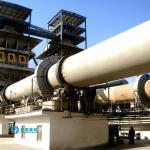
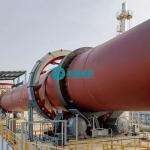
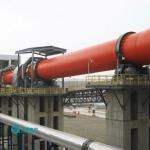
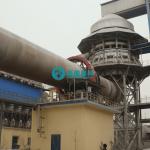
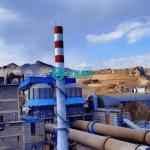
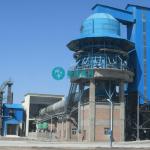
Customized calcination rotary kiln manufacturers for small scale pilot plants
1.Product Introduction Calcination Rotary Kiln
The Customized Small-Scale Rotary Kiln is a high-temperature
calcination unit engineered specifically for laboratory research
and pilot-scale process development. It is designed for the thermal
treatment of non-standard materials, such as heavy metal-bearing
black mass and New Energy Vehicle (NEV) material precursors.
Featuring a modular structure, the equipment supports multiple heat
sources (e.g., electromagnetic induction or gas-fired heating) and
provides precise control over temperature gradients, rotational
speed, inclination, and atmospheric conditions. Manufacturers offer
one-stop customization—from design and fabrication to system
integration—ensuring seamless connectivity with upstream flotation
or pretreatment equipment.
2.Application Calcination Rotary Kiln
New Energy Material Preparation: Oxidative calcination of cathode precursors (e.g., LFP, NCM) to manage phase transformation and residual carbon levels.
Mineral Processing & Metallurgy: Magnetizing roasting of lean iron ores and oxidative roasting of
ferrochrome/nickel ores to enhance downstream beneficiation
efficiency.
Hazardous Waste Valorization: Treatment of heavy metal sludges and battery black mass through
high-temperature solidification for detoxification and metal
recovery.
Eco-friendly Building Materials: Calcination of active lime, light-burned dolomite, and
high-alumina bauxite for green cement and refractory production.
R&D and Academic Instruction: Supporting universities and research institutes in heat treatment
process studies with integrated data logging and remote monitoring.
3.Working Principle Calcination Rotary Kiln
1.Material Transport & Feeding: Raw materials are fed continuously from the kiln tail via a
high-level inlet. Axial movement is achieved through a combination
of the kiln's inclination (typically 3%–6%) and slow rotation.
2. Multi-Zone Temperature Control:
• Drying Zone (<200°C): Low-temperature section for surface moisture removal.
• Preheating Zone (200–800°C): Mid-temperature section for the release of volatiles and initial
decomposition.
• Sintering/Calcination Zone (800–1,600°C): High-temperature section where phase transformation and redox
reactions occur. Electromagnetic or direct flame heating ensures
uniform thermal exposure.
3. Dynamic Heat Transfer: As the kiln rotates, the material tumbles continuously, ensuring
maximum contact with high-temperature airflows for efficient
reaction kinetics. The refractory lining stores thermal energy to
minimize temperature fluctuations.
4. Off-gas Discharge Treatment: Flue gases are purified through a dust collection system before
discharge. The calcined clinker is discharged from the kiln head
into a cooling unit for waste heat recovery.
4.Advantages Calcination Rotary Kiln
High Customization Capability: Kiln dimensions, shell materials (e.g., Q338 steel or high-temperature alloys), refractory types, and control
configurations can be tailored to material characteristics such as
particle size, angle of repose, and reaction enthalpy.
Precision Process Control: Equipped with multi-point temperature sensors and PLC automated control, enabling programmable heating curves, stepless speed regulation,
and closed-loop atmosphere management to guarantee batch
consistency.
Eco-friendly & Energy Saving: Features high-efficiency insulation and heat recovery systems,
reducing coal/power consumption by 10%–15% compared to traditional units. Supports inert atmosphere
protection to control critical indicators like residual $CaO$.
Ease of Integration: Can be interlocked with flotation machines, crushers, and
screening equipment to build a complete pilot production line,
facilitating process scale-up validation.
Stable Operation & Easy Maintenance: Equipped with dual-drive systems (primary/secondary) and
auxiliary motors to prevent kiln seizure during power outages. The
support roller structure allows for easy inspection and part
replacement.
5.Technical Specifications
| Model | Speed (r/min) | Inclination (%) | Capacity (t/h) | Gearbox Model | Ratio | Motor Model | Motor Power (kW) | Motor Speed (r/min) | Thrust Roller Type | Support Count | Weight (t) |
| Φ1.9/1.6x36 | 0.53-1.59 | 4 | 2.5-3 | JZQ750-1 | 48.58 | JZT-72-4 | 30 | 1200/400 | Mechanical | 3 | 53 |
| Φ2.1/1.8x36 | 0.5-1.51 | 4 | 4 | UT2-110 | 163.38 | JZS-81 | 30/10 | 1410/470 | .. | 3 | 75 |
| Φ1.2x25 | 0.5-1.6 | 3 |
| PM650 | 40.17 | JZTY71-4 | 22 | 1200/120 | .. | 3 | 34 |
| Φ1.6x32 | 0.158-0.258 | 3 |
| PM750 | 48.57 | JZJY61-4 | 15 | 1200/120 | .. | 3 | 46.82 |
| Φ1.8x45 | 0.66-1.98 | 4 | 3.5 | UT2-110 | 163.38 | JZS-81 | 30/10 | 1410/470 | .. | 3 | 80 |
| Φ2.2x50 | 0.125-1.25 | 3.5 | 4 | ZS145-11 | 157 | YCT280-4A | 30 | 1320/132 | .. | 3 | 130.71 |
| Φ2.5x50 | 0.516-1.549 | 3.5 | 5.5 | ZS165-7 | 99.96 | YCT355-4A | 55 | 1320/440 | .. | 3 | 167.5 |
| Φ3x48 | 0.3309-3.309 | 3.5 | 35 | ZL130-14 | 32.11 | ZSN4-250-21B | 90 | 1000/100 | .. | 3 | 237 |
| Φ3.2x50 | 0.398-3.975 | 3.5 | 50 | ZL130-16 | 40.85 | ZSN4-280-11B | 190 | 1500/150 | .. | 3 | 263 |
| Φ3.3x52 | 0.391-3.91 | 3.5 | 50 | ZSY500-28 | 27.707 | ZSN4-315-082 | 190 | 1000/100 | .. | 3 | 280.8 |
| Φ4x60 | 0.396-3.96 | 3.5 | 104 | ZSY630-35.5 | 34.601 | ZSN4-355-092 | 315 | 1000/100 | Hydraulic | 3 | 487.5 |
| Φ4.2x60 | 0.4165-4.165 | 3.5 | 116 | ZSY710-35.5 | 35.526 | ZSN4-355-12 | 420 | 1000/100 | .. | 3 | 576.1 |
| Φ4.3x62 | 0.398-3.98 | 3.5 | 125 | ZSY710-35.5 | 35.714 | ZSN4-355-12 | 420 | 1000/100 | .. | 3 | 598.5 |
| Φ4.8x74 | 0.35-4 | 4 | 208 | JH710C-SW305-40 | 42.226 | ZSN4-400-092 | 630 | 1500/130 | .. | 3 | 841 |
6.Our Solutions