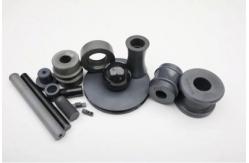
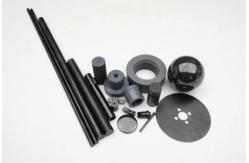
Silicon nitrides (Si3N4) feature an excellent combination of material properties. They are
nearly as light as silicon carbide (SiC), but their microstructure
gives them excellent thermal shock resistance and their high
fracture toughness makes them resistant to impacts and shocks.
Silicon nitride (Si3N4) has an exceptional set of properties:
- high hardness;
- high corrosion resistance;
- low density;
- stability in a wide range of temperatures;
- precision machining capability.
All these combinations make the material irreplaceable in the
production of corrosion-resistant, wear-resistant and
heat-resistant products for a variety of industries.
Basic properties of the material
| Properties | Brand of material |
| Composition | SN |
| Si3N4 |
| Density, g/sm3 | 3,2-3,3 |
| Isolated porosity, % | 0 |
| Hardness, GPa | 13,5-14,0 |
| Bending strength, MPa | 280-310 |
| Compressive strength, MPa | 3700-3900 |
| Thermal conductivity at 20-100°С, W/mK | 20-30 |
| Coefficient of linear thermal expansion at 20-1000°С, 10-6К-1 | 2,6-3,3 |
Maximum operating temperature °С Oxidative environment Reducing or inert environment | 1200 160 |
The main applications are:
- bearings for pumps and compressors;
- ceramic plungers;
- balls for ball bearings;
- grinding bodies;
- elements of valves and stop valves;
- lining for protection from wear and corrosion;
- sorting wheels of various grinding machinery;
- shafts of extruders (screws), nozzles of extruders (cores);
- covers and tubes of thermocouples, rods;
- nozzles;
- burners;
- products for the paper and printing industry;
- furniture and lining of furnaces;
- substrates, plates;
- products for the metallurgical industry.
Silicon Nitride Related Data
| Main component | 99%Al2O3 | S-SiC | ZrO2 | Si3N4 |
|
Physical
Property | Density | g/cm3 | 3.9 | 3.1 | 6 | 3.2 |
| Water Absorption | % | 0 | 0.1 | 0 | 0.1 |
| Sinter Temperature | °C | 1700 | 2200 | 1500 | 1800 |
Mechanical
Property | Rockwell Hardness | HV | 1700 | 2200 | 1300 | 1400 |
| Bend Strength | kgf/mm2 | 3500 | 4000 | 9000 | 7000 |
| Compression Intensity | Kgf/mm2 | 30000 | 20000 | 20000 | 23000 |
Thermal
Property | Maximum working
temperature | °C | 1500 | 1600 | 1300 | 1400 |
thermal expansion
coefficient
0-1000°C | /°C | 8.0*10-6 | 4.1*10-6(0-500°C) | 9.5*10-6 | 2.0*10-6(0-500°C) |
| 5.2*10-6(500-1000°C) | 4.0*10-6(500-1000°C) |
| Thermal Shock resistance | T(°C) | 200 | 250 | 300 | 400-500 |
| Thermal Conductivity | W/m.k(25°C | 31 | 100 | 3 | 25 |
| 300°C) | 16 | 100 | 3 | 25 |
Electrical
Property | Resisting rate of Volume | ◎.cm | | | | |
| 20°C | >1012 | 106-108 | >1010 | >1011 |
| 100°C | 1012-1013 | – | – | >1011 |
| 300°C | >1012 | – | – | >1011 |
Insulation Breakdown
Intensity | KV/mm | 18 | semiconductor | 9 | 17.7 |
| Dielectric Constant (1 MHz) | (E) | 10 | – | 29 | 7 |
| Dielectric Dissipation | (tg o) | 0.4*10-3 | – | – | – |