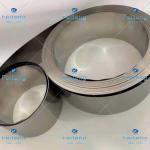
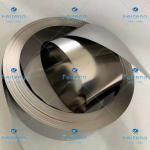
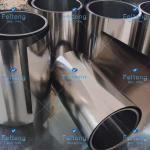
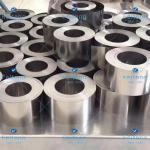
Titanium Foil Roll Gr2 ASTM B265 Foil Roll
| Product | Titanium Foil Roll |
| Grade | Gr2 |
| Packaging | Wooden case |
| Port of delivery | Xi'an port, Beijing port, Shanghai port, Guangzhou port, Shenzhen
port |
itanium has a metallic luster and ductility. Titanium is
characterized by its low density, high mechanical strength and ease
of processing.
At room temperature, the chemical activity of titanium is very
small and can react with a few substances such as hydrofluoric
acid, but when the temperature increases, the activity of titanium
increases rapidly, especially at high temperature, titanium can
react violently with many substances.
The good mechanical properties of titanium as a structural material
are achieved by strictly controlling the appropriate impurity
content and adding alloying elements.
In modern times, the methods of making metal foil include forging,
vacuum evaporation, powder rolling, electrolysis and calendering,
etc., but calendering and electrolysis are still the main methods
in large-scale production. Calendering method to produce aluminum,
foil as a representative, because of its use is very wide, so the
development is extremely rapid, has formed an independent
processing industry. Although both methods can be used in the
production of copper, nickel and iron foil, electrolysis has
obviously taken advantage. In calendering the foil is formed from
thick to thin, while in electrolysis the foil is formed in reverse.
Processing costs always increase with the increase of the process.
Therefore, in addition to meeting performance requirements,
thickness is also a factor to be considered when selecting a
production method. Early copper foil production had been 0.8 mm as
a boundary, thinner than its suitable electrolysis method. With the
improvement of processing equipment and the boundary has been
reduced to 0.2~0.4 mm. Calendered copper foil can be as thin as 6
microns, but the width is limited. In the future, the demand for
thin and wide foil tends to be more and more. For example, copper
foil half a meter wide and 50 microns thick has gradually been
replaced by one meter wide and 35 microns thick. The widest one
requires a width of up to two meters, so the calendering production
is limited. The use of copper foil, electrolytic copper foil, has
accounted for 90-95%. Others such as nickel, iron and alloy foil
have similar trends.
Six big features:
1. High strength
2. The corrosion
3. High temperature resistance
4. Good low temperature resistance
5. Environmentally friendly metals
6. Good thermal conductivity