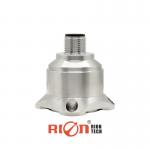
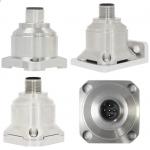
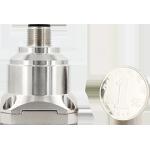
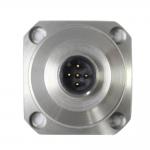
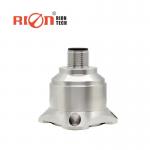
AKG392 three-axis vibration sensor is a product independently
developed and produced, applied in wide range of applications,
which covers many fields such as vibration testing and impact
testing. The product adopts digital interface output with options
as RS232/485/TTL. Different address codes can be set, multiple
Vibration sensor can be installed in series for long distance,
which is convenient for multi-point measurement and data analysis.
Internal FFT processing can directly output the object vibration
frequency and speed and Amplitude, convenient for users to analyze
data. The users can change the sampling frequency according to the actual
frequency of the object to improve the frequency measurement
accuracy. AKG392 is a single crystal silicon capacitive sensor,
which consists of a silicon chip processed by micro-machines, a
low-power ASIC for signal adjustment, a microprocessor for storing
compensation values, and a temperature sensor. This product has low
power consumption, calibration, sturdy structure, and stable
output. The new electronic configuration provides solid-state power
for reset and protection from over-voltage. The long-term stability
and deviation of the scale factor in the full-scale range are
typically less than 0.1%. This series of products have the
characteristics of sturdy structure, low power consumption, and
excellent deviation stability, ensuring stable output reliability.
▶ MAIN FEATURE
Three axes (X, Y, Z)
Output signal: RS232; RS485; TTL
Power supply voltage: 9-36V
Impact resistance: 2000G
Working temperature: -40°C ~ +85°C
Storage temperature: -40°C ~ +85°C
Size: L34.3×W34.3×H38.5mm
Excellent deviation stability, good environmental performance
(shock, vibration and temperature)
▶ APPLICATION
Medical equipment
Bridge
Automobile
Road roller
Wind power generation
Large machinery, engines
Low-frequency vibration and automatic monitoring
Traffic system monitoring, roadbed analysis and high-speed railway
fault detection
Product Description
▶ PERFORMANCE
AKG392
PARAMETERS
UNIT
Range
±2
±4
±8
±10
±20
±40
g
Bias calibration
<1
<1
<1
<1
<1
<1
mg
Measure axis
X,Y,Z
X,Y,Z
X,Y,Z
X,Y,Z
X,Y,Z
X,Y,Z
axis
Power on/off repeatability
<2
<2
<2
<2
<2
<2
mg(max)
Bias temperature coefficient
0.15
0.15
0.15
0.75
0.75
0.75
%/℃(typical)
Resolution/threshold (@ 1Hz)
< 1
< 1
< 1
< 1
< 1
< 1
mg(max)
Non-linearity
<0.5
<0.8
<1
<1
<1
<1
% FS(max)
Bandwidth (3DB)
500
500
500
500
500
500
Hz
Cross axis sensitivity
1
1
1
2
2
2
%
Transverse vibration sensitivity ratio
1
1
2
5
5
5
%
Resonance frequency
2.4
2.4
2.4
5.5
5.5
5.5
kHz
Output rate
5Hz,10Hz,25Hz,50Hz,100Hz,200Hz,500Hz,1000Hz
Output Interface
RS232/RS485/TTL
Protocol
RION 68 protocol and MODBUS RTU protocol
Reliability
MIL-HDBK-217,Grade 2
Impact resistance
100g@11ms, 3 Axial Direction (Half Sinusoid)
Recovery Time
<1ms(1000g, 1/2 sin 1ms, Impact on the i-axis)
Vibration
20g rms,20~2000Hz (Random noise, o, p, i acts on each axis for 30
minutes)