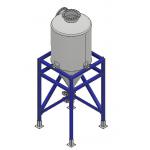
Stainless Steel Cyclone Separator Screen
The hydrocyclone is a device for separating and removing substances
such as heavier coarse-grained silt from sewage. Sometimes used for
mud dewatering. It is divided into two types: pressure type and
gravity type. It is usually made of circular column structure or
metal tube. The water enters the tangential line from the upper
part of the structure (or metal tube) by pressure or gravity. Under
the action of centrifugal force, the coarse and heavy particulate
matter is thrown to the wall and rotated downward to discharge
together with the formed concentrated liquid. The smaller
particulate matter is rotated to a certain extent and then
discharged with the secondary upper vortex.
Application Field
Hydrocyclones are used for grading, desliming and concentration.
For pulverized coal and dense metal minerals, it can sometimes be
used for sorting. When referring to heavy media, the cyclone can be
used for pre-selection or rough selection of ore.
The performance of inertial dust removal
equipment varies with different structures. When the gas flow rate
in the equipment is below 10m/S, the pressure loss is between 200
and 1000 Pa, and the dust removal efficiency is 50% to 70%. In
practical applications, inertial dust removal equipment is
generally placed in the first stage of a multi-stage dust removal
system to separate coarser dust particles. It is especially
suitable for capturing dry dust with a particle size greater than
10μm. It is not suitable for removing cohesive dust and fibrous
dust. Inertial dust removal equipment can also be used to separate
fog droplets. At this time, the flow velocity of the gas in the
equipment is required to be 1-2m/s.
Bio-Na membrane Biological nanomembrane dust removal equipment is
a dust removal equipment that has started to emerge abroad in
recent years. It uses the most advanced biological nanomembrane
technology. By spraying BME nanomembrane on the surface of the
material, it can minimize the generation of dust during the
production process. . This kind of dust removal technology belongs
to dust removal before dust emission. Compared with other dust
removal after production, it has a great advantage, so that the
dust emission can be effectively controlled during the entire
process of material production. The dust generated in the crushing
process is gathered into fine materials, which eventually become
finished materials, which can increase the output by 0.5%-3%. In
addition, it can effectively prevent PM2.5 and PM10 pollution,
which is in line with national environmental protection and energy
saving. Technology policy. Compared with wet dust removal and bag
dust removal, biological nano-film dust suppression has no water
pollution, the preparation does not have side effects on the
environment, does not affect the quality of finished materials, and
has lower input costs. It is suitable for mines, constructions,
quarries, and piles. Dust pollution control at sites, ports,
thermal power plants, iron and steel plants, garbage recycling and
treatment. Nano-film dust removal has been used in different
overseas applications, and is now gradually being applied in many
provinces and cities in China.
| model | XFFL1000 |
| diameter | 100mm |
| inlet | DN150 |
| outlet | DN150 |
| matching | bracket,vacuum lock |