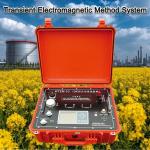
The Quintessential Analytical Platform for Multi-Disciplinary
Subsurface Investigation
The imperative to non-invasively characterize the shallow
subsurface unites a remarkably broad spectrum of scientific,
commercial, and societal endeavors. The WCZ-3 Proton Precession
Magnetometer has been established as the quintessential, multi-disciplinary analytical platform, its unparalleled sensitivity and robust performance rendering it
an indispensable investigative tool for discovery and analysis
across fields as diverse as resource geoscience, civil and
environmental engineering, archaeological research, and geohazard
monitoring. For professionals in mineral exploration, base metal discovery, and hydrocarbon
reservoir assessment, the platform delivers the high-resolution, high-density magnetic data essential for detailed
geological mapping. It excels at revealing subtle magnetic lithologies, delineating
the boundaries of hydrothermal alteration systems, and identifying
the distinctive signatures of buried intrusive bodies or fault
structures. The combination of its rapid measurement speed and
nanotesla-level sensitivity makes it equally effective for
large-scale regional reconnaissance and for focused,
high-resolution surveys at the deposit scale, directly contributing
to more informed targeting decisions, reduced exploration risk, and
robust resource modeling.
Within the geotechnical, environmental consulting, and utility management
sectors, the platform's primary value is derived from its exceptional capability to detect, precisely locate, and delineate
both natural subsurface conditions and anthropogenic artifacts. Its high tolerance for near-source magnetic gradients allows for
effective surveys in close proximity to targets, establishing it as
a premier tool for a wide range of applications. These include
locating and mapping buried steel pipelines and conduits, detecting
underground storage tanks (USTs), screening for unexploded ordnance
(UXO) in remediation projects, and investigating reinforcing steel
within concrete structures. For archaeological researchers, cultural resource managers, and
heritage conservation specialists, the WCZ-3 offers a powerful, completely non-destructive
methodology to image and interpret concealed historical landscapes. It can detect the often very faint magnetic contrasts arising
from buried foundations, hearths, kilns, ditches, middens, and even
evidence of ancient agricultural practices such as plow marks or
field boundaries. This capability enables highly precise,
hypothesis-driven excavation planning, maximizing the scientific
yield of archaeological investigations while conscientiously
minimizing disruptive and potentially destructive ground
disturbance.
The platform's utility extends authoritatively into the domain of long-term geophysical monitoring and fundamental Earth science
research. Its inherent measurement stability, precise GPS time
synchronization, and capability for programmable, automated
interval logging make it exceptionally well-suited for deployment
as a fixed-site observatory-grade instrument. It is increasingly employed in studies of volcano-magnetic
effects for eruption forecasting, for monitoring subtle crustal
strain signals through tectonomagnetic phenomena in seismically
active regions, and for tracking temporal variations in soil or
groundwater magnetism at environmental remediation sites. This
remarkable versatility is rendered logistically practical and
economically viable by the system's inherent design efficiency. Conceived as a complete, backpack-portable field kit operable by a single
individual, it dramatically lowers the logistical and manpower barriers
traditionally associated with high-quality magnetic surveys. This
operational accessibility, when combined with the comprehensive, user-friendly software suite that manages the entire
workflow from raw data download through diurnal correction to final
map and profile generation, empowers professionals across these diverse disciplines to
seamlessly integrate robust, quantitative magnetic surveying into
their standard investigative toolkit. In doing so, the WCZ-3
establishes itself as a universal and transformative catalyst for
discovery, analysis, and understanding of the subsurface world.