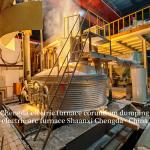
Aluminum Calcium DC Furnace Equipment Introduction
1. Equipment Positioning & Core ApplicationsThe aluminum calcium DC furnace is a custom-designed DC arc furnace dedicated to the production of calcium aluminate. It is mainly
used for high-temperature melting treatment of aluminum-containing
solid wastes such as aluminum dross and aluminum slag to produce
high-purity pre-melted calcium aluminate products. Widely applied
in steel metallurgy, building materials, and solid waste resource
utilization fields, it serves as an upgraded alternative to the
traditional rotary kiln process.
2. Core Working Principle- Electrical-to-Thermal Energy Conversion: Powered by a DC power supply system, a stable DC arc is generated
between the top graphite electrode and the furnace bottom anode.
The arc core temperature reaches up to 10,000°C, with the outer
flame temperature around 4,000°C. The high temperature of the arc
completely melts raw materials such as aluminum dross and lime.
- Electromagnetic Stirring Effect: The DC current generates a constant magnetic field, driving
directional flow in the molten pool. This enhances mass and heat
transfer, resulting in more uniform material reactions and
significantly improving the purity and composition stability of
calcium aluminate.
- Continuous/Semi-Continuous Smelting: Raw materials are fed from the furnace top feeding port, and
molten calcium aluminate is discharged from the furnace taphole.
This enables efficient continuous production, with power
consumption per ton of finished product as low as 700 kWh.
3. Equipment Structure & Components| System Module | Core Components | Function Description |
|---|
| Furnace Body System | Steel furnace shell with refractory lining, water-cooled furnace
roof, taphole/tapping spout | Contains the high-temperature molten pool, withstands thermal loads
and mechanical stress. The water-cooled furnace roof effectively
reduces heat loss. | | Electrode System | Top graphite electrode, electrode lifting mechanism, conductive
cross arm | Serves as the cathode for arc generation. PLC intelligent control
of electrode position ensures stable arc power. | | Power Supply System | High-power DC rectifier power supply, transformer, control cabinet | Outputs stable DC power with a power factor ≥ 0.95, causing no
harmonic interference to the power grid. | | Control System | PLC automatic control system, temperature/pressure sensors | Enables fully automatic control of electrode lifting, power
regulation, and smelting rhythm. | | Auxiliary Systems | Dust collection system, cooling system, feeding system | Treats smelting flue gas, ensures stable equipment operation, and
achieves clean production. |
4. Key Technical Advantages (vs. Traditional AC Furnaces/Rotary
Kilns)✅ High Efficiency & Energy Saving: Saves over 15% electricity compared to AC furnaces, reduces
electrode consumption by 35%, and increases output by 20% at the
same power. The power consumption per ton index is far lower than
traditional processes.
✅ High Product Purity: High-temperature melting above 2,500°C enables complete reaction
of raw materials, allowing precise adjustment of alumina content
without the under-firing/over-firing issues common in rotary kilns.
✅ Stable & Reliable Operation: DC arc eliminates power fluctuations in AC systems, ensuring
uniform electromagnetic stirring in the molten pool. The risk of
furnace bottom burn-through is significantly reduced, leading to
low equipment failure rates.
✅ Strong Environmental Adaptability: Can be equipped with high-efficiency dust collection systems to
treat flue gas generated during smelting, meeting environmental
requirements for solid waste resource utilization.
✅ Adaptable to Solid Waste Treatment: Directly processes aluminum-containing industrial solid wastes
such as aluminum dross and red mud, achieving reduction and
resource utilization of hazardous waste with both economic and
environmental benefits.
5. Typical Technical Parameters (2000-4000 kVA Models)| Parameter Item | Specification Range |
|---|
| Rated Capacity | 2000~4000 kVA | | Working Voltage | 120~300 V (adjustable) | | Working Current | 6000~15000 A (adjustable) | | Smelting Temperature | 2000~2500 °C | | Power Consumption per Ton | 700~900 kWh/ton | | Electrode Diameter | 300~500 mm | | Furnace Diameter | 3~5 m (customizable) | | Control Mode | PLC Fully Automatic Control |
6. Application Scenarios & Process Value- Production of Steelmaking Auxiliary Materials: High-purity calcium aluminate acts as a refining slag for
desulfurization and dephosphorization in steelmaking, significantly
improving molten steel purity and serving as a high-quality
metallurgical auxiliary material.
- Resource Utilization of Aluminum Dross Solid Waste: Converts secondary aluminum dross into high-value calcium
aluminate products, turning waste into treasure and solving the
problem of solid waste disposal in the aluminum industry.
- Raw Materials for the Building Materials Industry: Pre-melted calcium aluminate can be used as a raw material for
cement and refractory materials, improving product performance
while reducing production costs.
7. Comparison with Traditional Processes| Comparison Dimension | Aluminum Calcium DC Furnace | Traditional Rotary Kiln | AC Submerged Arc Furnace |
|---|
| Product Purity | High (Complete melting reaction) | Low (Prone to under-firing/uneven composition) | Medium (Poor arc stability) | | Energy Consumption | Low (700-900 kWh/ton) | High (Large coal/natural gas consumption) | Medium (15% higher than DC furnaces) | | Electrode Consumption | Low (Stable DC arc) | No electrode consumption | High (High three-phase electrode wear) | | Environmental Performance | Easy to equip with dust collection systems | Difficult flue gas treatment | Harmonic interference to the power grid | | Production Efficiency | High (Continuous smelting) | Low (Intermittent/semi-continuous) | Medium (Power fluctuations affect production rhythm) |
|