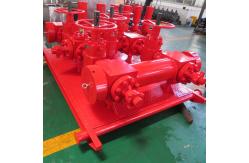
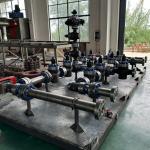
Brief Introduction to Choke and Kill Manifold The choke and kill manifold is a core component of well control
equipment, connected to the blowout preventer (BOP) stack. It is
mainly integrated with components such as choke valves and Check
valves. As a critical device for controlling well pressure,
handling well kicks and blowouts, and ensuring operational safety
during drilling and workover operations, its core functions revolve
around pressure control, well killing, and fluid diversion,
detailed as follows: Controlling Well Pressure to Maintain Operational Balance This is the most fundamental and core function of the choke and
kill manifold. During operations, when abnormal formation pressure
rise occurs and signs of well kick appear, the discharge flow rate
of drilling fluid (or formation fluid) can be controlled by
adjusting the opening degree of the choke valve on the manifold,
thereby regulating and stabilizing the wellbore backpressure.
Through precise pressure control, the dynamic balance between well
pressure and formation pressure can be maintained, preventing
further invasion of formation fluid into the wellbore, avoiding the
escalation of well kick incidents, and creating conditions for the
implementation of subsequent treatment measures. Meanwhile, in
pressure control operations during normal drilling, the choke
manifold can also be used to fine-tune the pressure of the
circulating system, ensuring that drilling operations proceed
smoothly within the preset pressure range. Performing Well Killing Operations to Restore Downhole Pressure
Balance When a well kick develops to a certain extent and it is necessary
to actively restore downhole pressure balance, the choke and kill
manifold serves as the core channel for conducting well killing
operations. During well killing, kill fluid with the required
density is injected into the wellbore through the kill line of the
manifold. Meanwhile, the choke valve is coordinated to adjust the
discharge flow rate and control the wellbore backpressure, ensuring
that the kill fluid can steadily and uniformly displace the
original drilling fluid and invaded formation fluid in the
wellbore. Through the "injection-discharge" circulation process,
the pressure of the kill fluid column is gradually made greater
than the formation pressure, ultimately achieving downhole pressure
balance, completely eliminating blowout risks, and restoring normal
operational conditions. According to different well conditions, the
manifold can be used to implement various well killing technologies
such as conventional well killing and forced kill operation. Diverting Formation Fluid to Ensure Operational Safety In the event of an emergency blowout or the initial stage of
high-pressure fluid loss of control, the manifold can guide
high-pressure formation fluids (oil, gas, water, etc.) to safe
areas such as blowout pits and burning pits through diversion
lines. This prevents the fluids from directly jetting into the
operation area, which could cause casualties, equipment damage, or
environmental pollution. At the same time, it can accurately
control the fluid flow direction, gaining time for subsequent
emergency measures such as well shutting and well killing, and
reducing accident hazards. Supporting Auxiliary Operations and Expanding Functional
Adaptability In addition to its core functions, the manifold can serve as a
wellbore pressure monitoring platform. Pressure gauges, sensors,
and other devices can be installed through reserved interfaces to
monitor pressure data in real time, providing a basis for well
condition judgment. Moreover, during workover, well testing, and
other operations, the pipeline channels can be utilized to carry
out auxiliary operations such as downhole fluid circulation, well
flushing, and acid fracturing fluid injection, improving process
continuity and safety.
In summary, the functions of the choke and kill manifold run
through the entire well control process. It is not only a defensive
line for preventing well control accidents but also a core
equipment for handling emergencies. Its reliability and operational
accuracy directly determine the success or failure of well control
and the level of on-site safety assurance. |