
860–1720 KWh Containerized BESS | EnerCube 3.0 | COENG
|
Detailed Product Description
|
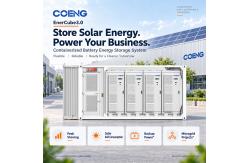
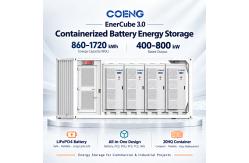
COENG EnerCube 3.0 Containerized Battery Energy Storage System 860-1720 kWh Energy Capacity | 400-800 kW Rated Output | LiFePO4
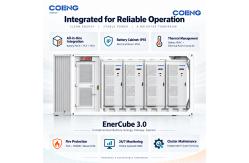
Battery Technology COENG EnerCube 3.0 is an all-in-one containerized battery energy
storage system designed for commercial and industrial energy
projects. With five configurations ranging from 860 kWh to 1720 kWh
and rated output from 400 kW to 800 kW, it provides a modular
platform for project-specific battery storage requirements. The system integrates battery PACKs, a power conversion system
(PCS), a power distribution unit (PDU), fire protection,
temperature control and intelligent monitoring within a standard
20HQ container. This integrated design simplifies equipment
coordination and supports transportation, installation and ongoing
maintenance. For EPC contractors, system integrators, energy developers and
distributors, EnerCube 3.0 offers a coordinated solution for
industrial battery storage, renewable energy integration and site
energy management. All-in-One Integration for Streamlined Deployment EnerCube 3.0 brings the main energy storage components together in
one containerized platform. Its modular design helps reduce on-site
equipment assembly and simplifies the coordination of battery
storage, power conversion and supporting systems. The standard 20HQ container measures 6058 × 2438 × 2896 mm,
providing a defined footprint for site planning, transportation and
lifting arrangements. Flexible AC and DC Coupling COENG EnerCube 3.0 supports AC and DC coupling for energy projects
involving solar generation, wind power and diesel generators. The coupling arrangement, external equipment and control strategy
can be evaluated against the site's electrical architecture and
operating objectives. This flexibility supports both new renewable
energy projects and the assessment of storage integration into
existing installations. Modular Battery Clusters for Convenient Maintenance Battery clusters are housed in individual cabinets, with thermal
isolation between clusters and independent cluster maintenance.
This arrangement supports service access and helps operators
organize maintenance activities. The system also provides 24/7 monitoring and online assisted
operation and maintenance. Ethernet connectivity and Modbus TCP/IP
support communication with compatible project monitoring and
control systems. Integrated Thermal Management and Fire Protection EnerCube 3.0 combines battery cabinet HVAC with forced-air cooling
for the electrical room. The specified fire protection system
includes FAS and FM200/Novec1230. The battery cabinets are rated IP55, while the electrical room is
rated IP34. These separate ratings support accurate site assessment
and equipment specification. Available Models and Configurations
Capacity figures represent beginning-of-life energy capacity.
Delivered energy and operating duration depend on the permitted
state-of-charge range, conversion losses, auxiliary consumption,
operating conditions and load profile. Technical Specifications
The system is derated when ambient temperature exceeds 45°C. The
datasheet also specifies derating above 2000 m altitude;
high-altitude projects require configuration review. Commercial and Industrial Energy Storage Applications Peak Shaving and Load Shifting Evaluate battery charging and discharging around site demand and
electricity tariffs. A suitable dispatch strategy can help manage
peak grid imports and shift energy consumption between time
periods. Project savings depend on local tariffs, load patterns and
system operation. Solar Energy Storage and Self-Consumption Store available solar generation for later use at factories,
warehouses and commercial facilities. Match the battery
configuration to the PV generation profile, daytime and nighttime
loads, and any export restrictions. Renewable Energy Integration Support project designs combining battery storage with solar, wind
or diesel generation. AC and DC coupling options provide
flexibility when developing the electrical layout and energy
management strategy. Backup Power and Microgrid Projects Assess EnerCube 3.0 for projects requiring critical-load support or
coordination between multiple energy sources. Backup operation,
islanding capability, switching equipment and generator
coordination must be confirmed through project-specific
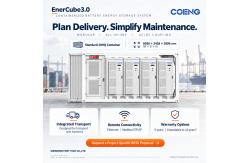
engineering. Transportation, Installation and Service Planning EnerCube 3.0 is designed for integrated transportation with
batteries. Its containerized construction supports coordinated
lifting, positioning, installation and maintenance planning. Before delivery, confirm the selected configuration, final shipping
weight, foundation requirements, service clearances, lifting
instructions and destination documentation. Any required isolation
transformer or medium-voltage equipment should be included in the
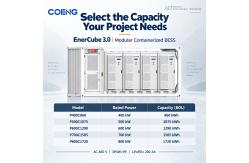
agreed project scope. Frequently Asked Questions What capacities are available? COENG EnerCube 3.0 is available in 860, 1075, 1290, 1505 and 1720
kWh configurations, paired with rated output powers of 400, 500,
600, 700 and 800 kW respectively. What battery technology does EnerCube 3.0 use? The system uses 280 Ah LiFePO4 cells, with a 1P20S battery module
configuration and model-specific battery cluster arrangements. Can the system integrate with an existing solar installation? EnerCube 3.0 supports AC and DC coupling. Integration with an
existing solar installation requires a review of inverter
compatibility, grid voltage, protection equipment, communication
and project controls. Is EnerCube 3.0 suitable for outdoor installation? The datasheet specifies outdoor installation, with IP55 battery
cabinets and an IP34 electrical room. Site temperature, humidity,
altitude, corrosion exposure and installation clearances must be
checked during engineering. What monitoring and communication features are provided? The system supports 24/7 monitoring and online assisted O&M.
Its specified communication interface is Ethernet, using Modbus
TCP/IP. What compliance documentation should buyers request? The datasheet lists system references UN3536, LVD, EMC and RoHS;
cell references IEC62619, UL1973 and UL9540A; PACK reference
UN38.3; and PCS references G99, EN50549, AS4777.2 and VDE4105.
Buyers should request the applicable certificates or test reports
for the exact supplied configuration and destination market. What warranty is available? The specified warranty is 5 years, with an option to extend to 10
years subject to agreed terms. Coverage, operating requirements and
extension conditions should be confirmed in the quotation. What information is needed for a quotation? Provide your project location, intended application, required kW
and kWh, load profile, grid voltage and frequency, existing PV or
generator details, installation conditions and target delivery
date. Request Your COENG Containerized BESS Proposal Planning a commercial solar storage project, industrial battery
installation or microgrid? Share your project requirements with COENG to discuss an EnerCube
3.0 configuration matched to your power demand, energy capacity and
site conditions. Request a project-specific proposal covering
equipment configuration, technical documentation, delivery scope
and service requirements. Request a BESS Proposal Download the EnerCube 3.0 Datasheet |
||||||||||||||||||||||||||||||||||||||||||||||||||||||||||||||||||||||||||||
| Product Tags: containerized BESS lithium battery EnerCube 3.0 energy storage COENG battery production line |
Related Products

|
Automatic Production Line for Lithium Battery Laser Welding Terminal Cleaning Polarity Detection |

|
Continuous automatic laser welding machine with protective cover |

|
COENG 7-Channel Automatic Pouch Cell Sorting Machine |

|
COENG 13-Channel Cylindrical Battery Cell Sorting Machine for Voltage and Internal Resistance Testing |

|
Fully Automatic Energy Storage PACK Production Line | Turnkey Battery Pack Manufacturing Solution | COENG |
|
860–1720 KWh Containerized BESS | EnerCube 3.0 | COENG |
Email to this supplier