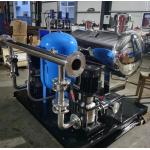
nanofiltration system
|

|
Product Overview A nanofiltration system (NF system) is a pressure-driven membrane separation device that falls between ultrafiltration and reverse osmosis. Its membrane pore size ranges from 0.001 to 0.01 μm (approximately 1 nm), and its molecular weight cutoff (MWCO) is typically between 200 and 1000 Da. Nanofiltration membranes usually carry a charge on their surface, exhibiting high removal rates for divalent and polyvalent ions (such as SO₄²⁻, Ca²⁺, Mg²⁺, etc., reaching over 90%), while its removal rate for monovalent ions (such as Na⁺, Cl⁻) is lower (20%–80%). This characteristic allows it to remove hardness and some salt while maintaining low operating pressure and high permeate recovery rates. Nanofiltration systems are widely used in water softening, partial desalination, color removal, organic matter removal, and material concentration and separation. They have important applications in industrial wastewater treatment, reclaimed water reuse, drinking water purification, and the dairy and pharmaceutical industries. Working principle Nanofiltration systems achieve selective separation based on the sieving effect and the Donnan charge effect: Sieving effect: The membrane surface has nanoscale micropores, trapping solutes with molecular weights larger than the membrane's molecular weight cutoff, while water molecules and smaller solutes permeate. Charge effect: The nanofiltration membrane surface is typically negatively (or positively) charged, selectively trapping charged ions through electrostatic repulsion. Multivalent ions, due to their high charge density, are repelled much more readily than monovalent ions. Under pressure, feed water flows tangentially along the membrane surface. Water molecules and some monovalent ions permeate to form permeate (product water), while multivalent ions, organic matter, and larger molecules are trapped to form concentrate. Due to the lower operating pressure (0.5~1.5 MPa), the system's energy consumption and operating costs are significantly lower than reverse osmosis. The system is equipped with automatic flushing and chemical cleaning functions, allowing for regular maintenance flushing of the membrane modules to prevent membrane fouling and extend membrane life. System Composition This nanofiltration system consists of the following core units: Pretreatment Unit:** Configured with a multi-media filter, activated carbon filter, security filter, or ultrafiltration system based on the influent water quality to ensure an influent SDI ≤ 3, protecting the nanofiltration membrane. High-Pressure Pump:** Provides stable operating pressure for the system, typically a stainless steel multi-stage centrifugal pump with frequency conversion control. Nanofiltration Membrane Module:** Employs spiral-wound nanofiltration membrane elements, made of polyamide composite membranes or other special membranes. Different models can be selected based on desalination rate and permeate requirements. Pressure Vessel:** A high-pressure resistant shell housing the membrane elements, made of FRP or stainless steel. Cleaning System:** Includes a cleaning water tank, cleaning pump, and security filter for periodic chemical cleaning of the membrane. Control System:** PLC fully automatic control, real-time monitoring of parameters such as pressure, flow rate, conductivity, and pH. Features automatic flushing, fault alarm, and remote data transmission functions, with touchscreen operation. Pipelining and Instrumentation:** High-pressure stainless steel piping, equipped with pressure gauges, flow meters, conductivity meters, pressure switches, and automatic valves. Core advantages
Technical parameters (customizable)
Application areas Advanced Wastewater Treatment and Reuse Dyeing and Printing Wastewater Treatment: Removes color, dyes, and hardness; permeate is reused in rinsing or dyeing processes. Electroplating Wastewater Treatment: Separates heavy metal ions (Ni²⁺, Cu²⁺, etc.) from monovalent salts, achieving metal recovery and water reuse. Papermaking Wastewater Treatment: Removes lignin and color, reduces COD; permeate is reused in pulping or papermaking processes. Chemical Wastewater Treatment: Separates high-value materials and reduces the organic load in concentrated wastewater. Leachate Treatment: Used as a pretreatment for reverse osmosis or as a standalone treatment unit to remove hardness and organic matter. Drinking Water and Industrial Water Treatment Groundwater/Surface Water Softening: Removes calcium and magnesium hardness, reducing total hardness to drinking water standards. Brackish Water Section Desalination: Reduces TDS while retaining some minerals. Decolorization and Deodorization: Removes natural organic matter (NOM), humic acid, and trihalomethane precursors. Pesticide and Micropollutant Removal: Ensures drinking water safety. Reclaimed Water System: Used as pretreatment for reverse osmosis to reduce hardness and organic matter, mitigating scaling and fouling risks; or used independently for production wastewater. Material Separation and Concentration (Food, Pharmaceutical, Chemical) Whey Protein Concentration and Desalination Concentration and Purification of Antibiotics, Amino Acids, and Vitamins Saccharide Desalination and Refining Desalination and Concentration of Dyes and Intermediates Seawater Desalination Pretreatment: Softens seawater, removes calcium and magnesium hardness and sulfate, improving the stability of subsequent reverse osmosis operations. Comparison with other membrane technologies
Why choose us? Extensive experience in water treatment projects: Providing hundreds of nanofiltration systems for industrial wastewater reuse, drinking water softening, and material separation, with mature process designs. Professional membrane element selection: Collaborating with renowned domestic and international membrane brands, we can recommend the optimal membrane model based on water quality and reuse goals, balancing investment and operating costs. Optimized design for reduced energy consumption: Employing high-efficiency high-pressure pumps, energy recovery devices, and frequency converters, the system saves 15%~30% more energy than conventional designs. Fully automatic control: PLC+HMI with automatic flushing, fault diagnosis, and remote data transmission functions, supporting unattended operation. Anti-fouling design: Configuring appropriate pretreatment and flushing schemes based on water quality characteristics, effectively extending membrane cleaning cycles and service life. Modular configuration: Standardized modules with a production capacity of 0.5~200 m³/h, which can be combined as needed, facilitating phased investment and capacity expansion. Comprehensive after-sales service: Providing membrane cleaning guidance, performance restoration services, long-term spare parts supply, and global technical support. |