
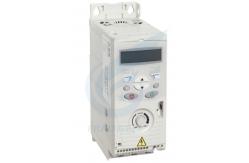
22kW Variable Frequency Drive Inverter ACS355 Three Phase Frequency Converter
|
Detailed Product Description
|
ACS355 Frequency Converter Inverter– Flexible Drive Solution for Small Conveyors, Packaging & Textile Machines ACS355 Frequency Converter Inverter Flexible Drive Solution for Small Conveyors, Packaging &
Textile Machines The ACS355 is an economical inverter designed for the equipment
manufacturing industry, covering a power range of 0.37 - 22kW. With
core advantages of high cost-effectiveness and excellent
connectivity, it accurately meets the drive needs of most small and
medium-sized mechanical equipment, especially suitable for various
customized small machinery scenarios. Core Product Features High Cost-Effectiveness for OEM Needs Integrates core control functions and stable performance,
eliminating the need for additional expansion modules to meet basic
automation requirements. Effectively controls equipment
manufacturing costs, making it the preferred drive solution for
small and medium-sized equipment manufacturers. Flexible and Powerful Connectivity Comes standard with a Modbus RTU communication interface and
supports optional bus adapters such as PROFIBUS DP and DeviceNet.
Enables quick integration into automated control systems for
equipment manufacturing, adapting to multi-device linkage
scenarios. Strong Customization Adaptability Supports sensorless vector control and V/F control, compatible with
induction motors and permanent magnet synchronous motors (PMSMs).
Offers a wide speed regulation range (0 - 590Hz), meeting
personalized speed control needs of customized small machinery
(e.g., special-purpose machine tools, custom conveyors). Stable, Reliable, and Easy to Maintain Features a compact design with an IP20 protection class, suitable
for installation in narrow control cabinets of equipment. Coated
circuit board design resists light dust and moisture, reducing
failure rates in production environments and lowering maintenance
costs. Core Specifications
Model Specifications
Optional Accessories
Applicable Industries & Scenarios
Frequently Asked Questions Q1: A small European machine tool factory uses the ACS355 to drive
a customized processing machine tool. After connecting to the PLC
via PROFIBUS DP, communication disconnections frequently occur. How
to solve this? A: First, check if the bus adapter is firmly inserted—vibrations in
industrial production environments often cause loose connections.
Second, adjust the communication baud rate from the default
187.5kbps to 9600bps to improve anti-interference capability.
Additionally, install 120Ω terminal resistors at both ends of the
bus to reduce signal reflection (cable wiring in machine tool
factories is relatively long, leading to significant signal
attenuation). If disconnections persist, check if power cables and
communication cables are laid in parallel—maintain a distance of at
least 50cm to avoid electromagnetic interference. Q2: A Southeast Asian food machinery factory uses the ACS355 to
control sauce mixing equipment. During operation, the inverter
housing has slight leakage current, and an electroprobe lights up,
but the motor runs normally. Is there a safety hazard? A: Yes, there is a safety hazard! This is mainly caused by poor
grounding. Food factories have humid environments, increasing the
risk of electric shock. Solutions: Check if the ground cable gauge
meets standards (at least the same as the power cable) and if the
ground terminal is tightly fastened. Measure the ground
resistance—European standards require ≤4Ω, while some Southeast
Asian countries require ≤10Ω, ensuring compliance with local
regulations. If the inverter is installed on a metal frame, the
frame must also be grounded to form an equipotential connection,
avoiding electric shock accidents. Q3: An Indian textile factory uses the ACS355 to drive a winding
machine. The motor vibrates at low speeds, resulting in uneven yarn
tension. How to debug? A: The ACS355 defaults to V/F control mode, which has poor
low-speed performance. Switch to "Sensorless Vector Control" mode
and perform motor auto-tuning (enter motor nameplate parameters) to
allow the inverter to accurately match motor characteristics.
Meanwhile, adjust the "Low-Speed Torque Compensation" parameter
from the default 0 to 5-10% to enhance low-speed operation
stability. Additionally, check if the mechanical transmission parts
of the winding machine (e.g., gearbox, belt) are worn—mechanical
jamming can also cause vibration and requires timely maintenance. Q4: A small African building materials factory uses the ACS355 to
drive a cement transfer pump. The power grid voltage fluctuates
heavily, and "undervoltage" faults frequently occur. How to handle
this? A: Enter the parameter menu, switch the "Input Voltage Allowable
Range" to "Wide," expanding the undervoltage threshold from 380V to
342V to adapt to grid fluctuations. Second, check if the power
cable gauge is too small—building materials factories are often far
from transformers, and line loss causes voltage drops at terminals.
It is recommended to upgrade the cable gauge (e.g., from 1.5mm² to
2.5mm²). If fluctuations are frequent, install a small voltage
stabilizer or UPS to avoid frequent inverter shutdowns affecting
production. Q5: A small North American packaging machinery factory uses the
ACS355 to control a customized packaging machine. It requires quick
stopping, but even with the inverter's deceleration time set to the
shortest, there is obvious inertial coasting. How to solve this? A: ACS355 models ≤11kW support external braking resistors. After
installing a braking resistor, enable the "DC Braking" function in
the parameters, setting the braking start frequency to 5Hz and
braking time to 3 seconds to quickly consume the motor's inertial
energy. If frequent start-stop is not required, an electromagnetic
brake can also be installed at the mechanical end, cooperating with
the inverter to achieve precise stopping (packaging machines have
high requirements for stopping positions, and relying solely on
electrical braking may be insufficient). |
|||||||||||||||||||||||||||||||||||||||||||||||||||||||||||||||||||||||||||||||||||||||||||||||||||||||||||||||||||||||||||||||||||||||||||||||||||||||||||||||||||||||||||||||||||||||||||||||||||||||||||||||||||||||||||||||||||||||||||||||||||||||||||
| Product Tags: 22kW Variable Frequency Drive Inverter Variable Frequency Drive Inverter ACS355 ACS355 Three Phase Frequency Converter |
Related Products
|
22kW Variable Frequency Drive Inverter ACS355 Three Phase Frequency Converter |
|
I510 Cabinet Frequency Converter Inverter 0.25kW-15kW Frequency Drive Inverter |
|
ATV310 Ac Frequency Converter 0.37kW-30kW VFD Inverter 3 Phase |
|
NE200/NE300 AC Frequency Converter VFD Inverter Drive 0.4KW-900KW |

|
FR-E800 Networked Vector Frequency Converter 0.4-22kW VFD Single Phase To Three Phase |
|
M701 High Performance Inverter 200V-690V Rock Solid In Harsh Environments |
Email to this supplier