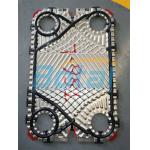
The T20B-5 Detachable Plate Heat Exchanger takes "modular assembly"
as its design core and mainly consists of three key components:
- Heat Exchange Plates: Made of stamped thin metal sheets with corrugated grooves on the
surface (to enhance heat transfer efficiency and structural
rigidity), serving as the core carrier for heat transfer;
- Sealing Gaskets: Installed around the plates to seal gaps between plates, prevent
medium leakage, and assist in dividing flow channels;
- Clamping Assembly: Includes clamping studs and other components, which fix all
plates through clamping force to ensure the overall sealing
performance and structural stability of the equipment.
In addition, the corners of the plates are provided with holes that
can be spliced to form continuous medium channels, providing paths
for fluid flow. The equipment achieves heat exchange through "countercurrent heat
exchange + plate heat conduction", with specific steps as follows:
- Medium Distribution: Two fluids to be heat-exchanged (hot medium and cold medium)
enter their respective dedicated channels from the equipment inlets
and are distributed into independent flow channels between the
plates (separated by sealing gaskets to avoid cross-flow);
- Countercurrent Heat Exchange: Under normal circumstances, the hot medium and cold medium flow
in countercurrent in the flow channels (to maximize temperature
difference and improve heat transfer efficiency), and the hot
medium transfers heat to the metal plates;
- Heat Transfer: The plates act as intermediate heat-conducting carriers,
transferring the absorbed heat to the cold medium on the other
side;
- Temperature Regulation: Finally, the temperature of the hot medium decreases (achieving
cooling), and the temperature of the cold medium increases
(achieving heating), thus completing the heat exchange goal.
The T20B-5 Detachable Plate Heat Exchanger excels in efficiency,
flexibility, and maintainability, with details as follows:
- High Heat Transfer Efficiency: The corrugated-groove plates expand the heat transfer area,
disrupt the fluid boundary layer, and combined with the
countercurrent heat exchange design, the heat transfer coefficient
is significantly higher than that of traditional heat exchangers;
- Easy Maintenance: Plates can be separated by disassembling the clamping assembly,
facilitating inspection and cleaning (Note: With the development of
THE-type heat exchanger technology, this advantage has relatively
diminished);
- Low Fouling Impact: Fluids flow in a turbulent state in the corrugated flow channels,
making it difficult for fouling to accumulate. The fouling
coefficient is low, reducing the need for frequent cleaning;
- Compact Structure: Adopts a plate-stacking design, featuring small floor space and
light equipment weight, saving installation space;
- Strong Flexibility: The heat exchange area can be adjusted by increasing or
decreasing the number of plates, or the process can be optimized by
changing the plate combination method, adapting to different
working condition requirements;
- High Heat Exchange Precision: Small end temperature difference (small temperature difference
between the outlets of hot and cold media), enabling more precise
temperature control.
|