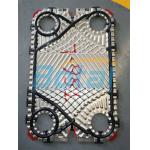
I. Product Positioning and Core FunctionsThe TS6-L plates and gaskets are key components of plate heat
exchangers, and they work together to fulfill two core functions,
ensuring the stable operation of the heat exchanger:
- Medium Isolation: Through the physical separation of plates and the
precise sealing of gaskets, the mixing channel of hot and cold
media is completely blocked, preventing equipment failures or
process contamination caused by medium cross-flow.
- Efficient Heat Exchange: As the core carrier for heat transfer, the
plates, combined with a special structural design, enhance heat
transfer efficiency and provide core support for the heat exchanger
to achieve the temperature regulation goal of "cooling the hot
medium and heating the cold medium".
II. Detailed Specifications and Characteristics of Plates1. Composition and Structure of PlatesEach TS6-L plate consists of two main components: "metal plate +
sealing gasket", which complement each other in function. The
specific parameters are as follows:
| Component Name | Structural Design | Core Functions and Advantages |
|---|
| Metal Plate | Made of thin metal sheets via mold stamping, with corrugations,
sealing grooves, and corner holes on the surface | 1. Heat Transfer Enhancement: The corrugated structure expands
the heat transfer contact area, disrupts the medium flow boundary
layer, and improves the heat transfer coefficient;
2. Structural Reinforcement: The corrugated design increases
the rigidity of the thin sheet, directly enhancing the overall
pressure-bearing capacity of the plate heat exchanger;
3. Self-Cleaning and Anti-Clogging: Corrugations guide the
medium to flow in a turbulent state, reducing the accumulation of
sediments and dirt on the plate surface and lowering the cleaning
frequency;
4. Flow Channel Distribution: Corner holes cooperate with
sealing grooves to divide independent flow channels for hot and
cold media, ensuring the fluid flows according to the designed path | | Sealing Gasket | Customized to match the plate size, installed in the gasket groove
around the plate | 1. Sealing and Leakage Prevention: Fills the gaps between
plates to prevent fluid leakage, avoiding medium waste or
environmental pollution (refer to "Causes and Solutions for
External Leakage of Plate Heat Exchangers" for more leakage
prevention solutions);
2. Flow Channel Partitioning: Seals some corner holes as per
design requirements, forcing hot and cold media to flow in
dedicated channels and eliminating the risk of cross-flow |
2. Material Selection for PlatesBased on the application scenarios of the plate heat exchanger
(such as medium corrosiveness, temperature, and pressure
conditions), the metal plates of TS6-L can be selected from a
variety of corrosion-resistant materials to meet different
industrial needs:
- Stainless Steel Series:
- 304/304L: General-purpose corrosion-resistant material, suitable
for scenarios with neutral media (e.g., ordinary water, air),
featuring high cost-effectiveness;
- 316/316L: Superior acid and alkali resistance compared to the 304
series, suitable for chemical, food processing, and other scenarios
involving weakly corrosive media;
- 254SMO: High-corrosion-resistance super austenitic stainless steel,
capable of withstanding strongly corrosive environments (e.g.,
high-concentration salt solutions, acidic wastewater);
- Special Alloy Series:
- Titanium: Excellent corrosion resistance and thermal conductivity,
suitable for seawater desalination, marine engineering, and other
scenarios involving seawater or strongly acidic media;
- Nickel: Combines high-temperature resistance and alkali resistance,
suitable for high-temperature and strong alkali working conditions
in the chemical industry (e.g., heat exchange of caustic soda
solutions);
- Titanium-Palladium Alloy: Corrosion resistance far superior to pure
titanium, applicable to high-concentration strong acids (e.g.,
sulfuric acid, hydrochloric acid);
- Hastelloy: Resistant to various strongly corrosive media (e.g.,
organic acids, chlorine-containing compounds), suitable for extreme
industrial heat exchange scenarios.
3. Plate Manufacturing ProcessThe TS6-L plates adopt the one-time mold stamping forming
process, and the advantages of this process directly determine the
product performance:
- It ensures the dimensional accuracy and structural consistency of
all plates, enabling uniform metal point contact between plates and
improving sealing stability;
- The uniform point contact structure not only allows the plate heat
exchanger to operate stably under relatively high pressure but also
effectively withstands pressure shocks during system operation,
reducing the risk of equipment damage.
III. Technical Parameters of Sealing Gaskets1. Composition of GasketsThe TS6-L sealing gaskets are complex polymer composite systems,
and each component collaboratively determines the final performance
of the gaskets. The specific components and their functions are as
follows:
| Component Type | Core Function | Impact on Gasket Performance |
|---|
| Rubber Polymer | Base material of the gasket | Determines the basic elasticity, temperature resistance, and
corrosion resistance of the gasket (e.g., natural rubber, isoprene
rubber); | | Vulcanizing Agent | Crosslinks rubber molecules | Enhances the strength, hardness, and anti-aging ability of the
gasket, preventing deformation after long-term use; | | Filler | Optimizes physical properties | Reduces costs while improving the wear resistance and pressure
resistance of the gasket; | | Anti-Aging Agent | Slows down the aging rate | Extends the service life of the gasket and reduces performance
degradation caused by oxidation and light exposure; | | Processing Aid | Improves the manufacturing process | Does not directly enhance the service performance of the gasket but
optimizes the processing fluency of mixing, extrusion, and molding
processes; | | Diluent | Adjusts the viscosity of the rubber compound | Facilitates gasket forming and ensures the precise matching of the
gasket size with the plate gasket groove. |
2. Performance Comparison of Mainstream Rubber MaterialsDepending on the application scenario, the TS6-L gaskets can be
made of various rubber materials. The performance differences and
applicable scenarios of each material are as follows:
| Rubber Type | Chemical Composition | Core Performance Advantages | Applicable Scenarios |
|---|
| Natural Rubber | Extracted from the latex of Hevea brasiliensis, mainly composed of
cis-polyisoprene | Excellent elasticity, high mechanical strength, good wear
resistance, and strong compatibility with other rubbers | Normal temperature, low pressure, and neutral medium scenarios
(e.g., civil HVAC systems); | | Isoprene Rubber (Synthetic Natural Rubber) | Polymerized from isoprene, with a structure similar to natural
rubber | Performance close to natural rubber, stable raw material supply,
and can replace natural rubber | General working conditions requiring stable supply and performance
matching natural rubber; | | Styrene-Butadiene Rubber (SBR) | Copolymerized from butadiene and styrene (divided into
emulsion-polymerized SBR and solution-polymerized SBR) | Good aging resistance, better wear resistance than natural rubber,
and low cost | General industrial sealing scenarios, suitable for non-strongly
corrosive media; | | cis-Polybutadiene Rubber (BR) | Polymerized from butadiene | Excellent cold resistance, wear resistance, and elasticity, low
heat generation under dynamic loads, strong aging resistance, and
easy blending with other rubbers (e.g., natural rubber, neoprene) | Low-temperature environments and high dynamic load working
conditions (e.g., heat exchange of low-temperature fluids,
frequently started/stopped heat exchangers). |
IV. Recommended Application ScenariosAs universal accessories for plate heat exchangers, the TS6-L
plates and gaskets can be adapted to heat exchange needs in
multiple fields based on material selection. Typical application
scenarios include:
- Chemical Industry: Temperature regulation of acid-alkali solutions
and chemical raw materials (316L, titanium alloy, or Hastelloy
plates + corrosion-resistant gaskets are recommended);
- Food and Beverage Industry: Sterilization and cooling of fruit
juices, preheating of dairy products (304 stainless steel plates +
food-grade rubber gaskets are selected to meet hygiene standards);
- Water Treatment Industry: Seawater desalination and industrial
wastewater treatment (titanium or 254SMO plates are adapted to
resist corrosion from seawater/sewage);
- HVAC Industry: Heat exchange in building heating and central air
conditioning systems (general 304 stainless steel plates + ordinary
temperature-resistant gaskets are used, featuring high
cost-effectiveness);
- Low-Temperature Industrial Scenarios: Heat exchange of
low-temperature fluids (e.g., chilled water) (cis-polybutadiene
rubber gaskets are recommended to ensure elasticity and sealing
performance at low temperatures).
|