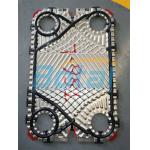
I. Basic Information- Product Model: BB1.2
- Product Name: BB1.2 Detachable Plate Heat Exchanger
- Product Category: Detachable Plate Heat Exchangers
II. Product Structure and Working Principle1. Core Structural ComponentsThe BB1.2 Detachable Plate Heat Exchanger features a "modular
assembly" as its core design, with key components and assembly
logic as follows:
- Heat Exchange Plates: Core heat transfer elements, made of stamped
thin metal sheets with corrugated grooves (to enhance heat transfer
efficiency);
- Sealing Gaskets: Installed around the perimeter of each plate, used
to seal gaps between plates to prevent medium leakage and assist in
dividing medium flow channels;
- Clamping Bolts: Compress all plates and gaskets via bolts to ensure
overall structural stability and maintain sealing performance;
- Corner Holes and Channels: Holes are provided at the corners of the
plates, which form continuous medium channels when assembled to
enable the inlet, outlet, and distribution of fluids.
2. Working Process (Heat Exchange Principle)- Medium Distribution: Two fluids to be heat-exchanged (hot medium
and cold medium) respectively enter their dedicated channels from
the equipment inlets, and are distributed into the flow channels
between the heat exchange plates through the corner holes of the
plates;
- Flow Channel Isolation and Countercurrent Flow: The plates and
sealing gaskets work together to completely isolate the two fluids
in independent flow channels, and countercurrent flow is
adopted by default (to maximize temperature difference and improve
heat exchange efficiency);
- Heat Transfer: The hot medium transfers heat to the cold medium
through the plates — the hot medium releases heat and its
temperature decreases (achieving cooling), while the cold medium
absorbs heat and its temperature increases (achieving heating);
- Goal Achievement: Finally, the "temperature regulation" of the two
media is completed to meet the heat exchange needs in industrial or
civil scenarios.
III. Core Product Features1. Advantageous Characteristics (Core Competitiveness)| Feature Category | Specific Description | Application Value |
|---|
| High Heat Transfer Efficiency | The corrugated groove design of the plates enhances fluid
turbulence, increases heat transfer area and heat transfer
coefficient, and enables fast heat exchange. | Shortens heat exchange time, reduces energy consumption, and is
suitable for scenarios requiring high heat exchange efficiency. | | Easy Maintenance | The detachable structure allows plates to be separated by loosening
the clamping bolts, facilitating inspection, cleaning, or gasket
replacement (Note: This advantage is somewhat diminished compared
to THE-type equipment). | Reduces downtime for maintenance, lowers operation and maintenance
costs, and extends the overall service life of the equipment. | | Low Fouling Impact | Turbulent flow reduces the accumulation of sediments and dirt in
the medium on the plate surface, resulting in a low fouling factor. | Minimizes efficiency loss caused by fouling blockage and reduces
cleaning frequency. | | Compact Structure | Adopts a multi-layer plate stacking design, with an occupied area
only 1/3 to 1/5 that of traditional shell-and-tube heat exchangers,
and light weight. | Saves installation space, suitable for scenarios with limited space
such as workshops and machine rooms. | | High Flexibility | The heat exchange area can be adjusted by increasing or decreasing
the number of plates, or the process can be adjusted by changing
the plate combination method. | Adapts to working conditions with different flow rates and
temperature differences, and reduces costs for later capacity
expansion or transformation. | | Precise Temperature Difference Control | The countercurrent design minimizes the end temperature difference
between hot and cold media (can be as low as 1°C), ensuring high
precision in temperature regulation. | Meets scenarios with strict requirements for outlet temperature
(e.g., food processing, precision chemical engineering). |
2. Relative Limitations (Comparison with Other Types of Plate Heat
Exchangers)Compared with semi-welded plate heat exchangers (SWPHE), fully
welded plate heat exchangers (WPHE), and brazed heat exchangers
(CBE), the BB1.2 Detachable Plate Heat Exchanger has the following
shortcomings:
- Lower Temperature and Pressure Resistance: Relying on sealing
gaskets for sealing, it is limited by the temperature and pressure
resistance of the gasket material, and cannot be adapted to
ultra-high temperature (usually ≤150°C) and ultra-high pressure
(usually ≤2.5MPa) working conditions;
- Weaker Corrosion Resistance: The combined sealing structure of
plates and gaskets has lower resistance to strongly corrosive media
(such as high-concentration acids and alkalis) than fully
welded/brazed structures, and is prone to seal failure due to
corrosion.
IV. Recommended Application ScenariosBased on its advantages of "high efficiency, easy maintenance, and
compact structure" and the limitation of "lower temperature and
pressure resistance", the BB1.2 Detachable Plate Heat Exchanger is
mainly suitable for medium-low temperature, medium-low pressure,
and non-strongly corrosive heat exchange scenarios, including but
not limited to:
- HVAC Field: Water-water heat exchange in building heating systems,
refrigerant-water heat exchange in central air conditioning;
- Food and Beverage Industry: Sterilization and cooling of fruit
juices, preheating or cooling of dairy products (food-grade
stainless steel plates and gaskets must be selected);
- Light Industry Field: Temperature regulation of electroplating
solutions, cooling of printing inks, heat exchange of low-corrosion
media in small chemical processes;
- Civil and Commercial Use: Hot water supply systems in hotels and
hospitals, maintenance of swimming pool water temperature, etc.
|