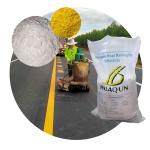
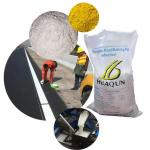
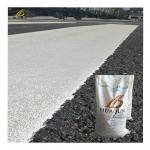
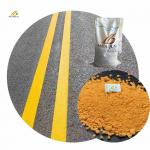
Thermoplastic Paint Reflective Road Paint Road Marking Paints
Manufacture Thermal Powder Coating
Product
Description
Thermoplastic paint is a highly durable and reflective road marking
material widely used for traffic management due to its exceptional
visibility, weather resistance, and long-lasting performance.
Composed of thermoplastic resins, pigments, glass beads, and
fillers, it is applied in a molten state and solidifies quickly
upon cooling, forming a robust adhesive layer on road surfaces. Composition and Key Components
Thermoplastic paint primarily consists of:
- Thermoplastic Resins: These act as the binding agent, providing structural integrity
and flexibility. A sufficient resin content (typically above a
critical threshold) ensures proper fluidity during application and
prevents issues like sedimentation, poor leveling, or decomposition
during heating.
- Pigments: Titanium dioxide (for white) and lead chromate (for yellow)
ensure high color retention and visibility.
- Glass Beads: Embedded in the paint or sprinkled during application, these
enhance retroreflection, improving nighttime visibility under
vehicle headlights.
- Fillers: Quartz sand, calcium carbonate, or other aggregates improve
abrasion resistance and texture. Key Features of Thermoplastic PaintThermoplastic Property:
The defining characteristic of thermoplastic paint is its ability
to melt at high temperatures. When heated (typically between 180°C and 200°C or 356°F to 392°F), the solid paint transforms into a liquid state, making it easier
to apply. Once it cools and hardens, it forms a durable,
wear-resistant surface. Durability:
Thermoplastic paint is known for its long-lasting performance. It is highly resistant to wear and tear from traffic, weather
conditions, and UV exposure, making it an excellent choice for
high-traffic areas. The paint maintains its effectiveness even
under harsh conditions like heavy rainfall, extreme temperatures,
and constant vehicular traffic. Reflectivity:
One of the significant advantages of thermoplastic road markings is
their reflective properties. Glass beads are often embedded in the paint during or immediately
after application. These beads enhance the visibility of the road
markings at night or in low-light conditions by reflecting
headlights, improving safety for drivers and pedestrians. Quick Drying:
After application, thermoplastic paint cools and solidifies
relatively quickly—usually within minutes. This quick drying time allows roads to be opened to traffic soon
after application, minimizing disruption. Eco-Friendly:
Thermoplastic paints are often more environmentally friendly than
traditional solvent-based paints. They typically contain fewer
volatile organic compounds (VOCs), reducing their environmental
impact. Additionally, they have a longer lifespan, meaning less
frequent reapplication and reduced waste.
Specification | Gravity(g/㎥) | 2.1g/㎥ | | Color | Yellow, Orange, Red and etc. | | Heating Temperature | 180℃-220℃ | | Softening Point(℃) | 110℃ | | Coating Appearance | No wrinkles, dots, blisters, cracks,fall-out&stick tyres | | Drying Time(min) | Within 3 minutes | | Chroma Performance | Reverse materials(white) | | Compressive Strength(Mpa) | 26 | | Abrasive Resistance(mg) | 42 | | Alkali Resistance | Great (in saturated solution of calcium hydroxide for 24 hours | | Glass Beads(%) | 19% | | Fluidity(s) | 40s | | Coating Resistance | Resis -10℃ for 4 hours | | Package | 25kg/bag, by plastic woven bag. One 20’container can load Max 26
tons | | Heat Resistance | Under 200℃-220℃ for hours | | Material | C5 Petroleum Resin, CACO3, Wax, Glass Beads, EVA, PE and so on. | | Application | Road marking, straight line, dotted line, curve, oriented
arrow,letter and etc. | | Water Resistance | Great (in water for 24 hours) |
Applications of Thermoplastic Paint Road Markings:
Thermoplastic paint is commonly used for lane markings, pedestrian crossings, arrows, and symbols on highways, roads, and streets. It provides clear, visible
markings that are essential for traffic management and safety. Parking Lots:
It is also widely used in parking lots for line marking, directional arrows, and handicap spaces, where durability and visibility are key. Runways and Airports:
Thermoplastic paint is used in airport runways and taxiways to mark
runway boundaries, parking areas, and safety zones due to its durability and resistance to wear under heavy traffic. Safety Markings:
It is also used for various safety markings in industrial environments, warehouses, and roadsides, such as warning lines, no-parking zones, and bicycle lanes.
Technical Specification
| Density(g/cm3) | 1.8-2.3 | | Softening point (℃) | 90-125 | | Compressive Strength(MPa) | ≥12 | | Glass bead content(%) | 0-30% | | Liquidity | 35±10 | | Packing | 25kg/bag | | Color | White/Yellow/Blue/Red/Green/Customized | | Executive standard | JT/T280-2004/AASHTO/BS3262/Customized | | Appearance | Powder | | Construction temperature | 180℃-220℃ | | Whiteness | 70-85(Customized) | | Inverse coefficient | 50-550 | | Warranty | 12 months | | Storage Method | Avoid light and moisture | | Packing Size | 45×70×5CM |
|