China DSC Differential Scanning Calorimeter manufacturer
Shanghai Glomro Industrial Co., Ltd.
2
Home > Products > DRS Thermal Conductivity Tester >

Direct Measurement BXT-DR-S Guarded Hot Plate Thermal Conductivity Tester

Browse Categories

Shanghai Glomro Industrial Co., Ltd.

City: shanghai

Province/State:shanghai

Country/Region:china

Tel:86-21-50476833

Contact Person:
Miss.Linda
View Contact Details

Direct Measurement BXT-DR-S Guarded Hot Plate Thermal Conductivity Tester

Measure the temperature range of the sample -20 ℃ -320 ℃ (requires optional external temperature control equipment)
Repeatability error ≤3%
Sample temperature rise ﹤15℃
Probe diameter No. 1 probe 7.5mm; No. 2 probe 15mm;No. probe 30mm
Brand Name BAXIT
Model Number BXT-DR-S
Certification CE
Place of Origin China
Minimum Order Quantity 1unit
Price USD4857/unit
Payment Terms L/C,D/A,D/P,T/T,Western Union,MoneyGram
Supply Ability 1000pcs/month
Delivery Time 5-7 working
Packaging Details Wooden
Test sample power P No. 1 probe power 0
Power supply AC 220V
Precision ±3%
Test Range 0.001-300W/(m*K)
Measure time 5~160s
Total power ﹤500w
Sample specifications Single sample measured by probe No. 1 (15*15*3.75mm) Single sample measured by the No. 2 probe (30*30*7.5mm) Single sample measured by the No. 3 probe (60*60*2mm)
Detailed Product Description

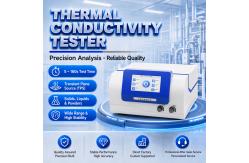
BAXIT Transient Plane Heat Source Method Thermal Conductivity Meter

BXT-DR-S


Instrument Introduction

BXT-DR-S is a thermal conductivity tester developed using transient planar heat source technology (TPS), which can be used to test the thermal conductivity performance of various types of materials. The transient planar heat source method is the latest type of method for studying thermal conductivity performance, which has taken measurement techniques to a whole new level. The ability to quickly and accurately measure thermal conductivity when studying materials provides great convenience for enterprise quality monitoring, material production, and laboratory research. The instrument is easy to operate, the method is simple and easy to understand, and it will not cause damage to the tested sample.

Working principle

Transient planar heat source technology (TPS) is a novel method for measuring thermal conductivity. The principle of determining the thermal properties of materials is based on the transient temperature response generated by a disc-shaped heat source with step heating in an infinite medium. Using thermal resistant materials to create a flat probe that serves as both a heat source and a temperature sensor. The thermal resistance coefficient of an alloy is linearly related to temperature and resistance, which means that by understanding the change in resistance, the heat loss can be determined, thereby reflecting the thermal conductivity of the sample. The probe of this method is a continuous double helix structure thin film formed by etching conductive alloy, with a double-layer insulating protective layer on the outer layer and a very thin thickness, which gives the probe a certain mechanical strength and maintains electrical insulation with the sample. During the testing process, the probe is placed in the middle of the sample for testing. When current passes through the probe, a certain temperature rise is generated, and the heat generated simultaneously diffuses to the samples on both sides of the probe. The speed of thermal diffusion depends on the thermal conductivity characteristics of the material. By recording the temperature and the response time of the probe, the thermal conductivity can be directly obtained from a mathematical model.

Test object

Metals, ceramics, alloys, ores, polymers, composites, paper, fabrics, foamed plastics (thermal insulation materials and plates with flat surfaces), mineral wool, cement walls, glass reinforced composite plates CRC, cement polystyrene plates, sandwich concrete, glass reinforced steel panel composite plates, paper honeycomb plates, colloids, liquids, powders, granular and paste solids, etc., have a wide range of test objects.

Main features

  • Reference standards for whole machine instruments: ISO 22007-2;
  • The testing scope is wide, the testing performance is stable, and it is at the leading level among similar instruments in China;
  • Direct measurement, with a testing time of about 5-160 seconds that can be set, can quickly and accurately measure the thermal conductivity, saving a lot of time;
  • It will not be affected by contact thermal resistance like the static method;
  • No special sample preparation is required, and there are no specific requirements for sample shape. Solid blocks only need a relatively smooth sample surface and a length and width that is at least twice the diameter of the probe;
  • Performing non-destructive testing on samples means that they can be reused;
  • The probe adopts a double helix structure for design, combined with a dedicated mathematical model, and uses core algorithms to analyze and calculate the data collected on the probe;
  • The structure design of the sample table is clever, easy to operate, suitable for placing samples of different thicknesses, and simple and beautiful at the same time;
  • The data acquisition on the probe uses imported data acquisition chips, which have high resolution and can make the test results more accurate and reliable;
  • The control system of the host uses ARM microprocessors, which have faster processing speed than traditional microprocessors, improving the system's analysis and processing capabilities, and resulting in more accurate calculation results;
  • The instrument can be used for the determination of thermal properties such as block solids, paste solids, granular solids, colloids, liquids, powders, coatings, films, insulation materials, etc;
  • Intelligent human-machine interface, color LCD display, touch screen control, easy and simple operation;
  • Powerful data processing capabilities. A highly automated computer data communication and report processing system.

Technical parameter

Test Range0.001-300W/(m*K)
Measure the temperature range of the sample-20℃-320℃ (requires optional external temperature control equipment)
Probe diameterNo. 1 probe 7.5mm; No. 2 probe 15mm;No. probe 30mm
Precision±3%
Repeatability error≤3%
Measure time5~160s
Power supplyAC 220V
Total power﹤500w
Sample temperature rise﹤15℃
Test sample power PNo. 1 probe power 0<P<1w; No. 2 probe power 0<P<14w No. 3 probe power 0<P<14w
Sample specificationsSingle sample measured by probe No. 1 (15*15*3.75mm) Single sample measured by the No. 2 probe (30*30*7.5mm) Single sample measured by the No. 3 probe (60*60*2mm)

Note: Probe 1 measures thin low conductivity materials, probe 2 is a conventional universal probe, and probe 3 measures high conductivity materials with high thermal conductivity. If the surface of the tested sample is smooth, flat, and sticky, the sample can be stacked.

Compared to other methods, it is faster, simpler, and more comprehensive

Measurement methodsTransient planar heat source methodLaser methodHotline methodProtection plate method
Measurement methodsNon-steady state methodNon-steady state methodNon-steady state methodSteady state method
Measure physical propertiesGet thermal conductivity and thermal diffusivity directlyDirectly obtain the thermal diffusivity and specific heat, and calculate the thermal conductivity from the input sample density valueGet thermal conductivity directlyGet thermal conductivity directly
Scope of applicationSolid,liquid, powder, paste,colloid, granuleSolidSolid, liquidSolid
Sample PreparationNo special requirements, simple sample preparationComplex sample preparationSimple sample preparation with specific requirementsLarge sample size
Measurement accuracy± 3%,preferably ± 0.5%Preferably up to ± 10%Preferably up to ± 5%Preferably up to ±3%
Physical modelPlanar heat source contact measurement, as long as the limited surface contact is goodNon-contact heat sourceWire heat source, the wire model must be in good contactHeat source contact type, need good surface contact
Thermal conductivity range[w/(m*k)]0.005-30010-5000.005-100.005-5
Measure time5-160SA few minutesTens of minutesHours

The operation method is simple and easy to understand

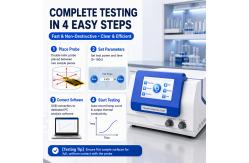
Two samples are required for testing. In order to ensure good contact between the sample and the probe, and to ensure that all heat generated by the probe is absorbed by the sample, the surface of the sample needs to be relatively flat. During testing, the probe is sandwiched between two samples, forming a sandwich like structure. By adjusting the power and testing time data, the thermal conductivity can be obtained by calculating the mathematical model. If the thermal conductivity of the tested sample is relatively low, the insulation effect is good, and the heat is not easily transferred away, then the temperature rise of the probe is relatively high.

Related Products
Email to this supplier
 
From:
Enter your Email please.
To: Shanghai Glomro Industrial Co., Ltd.
Subject:
Message:
Characters Remaining: (80/3000)