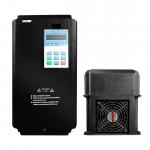
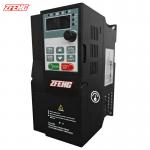
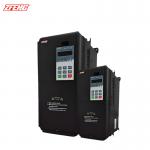
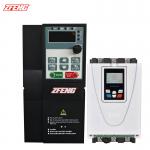
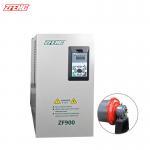
The ball mill dedicated frequency converter is an industrial
control equipment customized and developed for the grinding
scenarios of raw materials in industries such as ceramics, cement,
building materials, and chemicals. Through frequency conversion
speed regulation technology, the traditional power frequency
control system is transformed to solve industry pain points such as
excessive grinding of materials, large starting current impact, and
high energy consumption, achieving the dual goals of improving
grinding efficiency and energy conservation and consumption
reduction. Core functions and technological advantages Smooth startup and stable operation - Adopting soft start technology to avoid high current surges during
power frequency startup and extend the service life of motors and
equipment.
- Support low-speed high torque output, meet the start-up
requirements of the ball mill after sedimentation, and ensure the
quality of process control.
Intelligent speed regulation and energy-saving optimization - Realize continuous adjustable speed, match the optimal grinding
speed according to material characteristics, and improve grinding
uniformity.
- The automatic energy-saving function dynamically adjusts the
frequency and voltage according to the load demand, with an
energy-saving rate of 5% -15%, and up to 18% in some scenarios.
Multiple protection mechanisms - Integrate protection functions such as overcurrent, overvoltage,
overload, phase loss, and overheating to reduce the risk of
equipment damage.
- Reliable hardware current limiting design ensures stable operation
of the frequency converter under heavy load conditions.
Process adaptability design - The vector control algorithm supports low-frequency torque output
and adapts to the large inertia load characteristics of ball mills.
- Some models are equipped with eccentric grinding function to
optimize grinding efficiency and material uniformity.
Application scenarios and industry value |

![China ZFENG [Full Power Coverage] Optimization Of Eccentric Grinding With Vector Control Of 7.5kW-800kW Ball Mill Frequency Converter supplier](http://img.everychina.com.cn/nimg/cd/61/76b4cc91c80099c5f9e3addcaba5-249x163.jpg)
![China ZFENG [Full Power Coverage] Optimization Of Eccentric Grinding With Vector Control Of 7.5kW-800kW Ball Mill Frequency Converter supplier](http://img.everychina.com.cn/nimg/7d/b2/82395723831e2e75a7e7f6a0769a-249x163.jpg)
![China ZFENG [Full Power Coverage] Optimization Of Eccentric Grinding With Vector Control Of 7.5kW-800kW Ball Mill Frequency Converter supplier](http://img.everychina.com.cn/nimg/d8/24/23f403fd434889ad0811caeb21dd-249x163.jpg)
![China ZFENG [Full Power Coverage] Optimization Of Eccentric Grinding With Vector Control Of 7.5kW-800kW Ball Mill Frequency Converter supplier](http://img.everychina.com.cn/nimg/89/f4/141cb290135e4ad09914633a566d-249x163.jpg)
![China ZFENG [Full Power Coverage] Optimization Of Eccentric Grinding With Vector Control Of 7.5kW-800kW Ball Mill Frequency Converter supplier](http://img.everychina.com.cn/nimg/7d/33/cf79fc687e0a841a837c962b34e1-249x163.jpg)
![ZFENG [Full Power Coverage] Optimization Of Eccentric Grinding With Vector Control Of 7.5kW-800kW Ball Mill Frequency Converter for sale](http://img.everychina.com.cn/nimg/cd/61/76b4cc91c80099c5f9e3addcaba5-150x150/zfeng_full_power_coverage_optimization_of_eccentric_grinding_with_vector_control_of_7_5kw_800kw_ball_mill_frequency_converter.jpg)