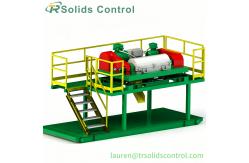
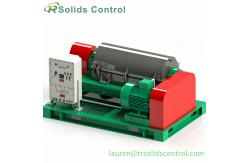
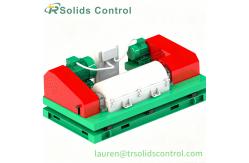
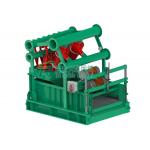
The decanter centrifuge is a critical piece of equipment used in industrial and oilfield
applications for efficient solid-liquid separation. Its main
function is to remove solids from liquids, allowing for cleaner
process fluids and reduced waste handling. Understanding how a
decanter centrifuge operates is essential for engineers and
operators seeking to optimize production efficiency and reduce
operating costs.
The decanter centrifuge works on the principle of centrifugal force. Inside the machine, a rotating bowl spins at high speed, causing
the denser solid particles in the liquid to move outward toward the
bowl wall, while the clarified liquid remains closer to the center.
The solids are then collected at one end of the bowl and discharged
continuously, making the process highly efficient.
Key Components and Working Principle
- Rotating Bowl: The heart of the centrifuge, this high-speed rotating component
generates the centrifugal force needed for separation. The bowl’s
design ensures a continuous flow of feed and prevents sediment
accumulation.
- Scroll Conveyor: Inside the bowl, a scroll or screw conveyor rotates at a slightly
different speed than the bowl. This differential speed moves the
separated solids toward the discharge end while allowing the
clarified liquid to flow out the other end.
- Feed System: The liquid containing solids enters the centrifuge via a feed
tube. Proper flow control is essential to ensure uniform separation
and prevent overloading.
- Drive System: The bowl and scroll are powered by either mechanical or hydraulic
drives. Precise speed control is critical for adjusting the
separation process according to different sludge characteristics.
- Discharge Mechanism: Solids are expelled continuously, while clarified liquid flows out
separately, minimizing downtime and improving throughput.
Applications of Decanter Centrifuge
Decanter centrifuges are widely used in industries such as:
- Oil & Gas: For drilling mud recovery, oil sludge treatment, and waste
management.
- Food & Beverage: For juice clarification, vegetable oil refining, and wine
processing.
- Wastewater Treatment: For sludge dewatering and water purification.
- Chemical & Pharmaceutical: For separating chemical suspensions and extracting fine powders.
The efficiency of a decanter centrifuge depends on several factors:
- Bowl Speed: Higher speeds increase centrifugal force, improving solid
separation.
- Differential Speed: The relative speed between the scroll and bowl determines the
residence time of solids and their dryness.
- Feed Consistency: Thick sludges require slower speeds or specially designed scrolls.
- Operating Temperature and Viscosity: These affect the fluid flow and separation efficiency.
Advantages of Decanter Centrifuge
- Continuous Operation: Unlike batch separation methods, decanter centrifuges operate
continuously, providing consistent output.
- High Efficiency: Capable of removing fine solids and achieving high liquid clarity.
- Reduced Labor: Automated systems reduce manual handling and maintenance.
- Versatility: Adjustable settings allow operation across a wide range of liquids
and sludges.
| Model | TRLW600B-1 | TRLW450N-1 | TRLW450N-2 | TRLW355N-1 | TRLW355NB-1 |
| Bowl Diameter | 600mm | 450mm | 450mm | 355mm | 355mm |
| Bowl Length | 1500mm | 1000mm | 1250mm | 1250mm | 1250mm |
| Bowl Speed | 2200r/min | 2200r/min | 3200r/min | 3200r/min | 0~3200r/min |
| Capacity | 90m³/h | 50m³/h | 50m³/h | 40m³/h | 40m³/h |
| G-Force | 1623 | 1217 | 2035 | 2035 | 0~2035 |
| Separation point | 5~7μm | 5~7μm | 2-5μm | 2-5μm | 2-7μm |
| Gear Box Speed | 40r/min | 40r/min | 30r/min | 30r/min | 0-30r/min |
| Gear Box Ratio | 35:1 | 57:1 |
| Main Motor Power | 55kw | 30kw | 37kw | 30kw | 37kw |
| Auxiliary Motor Power | 15kw | 7.5kw | 7.5kw | 7.5kw | 7.5kw |
| EX Standard | ExdllBt4 /IECEX /A-TEX |
| Weight | 4800kg | 2700kg | 3200kg | 2900kg | 3200kg |
| Dimension | 2900x1900x1750mm | 2600x1860x1750mm | 2600x1860x1750mm | 2600x 1620×1750mm | 2600x 1620 x1750mm |
Modern decanter centrifuges incorporate advanced automation,
vibration monitoring, and wear-resistant materials to extend
service life and improve performance. For oilfield applications,
they are particularly valuable in drilling fluid management, enabling the recovery of expensive drilling mud and minimizing
environmental impact.
In conclusion, the decanter centrifuge is an essential tool for industries that require effective and
continuous solid-liquid separation. By optimizing operating
parameters such as bowl speed, differential speed, and feed rate,
operators can maximize efficiency, reduce operational costs, and
improve process reliability. Its versatility and high performance
make it indispensable in modern industrial and oilfield operations.