Versatile Helical Pile for Customized Solutions in Various Soil and
Loading Conditions
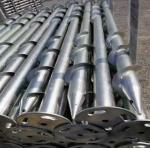
Helical piles, which are sometimes referred to as helical piers,
helical anchors, and posts, are a screw-in pile used to build deep
foundation systems and ground anchoring systems. A helical pile
consists of a central shaft (circular or square) and a helix
plate(s). The helix plates which are press-formed with a
predetermined pitch to resemble a screw are welded to the shaft.
They are fabricated in various sizes and configurations to meet
different types of loading and logistical requirements. The size
and configuration of a helical pile is based on the design load the
pile will carry, the existing soil conditions, the corrosiveness of
the existing soils and the service life of the structure.
Basic Info.
| Condition | New | Certification | API, ISO, CE, CE, SGS, BV | | Application | Home, Industrial, Commercial | Specification | Normal, customised | | Steel Grade | Q355 | Material | Steel | | Tube Thickness | 0.217",0.276" | Diameter | 2-7/8" | | Length | 1200/1600/1800/2000mm | Surface Treatment | Hot DIP Galvanizing with an Average of Over 80 Mic | | Transport Package | Pallet | Trademark | KXD | | Origin | Qingdao,China | HS Code | 730110 | | Production Capacity | 10000 Pieces/Month |
|
|
Packaging & Delivery
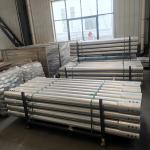
| Package Size | 1200.00mm * 230.00mm * 230.00mm | | Package Gross Weight | 27.000kg |
Detailed Photos
Ground screw system is a modern foundation system,using the drilling machine to
install which makes it as the most efficient and cost-saving
footing solution.It can be widely applied to different soil
conditions. Ground screw can be used for many kinds of application, like solar system; timer-fram construction;
advertising and traffic systems; urban garden and landscape
construction; flag poles and so on.
A helical piers is like a big screw with a shaft and bearing
plates. Soil conditions and loads determine the necessary depth of
the pier and diameter of the helixes, or bearing plates. Helixes
are only found on the lead section of the pier, and extensions are
added when needed to drive the pier deeper. Bearing capacity can be
verified by the amount of torque required to drive the pier during
installation. At the top of the pier is a cap to which various
heads can be attached. Usually welded to the cap or somewhere along
the shaft, the head may be a bracket that can be bolted to a
foundation, like the ones shown here, or it could be a base for a
deck post, for example.
How to Properly Package Helical Piles for Safe Transportation
1) Materials Preparation
- Protective Wrapping: Start by wrapping the helical steel sections and shafts in
corrosion-resistant materials such as plastic film or waterproof
kraft paper. This shields against moisture, rust, and abrasions.
- Padding: Use foam padding or bubble wrap at critical points (e.g., threaded
connections, welded joints) to avoid impact damage.
- Straps and Buckles: Prepare heavy-duty nylon straps or steel bands for securing the
piles. Avoid metal-to-metal contact to prevent scratches.
2) Layered Packaging
- Individual Protection: For long-distance transport, wrap each pile separately. Bundle
smaller components (e.g., helices, couplings) in labeled bags or
boxes.
- Shrink-Wrap or Heat Sealing: Encase wrapped piles in shrink-wrap film or seal with
heat-resistant adhesive tape to create a dust-proof barrier.
- Cushioning: Place piles in custom wooden crates or sturdy cardboard boxes
lined with foam inserts. Use void fill or packing peanuts to fill
empty spaces.
3) Securing and Labeling
- Stability: Strap the piles vertically or horizontally, ensuring uniform
pressure. Reinforce corners with corner protectors.
- Labeling: Clearly mark the package with: Product details (size, length, quantity). Warning labels (e.g., “Top Load Limit,” “Handle with Care”). Client/project-specific tags for easy identification.
4) Final Checks
- Moisture Control: Add desiccant packets inside sealed packages for humid climates.
- Compliance: Ensure packaging meets ISO standards for shipping and handling.
- Testing: Perform a drop test on sample packages to verify
durability.
Please feel free to contact me for more details, thank you! |