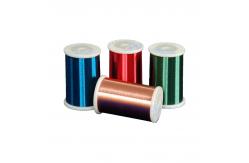
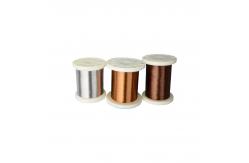
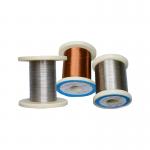
180/200/220 Temperature Class Enameled Wire
Description:
| Enameled Type | Polyester | Modified Polyester | polyester-imide | Polyamide-imide | polyester-imide /Polyamide-imide |
| Insulation Type | PEW/130 | PEW(G)/155 | EIW/180 | EI/AIW/200 | EIW(EI/AIW)220 |
| Thermal class | 130, CLASS B | 155, CLASS F | 180, CLASS H | 200, CLASS C | 220, CLASS N |
| Standard | IEC60317-0-2 IEC60317-29 MW36-A | IEC60317-0-2 IEC60317-29MW36-A | IEC60317-0-2 IEC60317-29 MW36-A | IEC60317-0-2 IEC60317-29 MW36-A | IEC60317-0-2 IEC60317-29 MW36-A |
Magnet wire or enameled wire is a copper or aluminum wire coated
with a very thin layer of insulation. It is used in the
construction of transformers, inductors, motors, generators,
speakers, hard disk head actuators, electromagnets, electric guitar
pickups and other applications that require tight coils of
insulated wire.
The wire itself is most often fully annealed, electrolytically
refined copper. Aluminum magnet wire is sometimes used for large
transformers and motors. The insulation is typically made of tough
polymer film materials rather than enamel, as the name might
suggest.
Conductor
The most suitable materials for magnet wire applications are
unalloyed pure metals, particularly copper. When factors such as
chemical, physical, and mechanical property requirements are
considered, copper is considered the first choice conductor for
magnet wire.
Most often, magnet wire is composed of fully annealed,
electrolytically refined copper to allow closer winding when making
electromagnetic coils. High-purity oxygen-free copper grades are
used for high-temperature applications in reducing atmospheres or
in motors or generators cooled by hydrogen gas.
Aluminium magnet wire is sometimes used as an alternative for large
transformers and motors. Because of its lower electrical
conductivity, aluminium wire requires a 1.6-times larger cross
sectional area than a copper wire to achieve comparable DC
resistance.