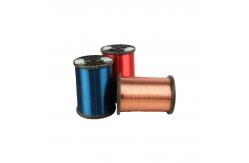
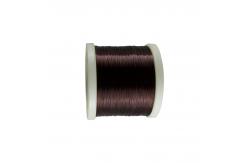
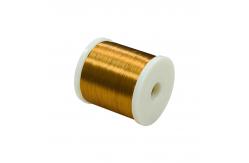
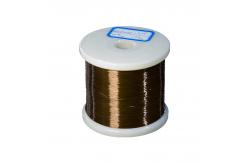
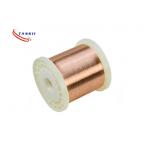
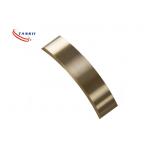
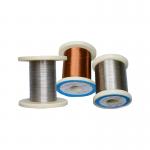
Enamelled Karma NiCr20AlSi Resistance Alloy Wire
Product Description
These enameled resistance wires have been broadly used for standard
resistors, automobile
parts, winding resistors, etc. using the insulation processing best
suited for these applications, taking full advantage of the
distinctive features of enamel coating.
Furthermore, we will carry out enamel coating insulation of
precious metal wire such as silver and platinum wire upon order.
Please make use of this production-on-order.
Type of bare Alloy wire
The alloy we can do enamelled are Copper-nickel alloy
wire,Constantan wire,Manganin wire. Kama Wire,NiCr Alloy
wire,FeCrAl Alloy wire etc alloy wire
Size:
Round wire:0.018mm~3.0mm
Color of enamel insulation:Red,Green,Yellow,Black,Blue,Nature etc.
Ribbon Size:0.01mm*0.2mm~1.2mm*24mm
Moq:5kg each size
Karma Property
| name | code |
Main Composition (%) |
Standard
|
| Cr | Al | Fe | Ni |
| Karma | 6J22 |
19~21 |
2.5~3.2 |
2.0~3.0 | bal. |
JB/T 5328 |
| Name | Code | (20ºC)
Resisti vity
(μΩ.m) | (20ºC)
Temp. Coeff. Of Resistance
(αX10-6/ºC) | (0~100ºC)
Thermal EMF vs. Copper
(μv/ºC) | Max.workin g
Temp.(ºC) | (%)
Elongati on | (N/mm2)
Tensile
Strength | Standard |
| Karma | 6J22 | 1.33±0.07 | ≤±20 | ≤2.5 | ≤300 | >7 | ≥780 | JB/T 5328 |
Distinctive features of Karma resistance wire
1) Starting with Nickel Chromium electric heat wire Class 1, we
replaced some of the Ni with Al and other elements, and thus
achieved a precision resistance material with
improved resistance temperature coefficient and heat
electromotive force against copper. With the addition of Al,
we have succeeded in making volume resistivity 1.2 times
greater than Nickel Chromium electric heat wire Class 1 and the tensile strength 1.3 times greater.
2) The secondary temperature coefficient β of Karmalloy wire KMW is
very small, - 0.03 × 10⁻⁶/ K2, and the resistance temperature
curve turns out to be almost a straight line within a
wide temperature range.
Therefore, the temperature coefficient is set to be the average
temperature coefficient between 23 ~ 53 °C, but 1 × 10⁻⁶/K,
the average temperature coefficient between 0 ~ 100 °C, also
may be adopted for the temperature coefficient.
3) Electromotive force against copper between 1 ~ 100 °C is also
small, below + 2 μV/K,
and exhibits excellent stability over a period of many years.
4) If this is to be used as a precision resistance material, low
temperature heat treatment is required to eliminate processing
distortions just as in the case of Manganin wire CMW.