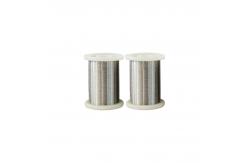
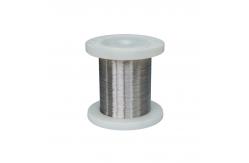
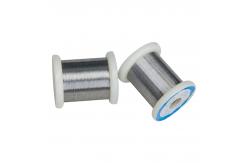
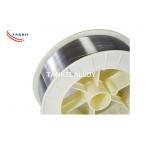
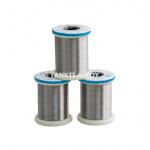
Ni80Cr20 Round Wire: Diameter 0.018mm~10mm
Ni80Cr20 Ribbon: Width 5~0.5mm, thickness 0.01-2mm
Grade: Ni80Cr20, Ni70Cr30, Ni60Cr16, Ni60Cr23, Ni35Cr20Fe
Nichrome's metallurgical structure confers them a very good
plasticity when cold.
In addition of a relatively high specific resistance, Ni-Cr alloys
join all the necessary properties for good performances in use of
furnaces: Resistance to oxidation (they are not sensitive to
aggressions of humid air).
Low embrittlement at high temperature. Good plasticity-Easier to
give them a shape compared with FeCrAl (lower mechanical
characteristics allow indeed a good control of elasticity of the
product during shaping (coiling, folding, drawing).
Good resistance to creeping (more important than ferritic alloys)
which is important during conception of a resistance presenting big
heights of waves.
| Chemical Composition and Main Properties of Nichrome |
| Properties Grade | Ni80Cr20 | Ni70Cr30 | Ni60Cr15 | Ni35Cr20 | Ni30Cr20 |
| Main Chemical Composition | Ni | Balance | Balance | 55.0-61.0 | 34.0-37.0 | 30.0-34.0 |
| Cr | 20.0-23.0 | 28.0-31.0 | 15.0-18.0 | 18.0-21.0 | 18.0-21.0 |
| Fe | ≤ 1.0 | ≤ 1.0 | Balance | Balance | Balance |
| Max Continuous Service Temperature(oC) | 1200 | 1250 | 1150 | 1100 | 1100 |
| Resisivity 20oC (Ω mm2/m) | 1.09 | 1.18 | 1.12 | 1.04 | 1.04 |
| Density (g/cm3) | 8.4 | 8.1 | 8.2 | 7.9 | 7.9 |
| Thermal Conductivity(KJ/m@ h@ oC) | 60.3 | 45.2 | 45.2 | 43.8 | 43.8 |
| Coefficient of Thermal Expansion(α × 10-6/oC) | 18 | 17 | 17 | 19 | 19 |
| Melting Point( oC) | 1400 | 1380 | 1390 | 1390 | 1390 |
| Elongation(%) | > 20 | > 20 | > 20 | > 20 | > 20 |
| Micrographic Structure | austenite | austenite | austenite | austenite | austenite |
| Magnetic Property | nonmagnetic | nonmagnetic | nonmagnetic | Weak magnetic | Weak magnetic |