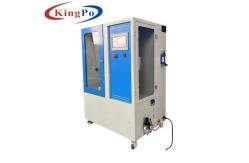
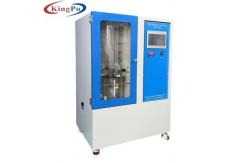
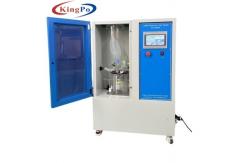
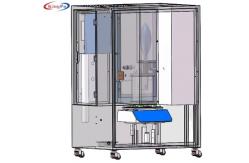
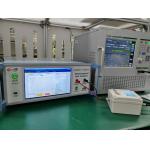
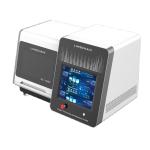
1. Overview:
The HME testing equipment is developed and designed according to
ISO 9360-1 and ISO 23328-1. This equipment is mainly used to test
the performance of the heat and moisture exchanger that simulates
the human body, mainly measuring the water loss value during the
use of the HME.
2. Specifications: - The instrument is based on the standards ISO 9360-1, ISO23328-1;
- The instrument is mainly used to test the water loss of heat and
moisture exchangers (HME) used in anesthesia and respiratory
systems to humidify human respiratory gases.
- Working principle: A sinusoidal gas generator is used to simulate
human breathing. The test system is calibrated using a standard
HME, and the tidal volume is adjusted. The weight change of the
simulated respiratory system and HME is recorded by weighing, and
the water mass loss of the HME during breathing is calculated to
determine the performance of the HME.
- The tester consists of a sine wave generator, a test host, a
moisture generator, a simulated lung, a constant temperature water
bath, an insulation box, a gas constant temperature control device,
a gas storage container, a gas delivery system, an automatic
separation weighing system, a calibration HME and auxiliary test
accessories.
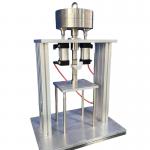
- Automatic weighing, using a precision electronic scale with a
measuring range of 0-15 kg and an accuracy of ±0.1g. Automatic
lifting and lowering of the electronic scale, automatic separation
of the test system, automatic recording of system mass changes, and
automatic calculation of HME moisture loss.
- Sine wave gas generator, used to generate sine wave gas that
simulates human breathing, with adjustable breathing rate from 0 to
30 times/min;
- Automatic adjustment of tidal volume, the system defaults to four
levels: 250mL, 500mL, 750mL, and 1000mL.
- A constant temperature water bath ensures that the gases entering
the HME from the simulated lung are fully humidified and kept at a
constant temperature of 37°C. The constant temperature water bath
automatically controls the temperature to a constant of 37°C with a
control accuracy of 0.1°C.
- The insulation box is filled with foamed polypropylene material to
isolate the internal temperature of the test system from the
external environment. A constant temperature control device is used
to control the air temperature inside the insulation box at 37°C
with a control accuracy of ±0.5°C.
- Gas flow measurement uses a precision electronic flow meter with a
response time of 10ms, a maximum resolution of 0.001SLPM, an output
fluctuation of ±0.12%/℃, a flow pressure upper limit of 600Pa, and
a flow upper limit of 50SLPM;
- Test time can be set to any value between 0-9999H9999 min;
- Calibration HME: The housing contains 81 polyvinyl chloride (PVC)
pipes arranged in a 9×9 pattern. Each pipe has an inner diameter of
2mm, an outer diameter of 4mm, and a length of 50mm. It has 22
outer cones, 15 outer cones, and 15 inner cones;
- Simulated lung volume: 2L;
- Display: The system main interface displays real-time data such as
running time, water temperature, air temperature, number of
breaths, weight, tidal volume, respiratory rate, flow rate, etc.
- Touch screen control, use the touch screen to input parameters and
operate the instrument;
- It can run continuously for 4800 hours; power supply: AC220, power
500W;
- Weight: The main unit weighs less than 15 kg.
3. Equipment control and operation:
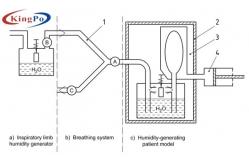
① 2-liter anesthesia bag
② Postpartum dampness patient model
③ Control system
④ Flow meter (ISO9360 test)
3.1. Front page
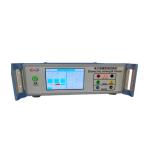
You can choose Chinese or English on the homepage. Click the [Enter System] button to open the running interface.
3.2. Run interface
1. Heating switch: ON, the heater starts heating, PID control, OFF
turns off heating;
2. Humidity PV: humidity value in the water tank;
3. Water tank temperature SV: set the water tank temperature;
4. Water tank temperature PV: real-time display value of water tank
temperature;
5. Box temperature SV: set the box temperature;
6. Box temperature PV: real-time display value of box temperature;
7. Time setting: set the breathing operation time, and it will stop
automatically when the time is up;
8. Time display: display breathing running time;
9. [TIMER] button: white, timer stop, yellow, timer start;
10. Breathing volume: Click the input box to select 1000ml, 750ml,
500ml, 250ml;
11. Respiratory frequency: automatically selected after selecting
respiratory volume;
12. [Breathing Start] button: start breathing after selecting the breathing volume;
13. [Return to origin] button: After the device is powered on, it will return to the
origin before starting breathing;
14. Current weight: When weighing, it displays the weight of the
breathing device, which is used to calculate the loss of water
during breathing;
15. [Reset] button: used to clear the scale before weighing, so that the
current weight is zero;
16. [Record Clear] button: clear the recorded weight value;
17. [Weight] button: used for weighing;
18. [Record] button: used to record the weight during weighing;
4. Test steps: (1) Open the water inlet on the sink and fill the sink with water
to the standard water level (119-143mm). (2) Connect the external power supply and turn the power switch to
the "open" position.
(3) Connect the test sample to the port on the right side of the
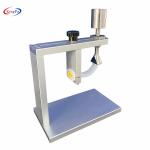
device.
(4) Set the heating temperature to 37°C. Click the water tank and
box heating button to start heating, and wait for the temperature
to stabilize for at least 1 hour.
(5) Set the test time to 25±1H
(6) Set up a test Tidal volume and start it. (7) The device stops automatically when the test time is reached
5. Notes: - Please test the samples according to ISO23328-1 standard test
requirements;
- Please read this manual carefully before operating this machine,
and do not operate it in violation of regulations.
6. Common troubleshooting
Serial number | Fault phenomenon | Cause of failure | Treatment method | 1 | The touch screen does not light up when the power switch is turned
on | External power supply is not working | Reconnect the power supply | The device circuit breaker is disconnected | Close the circuit breaker | 2 | Pressing the start button does nothing | The test time is not reset | Reset the time to zero | Emergency stop switch not reset | Reset the emergency stop switch | 3 | Large temperature fluctuations | Thermocouple Connection Problems | Reconnect the thermocouple plug | 4 | Unstable weighing | Other items touch HG | Remove the left and right pipes inside the box |
|