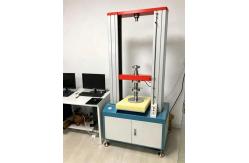
Product Overview The SL-T41 Foam Compression Hardness & Tensile Strength Tester
is a versatile universal testing machine engineered for precision
evaluation of both metallic and non-metallic materials. It is
widely applied to tensile, compression, bending, shearing,
stripping, tearing, and two-point extension testing (additional
extensometer required) across rubber, plastic, wire and cable,
optical fiber, safety belts, leather composite materials, plastic
profiles, waterproof coiled materials, steel pipes, copper
materials, profiles, spring steel, bearing steel, stainless steel
and other high-hardness steels, castings, steel plates, steel
strips, and non-ferrous metal wires. The machine adopts a mechatronics design, integrating a force
sensor, transmitter, microprocessor, load drive mechanism,
computer, and color inkjet printer. It delivers a wide and accurate
loading speed and force measuring range, with high accuracy and
sensitivity for load and displacement measurement and control.
Constant-speed loading and constant-speed displacement tests can be
performed under automatic control. The floor-type model's styling
and finish reflect modern industrial design and ergonomic
principles. Main Features An imported photoelectric encoder is used for displacement
measurement. The controller features an embedded single-chip
microcomputer structure with built-in powerful measurement and
control software that integrates measurement, control, calculation,
and storage functions. The system automatically calculates stress,
elongation (extensometer required), tensile strength, and elastic
modulus, and automatically counts results. It records the force
value or elongation at the maximum point, breaking point, and
specified point. The connected computer dynamically displays the
test process and test curve and processes the data. After testing,
the curve can be magnified through the graphic processing module
for data re-analysis and editing, and reports can be printed.
Product performance has reached the international advanced level. Technical Parameters | Maximum test force | 500 kg |
|---|
| Accuracy level | 1 |
|---|
| Load accuracy | ±0.5% |
|---|
| Allowable error limit | Within ±1% of the indication value |
|---|
| Load measurement range | Full scale 2% ~ 100% FS |
|---|
| Test force resolution | 1/50000 of the maximum test force |
|---|
| Displacement limit error | Within ±0.5% of the indication value |
|---|
| Displacement resolution | 0.01 mm |
|---|
| Effective stretching space distance | 600 mm |
|---|
| Effective test width distance | 500 mm |
|---|
| Test speed | 0.01 ~ 500 mm/min (adjustable) |
|---|
| Force reading units | kgf, Ibf, N, KN, T, etc. |
|---|
| Curve display | Load–elongation, elongation–time, time–elongation, stress–strain |
|---|
| Data display | Max. force, speed, sample information, strength (Kpa, Mpa, N/mm,
N/mm²), etc. |
|---|
| Control system | PC software with interactive human–computer dialogue interface
under Windows operating environment |
|---|
| Test methods | Tensile Strength Test, Elongation-at-break Test, Compression
Hardness Test, IFD Test, CLD Test |
|---|
Machine Features & Functions - Automatic shutdown: After the sample is damaged, the moving beam automatically stops
moving (or automatically returns to the initial position).
- Automatic shift: Automatically switches to the appropriate range according to the
test force to ensure measurement data accuracy.
- Condition module: Test conditions and sample raw data can be stored as standard
modules for convenient recall and viewing, saving test time.
- Automatic transmission: Displacement speed or loading speed is completed automatically
according to a pre-set program, or can be manually changed.
- Automatic process system: Users can easily build custom test templates (methods) for quick
recall, enabling closed-loop control of loading speed, stress, and
strain.
- Automatic saving: At the end of the test, test data and curves are automatically
saved by the computer to prevent data loss from forgotten saves.
- Test process: Testing, measurement, display, and analysis are all completed by
the microcomputer.
- Batch testing: For samples with the same parameters, a batch of tests can be
completed in sequence after setup.
- Test software: Chinese Windows user interface for easy operation.
- Display mode: Data and curves are dynamically displayed alongside the test
process.
- Curve traversal: After testing, curves can be magnified and analyzed, and the data
corresponding to each point on the curve can be located with the
mouse.
- Test report: Editable and printable according to user requirements.
- Limit protection: Program-controlled and mechanical two-level limit protection.
- Overload protection: Automatic stop when the load exceeds the rated value by 3% ~ 5%.
- Report display: Automatic and manual modes obtain various test results and
automatically form reports, simplifying data analysis.
- Add test method: Users can add test methods according to their testing
requirements.
|