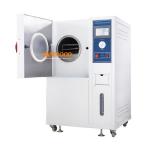
Altitude Temperature Test Chamber Altitude Simulation Low Pressure
to 1.1Kpa
Altitude Test Chamber is widely use for electrical &
electronic, aerospace, military, automotive industries and packages and comsumable products. According to GB,GJB and IEC standard, to do high low
temperature,low pressure and other environmental and reliability
test.
Sanwood altitude chamber is composed of test room formed by
pressure-containing shell, and insulation structure, refrigeration
system,vacuum system and circuit system and other components
precision instruments etc.
Altitude Test Chamber Specification
| Model | SM-VTH-2000-CD |
| Temperature | Temperature control range | -70℃~180℃ |
| Temperature fluctuation | ±0.5℃ |
| Cooling rate | 180.0℃~-70.0℃ Within 120mins |
| Heating rate | -70.0℃~180.0℃ Within 100mins |
| Temperature uniformity | ±2.0℃ |
| Pressure | Pressure range | Normal pressure~1.09kpa(30500 Meter height) |
| Pressure error | ±2kpa(>40kpa),±5%(2kpa~40kpa),±0.1kpa(<2kpa) |
Material /
components | Internal material | Adopt 2mm thickness stainless steel plate (SUS304) |
| External material | Adopt 10mm thickness cold rolled steel plate fully welded / powder
sprayed |
| Heat insulating material | 100mm thickness polyurethane plate |
| Size | Inner size(mm)W*H*D | 1400*1200*1200 |
| Outer size(mm)W*H*D | About 1650x1400x3200 |
| Volume(L) | 2000L |
| Operating ambient temperature | +5 ~ 35℃ |
| Power supply | 380V AC 50/60Hz |
| Controller | SANWOOD SH5600:Equipped with RS232 port;(7.0 inch controller)USB data export |
| Safety | Over temperature protection, Leakage protection function, etc. |
Customized sizes and models are available.
Altitude Test Chamber Test Standards comply:
GB/T2423.1-2001 test A: Low temperature test
GB/T2423.2-2001 test B: High temperature test
GB/T2423.21-2001 test M: Low pressure test
Research
Research is essential for the technology and engineering activities
required to advance the design and development of products.
Companies in almost every industry rely on research and development
(R&D) to plan, design, and deliver new, innovative products.
Environmental test chambers accommodate various aspects of R&D.
Some are designed for laboratory research, testing in search for or
evaluation of product alternatives, construction, and testing of
pre-production prototypes.
The most common tests run are for product shelf-life. Companies
simulate the lifespan of a product (e.g, a change of five degrees
in the test chamber is equivalent to two years in a real-world
environment) through what’s known as highly accelerated life
testing (HALT). The goal is to identify the so-called ‘failure
point’ of products, so companies can set expectations or, if need
be, focus on a different design that proves more durable.
The more time, resources, and energy you put into R&D testing,
the more confident you’ll feel advancing to production.