2-core and 4-core Teflon oil well high-temperature optical cables
and high-temperature resistant detection sensor temperature-measuring optical fibers for oil well
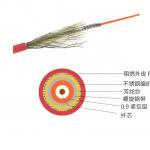
sensing - Optical Fiber: Usually made of polyimide high-temperature optical fiber, which
has excellent high-temperature resistance and optical properties,
enabling stable transmission of optical signals in high-temperature
environments.
-
- Cladding Layer: Typically coated with a layer of polytetrafluoroethylene
(Teflon). Teflon features outstanding high-temperature resistance,
corrosion resistance, water resistance, and electrical insulation,
protecting the optical fiber from harsh external environments.
-
- Reinforcement Layer: Kevlar and other materials are used as the reinforcement layer in
the middle, which enhances the mechanical strength of the optical
cable, improving its resistance to tension, extrusion, and bending,
and ensuring it is not easily damaged in the complex downhole
environment of oil wells.
-
- Outer Sheath: The outer sheath also uses polytetrafluoroethylene to provide
further protection, making the overall optical cable flexible and
corrosion-resistant for convenient construction and laying.
Cable Parameters | Items | Specifications | Fiber Count | 2~24 | Colored Coating Fiber | Dimension | 260µm±15µm | Color | Blue, Orange, Green, Brown, Gray, White | Loose Tube Dimension 2.10mm±0.05mm | Dimension | 2.10mm±0.05mm | Material | PBT | Color | Natural | Strength Member | Diameter | 1.0mm | Material | Steel | Outer Jacket | Dimension | 8.0mm±0.1mm | Material | PE | Color | Black |
Other Main Parameters FYI: Cable Type | Fiber Count | Tubes | Fillers | Cable Diameter mm | Cable Weight kg/km | Tensile Strength Long/Short Term N | Crush Resistance Long/Short Term N/100mm | Bending Radius Static/Dynamic | GYTA53-2-6 | 2-6 | 1 | 5 | 14.5 | 209 | 1000/3000 | 1000/3000 | 10D/20D | GYTA53-8-12 | 8-12 | 2 | 4 | 14.5 | 209 | 1000/3000 | 1000/3000 | 10D/20D | GYTA53-14-18 | 14-18 | 3 | 3 | 14.5 | 209 | 1000/3000 | 1000/3000 | 10D/20D | GYTA53-20-24 | 20-24 | 4 | 2 | 14.5 | 209 | 1000/3000 | 1000/3000 | 10D/20D | GYTA53-26-30 | 26-30 | 5 | 1 | 14.5 | 209 | 1000/3000 | 1000/3000 | 10D/20D | GYTA53-32-36 | 32-36 | 6 | 0 | 14.5 | 209 | 1000/3000 | 1000/3000 | 10D/20D | GYTA53-38-48 | 38-48 | 4 | 1 | 15.4 | 234 | 1000/3000 | 1000/3000 | 10D/20D | GYTA53-50-60 | 50-60 | 5 | 0 | 15.4 | 234 | 1000/3000 | 1000/3000 | 10D/20D | GYTA53-62-72 | 62-72 | 6 | 0 | 15..9 | 244 | 1000/3000 | 1000/3000 | 10D/20D | GYTA53-74-84 | 74-84 | 7 | 1 | 18 | 297 | 1000/3000 | 1000/3000 | 10D/20D | GYTA53-86-96 | 86-96 | 8 | 0 | 18 | 297 | 1000/3000 | 1000/3000 | 10D/20D | GYTA53-98-108 | 98-108 | 9 | 1 | 19.4 | 338 | 1000/3000 | 1000/3000 | 10D/20D | GYTA53-110-120 | 110-120 | 10 | 0 | 19.4 | 338 | 1000/3000 | 1000/3000 | 10D/20D | GYTA53-122-132 | 122-132 | 11 | 1 | 21.3 | 392 | 1000/3000 | 1000/3000 | 10D/20D | GYTA53-134-144 | 134-144 | 12 | 0 | 21.3 | 392 | 1000/3000 | 1000/3000 | 10D/20D | GYTA53-146-216 | 146-216 | | | 21.3 | 395 | 1000/3000 | 1000/3000 | 10D/20D |
Here is the relevant introduction to 2-core and 4-core Teflon oil
well high-temperature optical cables and high-temperature resistant detection sensor
temperature-measuring optical fibers for oil well sensing: Based on the Raman scattering principle, when a laser pulse
propagates in the optical fiber, it interacts with the fiber
molecules to generate Stokes and anti-Stokes optical signals. The
intensity of the anti-Stokes light changes with temperature. By
analyzing this signal, the system can not only accurately measure
temperature but also locate abnormal points through the optical
time difference. - High-temperature Resistance: It can withstand temperatures below 200°C or even 300°C, meeting
the high-temperature requirements of the downhole environment in
oil wells.
- Corrosion Resistance: Materials such as Teflon have good corrosion resistance, capable
of withstanding the erosion of various chemical substances in oil
wells, such as sulfides.
- Anti-interference: The optical fiber itself is immune to electromagnetic
interference, enabling stable operation in the strong
electromagnetic environment of oil wells and ensuring the accuracy
and reliability of measurement data.
- High-precision Measurement: It can achieve high-precision temperature measurement with an
accuracy of up to ±0.5°C or even higher, capable of promptly
capturing subtle temperature changes in the downhole of oil wells,
providing accurate data support for oil well production.
- Long-distance Monitoring: The maximum monitoring distance per channel can reach 16
kilometers or longer, suitable for large-scale oil well monitoring,
and enabling comprehensive temperature monitoring of different
depths in oil wells.
-
- Oil Well Temperature Monitoring: Real-time monitoring of temperature changes at different depths
in oil wells helps petroleum engineers understand the production
status of oil wells, such as judging the temperature distribution
of oil layers and changes in oil-gas-water interfaces, so as to
adjust production strategies in a timely manner and improve oil
recovery efficiency.
- Oil Well Fault Diagnosis: Abnormal temperatures are monitored to detect potential faults in
oil wells, such as tubing leakage and casing damage, and timely
measures are taken for repair to avoid the occurrence and expansion
of accidents.
- Reservoir Dynamic Monitoring: Long-term monitoring of temperature changes in reservoirs,
analysis of the dynamic characteristics of reservoirs, providing
important basis for reservoir development and management, and
optimizing reservoir exploitation plans.
-
- Selection: According to the specific environmental conditions of the oil
well (such as temperature, pressure, corrosion, etc.), monitoring
requirements (accuracy, distance, etc.), and budget, select the
appropriate core number (2-core or 4-core), specifications, and
performance of the oil well sensing optical cable.
- Installation: The installation process requires professional technology and
equipment to ensure the correct laying and fixing of the optical
cable downhole, avoiding excessive tension, bending, or extrusion
of the optical cable. At the same time, pay attention to the
connection between the optical cable and wellhead equipment,
monitoring systems, etc., to ensure stable signal transmission.
|