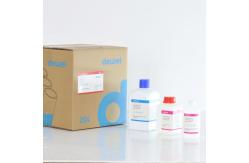
Hematology Analyzer Reagent for 3 Part Erma PCE-210 Compatible Cell
Counter Reagent Manufactuer
Specification
| Erma PCE-210 |
| Cat. No | Description | Pack Size |
| DWX-36101 | DILUENT-ER | 20L |
| DWX-36102 | LYSE-ER | 500ml |
| DWX-36103 | RINSE-ER | 1L |
Intended Use
To be used for blood cell counting, sizing, and WBC
differentiation, hemoglobin determination on ERMA PCE-210
Hematology Analyzers. This product is for In Vitro Diagnostic Use
only.
1. How about our after-sales service?
For international customers, the agent is responsible for
after-sales service.
For direct selling customers, it can provide free after-sales
service (excluding spare parts fee), and make the first reply on
the day of customer feedback.
For non-direct customers, the agent is responsible for providing
after-sales service, and our company can provide telephone
technical assistance.Under special circumstances, our company can
also offer engineers to assist, and the fee depend on specific
situation.
2. Are the specifications of a set of reagents fixed?
Certainly, our products is produced according to the specifications
od the original reagents, however, some products can be adjusted
according to the demand of different customers.
3. STORAGE
Store the product at 2-35℃ in a dust free place with good
ventilation. Temperature outside the range may damage the product.
The open vial life of the product is 60 days. Unused reagents
should be discarded after 60 days. Do not mix residual with a new
carton.
4. PRECAUTIONS
Re-calibration is recommended when changing the origin of the
reagents.
It is not recommended using different brands of solutions together
on one unit of analyzer.
Do not ingest. Avoid contact with skin and eyes.
Skin contact: Flush with plenty of water.
Eyes contact: Flush with plenty of water. Obtain immediate medical
attention.
This kit is for professionals and in vitro diagnostic use only.
Never put distilled water on the analyzer (except clean for
shipping menu), otherwise the pneumatic unit can be damaged
seriously.
Some product questions you may want to ask:
1) What is the principle of 3 part hematology analyzer?
In a 3-part analyzer the cell counting is based on the Coulter
Principle. All hematology analyzers utilise Coulter's Principle.
3-part differential cell counter employs Coulter's Principle to
determine the size as well as volume of the cells. Coulter's
principle is applied employing two electrodes.
2) What is the diluent in the hematology analyzer?
The diluent for the hematology analyzer comprises sodium chloride,
sodium sulfate, a phosphate buffer agent, ethylene diamine
tetraacetic acid, 1-pyridone-2-sulphur and formaldehyde, and the pH
value of the solution is 6.5-7.4, and preferably is 7.2; the
content of each component is preferably as follows: 5g/L of ...
3) Which diluent is good for RBC and platelet counting?
For this, the blood specimen is diluted (usually in 1:200 ratio)
with the help of RBC diluting fluid (commonly the Hayem's Fluid)
which preserve and fix the Red blood cells. The Hayem's fluid is
isotonic to the Red blood cells and does not cause any damage to
it.
4) What is the use of Lyse in hematology analyzer?
It is used to lyse (destroy) red blood celis for hemogiobin
determinations or aid in the counting of white blood cells.
Applicable to the hematology analyzers.
5) What are the reagents of hematology Analyser?
At present, hematology analyzers on the market can be divided into
3 part hematology analyzers and 5 part hematology analyzers.
Hematology reagents are also indispensable in the use of hematology
analyzer. Hematology reagents include hemolytic agents, diluents,
cleaning solutions and concentrated cleaning solutions.
6) Which of the following combination of reagents is used to
measure hemoglobin?
This is done by adding both potassium cyanide and ferricyanide
whose absorbance is then measured at 540 nm using a photoelectric
colorimeter against a standard quality control solution. The Hb
concentration is then determined by the result produced by the
photoelectric colorimeter.
7) Will the quality of CBC reagents change with different
temperature?
Normal weather change will not affect the use of the product. If
the reagents freeze for low temperature, returning it to room
temperature make the ice melt completely and the products can be
used normally. Ensurind the ice melt completely otherwise it may
cause blockage. The store temperature of hematology reagents is
2-35 degrees, and the biochemical reagents require 2-8 degrees, if
not the validity of products will shorten.