
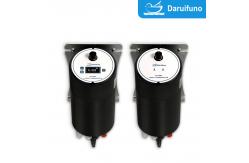
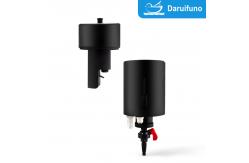
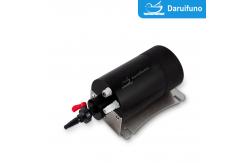
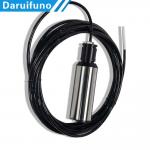
Flow Cell Type Lower Turbidity Water Tubidity Sensor For Drinking Water
|


|
Flow Cell Type Lower Turbidity Water Tubidity Sensor For Drinking Water
Turbidity refers to the content of suspended particles or pollutants in water, and is an important indicator for evaluating the clarity of water quality. During drinking water treatment, monitoring of turbidity is critical to ensure safe and acceptable water quality.
The OLTU6 flow-through low turbidity sensor uses a laser light source to emit a laser beam through the water sample, and then measures the scattering or absorption of the laser beam after passing through the water sample. Based on the number, size and nature of particles in the water, the sensor can calculate the turbidity level of the water sample. Laser low turbidity sensors typically have high precision and sensitivity to detect the presence of tiny particles to accurately assess water clarity.
Technical Parameters
User manual of OLTU60:
OLTU600 Low turbidity sensor user manual.pdf
Features
Advantage
Drinking water flow-through low turbidity laser sensor OLTU60 is mainly used in environments related to drinking water treatment and monitoring. It aims to monitor the turbidity level of drinking water in real time to ensure safe and qualified water quality. The following are the main application environments for this sensor:
Drinking water production line: In the drinking water production line, the sensor can be installed at key positions in the process to monitor the turbidity of water samples in real time. This helps detect anomalies in the treatment process and if treatment needs to be adjusted to keep the water quality stable.
Waterworks: Waterworks are responsible for treating and supplying tap water to urban residents. The drinking water flow-through low turbidity laser sensor can be installed at the water inlet and outlet of the water plant to continuously monitor the turbidity changes of the raw water and the treated tap water. In this way, potential water quality problems can be detected in time, and measures can be taken to ensure that the drinking water supplied meets safe standards.
Water treatment facilities: In other types of water treatment facilities, such as sewage treatment plants, industrial wastewater treatment plants, etc., the sensor can also be applied. It monitors water quality changes during treatment and helps operators adjust and optimize treatment methods to meet treatment requirements and reduce environmental impact.
Drinking water quality monitoring station: Drinking water flow-through low-turbidity laser sensors can be deployed in drinking water quality monitoring stations in cities or communities for real-time monitoring of water quality in water supply systems. Such monitoring stations can provide continuous water quality data, provide decision-making basis for local governments and relevant departments, and ensure the safety of drinking water for the public.
In general, drinking water flow-through low turbidity laser sensors are widely used in all aspects of drinking water treatment and monitoring, aiming to provide high-precision, real-time water quality monitoring data to ensure the safety and qualification of drinking water and protect public health . |
||||||||||||||||||||||||||||||||||||||||||||||||||||||||||||||||||||||||||||||||||||||||||||
| Product Tags: Flow Cell Water Tubidity Sensor Drinking Water Tubidity Sensor | ||||||||||||||||||||||||||||||||||||||||||||||||||||||||||||||||||||||||||||||||||||||||||||
|
RS485 Signal 4000NTU Turbidity Electrode For Waste Water Measuring |
|
RS485 Output 1000 NTU Turbidity Sensor For Industrial Sewage Water Detecting |
|
RS485 Signal Data Collection Turbidity Controller For Waste Water Monitoring |
|
Relay Control Communication Data Collection Turbidity Transmitter For Surface Water |
|
RS485 Interface Remote Signal Turbidity Controller For Water Station Monitoring |
|
Self-Cleaning Function RS485 Turbidity Sensor For Waste Water Monitoring |