
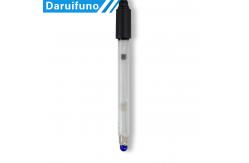
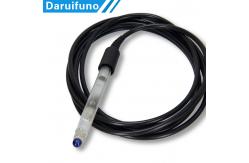
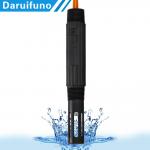
PH Sensor With 100℃ Temperature Resistance For Industrial Wastewater
|
|
PH Sensor With 100℃ Temperature Resistance For Industrial Wastewater
The pH value of water depends on the amount of dissolved substances, so pH value can sensitively indicate changes in water quality. The change of pH value has a great impact on the reproduction and survival of organisms, and also seriously affects the biochemical effect of activated sludge, that is, affects the treatment effect. The pH value of sewage is generally controlled between 6.5 and 7. Water is chemically neutral, and some water molecules spontaneously decompose according to the following formula: H2O=H++OH-, that is, decomposed into hydrogen ions and hydroxide ions.
In a neutral solution, the concentrations of hydrogen ions H+ and hydroxide ions OH- are both 10-7 mol/l, and the pH value is the negative number of the base 10 logarithm of the hydrogen ion concentration: pH=-log, so neutral The pH of the solution is equal to 7. If there is an excess of hydrogen ions, the pH value is less than 7 and the solution is acidic;
Conversely, if the hydroxide ions are excessive, the solution is alkaline. The pH value is usually measured by the potentiometric method. A galvanic cell is usually composed of a constant potential reference electrode and a measuring electrode. The electromotive force of the galvanic cell depends on the concentration of hydrogen ions and the pH of the solution. The factory uses a special glass probe that is sensitive to pH on the measuring electrode. It is made of special glass that can conduct electricity and penetrate hydrogen ions. It has the characteristics of high measurement accuracy and good anti-interference. When the glass probe comes into contact with hydrogen ions, a potential is created. Potentials were measured against a reference electrode with a silver wire suspended in a silver chloride solution. The pH value is different, and the corresponding potential is also different, which is converted into a standard 4-20mA output through the transmitter.
Specification:
Please click the catalog of pH controller here:
Brief introduction:
Aplication: Pure water monitoring Drinking water,surface water,water quality analyze,ground water,ect.
Industrial process monitoring and dosing control Chemical,petroleum,paper,food and medicine,PCB manufacturing,etc.
FAQ 1. What is themeasurement principle of this pH electrode?
5. How often must the pH sensor be calibrated? A: Depends on the type of sample: Dirty samples and non-aqueous samples require more frequent
calibration. Depends on the required accuracy: For very accurate measurements, at least daily calibration is required. Depends on the quality of the electrode: Old electrodes require more frequent calibration.
|
||||||||||||||||||||||||||||||||||||||
| Product Tags: Four Claw Sheath PH Sensor Four Claw Sheath PH ORP Sensors PH ORP Sensors Temperature Resistant |

|
Low Temperature Resistant PH Sensor Used For Below Minus Celsius |

|
High Temperature Resistant 135℃ Analog PH Sensor For Strong Acid & Alkali |
|
0~14pH Inline PH Sensor For Water Treatment |
|
Industrial Rs485 Online Water Orp PH Sensor/PH Probe/PH Electrode |
|
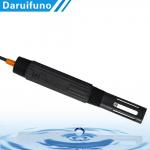
Pipeline Installation 60℃ ABS Analog Type PH Probe For Pure Water |
|
PT1000 /PT100 Temp. Compensation PH Sensor For Wastewater |