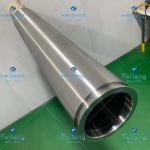
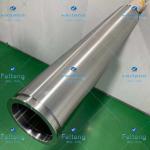
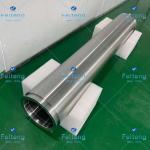
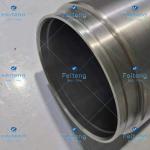
Stainless Steel Tube Target 155OD*125ID*888L Steel 304 Seamless
Tube Vacuum Coating Target
| Item name | Stainless Steel Tube Target |
| Size | φ155*φ125*888 |
| Grade | Gr1 |
| Packaging | Vacuum package in wooden case |
| Port of place | Xi'an port, Beijing port, Shanghai port, Guangzhou port,
Shenzhen port |
Stainless steel is often divided into: martensitic steel, ferrite
steel, austenitic steel, austenitic - ferrite (duplex) stainless
steel and precipitation hardening stainless steel. In addition, can
be divided into: chromium stainless steel, chromium nickel
stainless steel and chromium manganese nitrogen stainless steel.
Chromium 15% ~ 30%. Its corrosion resistance, toughness and
weldability improve with the increase of chromium content, chloride
stress corrosion resistance is better than other types of stainless
steel, belonging to this category are Crl7, Cr17Mo2Ti, Cr25,
Cr25Mo3Ti, Cr28 and so on. Ferritic stainless steel because of high
chromium content, corrosion resistance and oxidation resistance are
better, but the mechanical properties and process properties are
poor, mostly used for the force is not acid-resistant structure and
used for oxidation resistance steel. This kind of steel can resist
the corrosion of atmosphere, nitric acid and saline solution, and
has the characteristics of high temperature oxidation resistance,
low thermal expansion coefficient, used in nitric acid and food
factory equipment, but also can make parts working at high
temperature, such as gas turbine parts.
Vacuum coating refers to heating metal or non-metal materials under
high vacuum conditions, so that it evaporates and condenses on the
surface of plated parts (metal, semiconductor or insulator) and
forms a film in a method.
Vacuum coating is an important aspect in the field of vacuum
application. It is based on vacuum technology, using physical or
chemical methods, and absorbing a series of new technologies such
as electron beam, molecular beam, ion beam, plasma beam, radio
frequency and magnetic control, providing a new process for the
preparation of thin films for scientific research and practical
production. To put it simply, the metal, alloy or compound in
vacuum evaporation or sputtering, so that it is coated in the
object (called substrate, substrate or matrix) on the
solidification and deposition method, called vacuum coating.
Advantages:
1, high conductivity
2. Good thermal conductivity
3, good weldability
4, excellent plasticity and ductility
5, excellent cold working performance
6. Customized according to the drawings required by customers