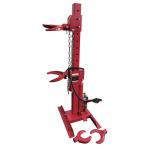
The YD23-005 1650LBS Hand Hydraulic Spring Compressor is a
lightweight equipment developed to address the pain points of
"difficult portability, tiring force application, and scenario
limitations" in small spring maintenance. With "1650LBS stable load-bearing + single-person portability + no
external dependence" as the core, it breaks through the limitations of traditional
compressors, which are "heavy (mostly over 30kg), energy-dependent,
and difficult to operate in small spaces". It provides a "portable,
labor-saving, and flexible adaptation" solution for small-scenario
spring processing. Its core advantages are as follows: With a net weight of only 22kg (equivalent to the weight of a 25kg
bag of rice), it is equipped with an anti-slip handle on the top of
the fuselage. An adult male can lift it with one hand for 50 meters
without pressure: For example, during automotive emergency rescue,
maintenance personnel can directly lift the equipment from the
rescue vehicle trunk to the faulty vehicle without assistance;
during home DIY maintenance, it can be easily taken out of the
toolbox. Compared with heavy equipment of the same function (over
35kg), its portability is increased by 59%, completely getting rid
of the problem of "unmovable equipment and limited scenarios". With a packing size of 60×19×25cm, it can be placed upright in a
home storage cabinet (with a thickness of ≥20cm) or horizontally
under the trunk partition of a car, occupying a space equivalent to
only 2 suitcases. When the workstation of a small auto repair shop
is tight, the equipment can be stored in the tool cabinet at any
time without occupying the workbench. Compared with traditional
floor-standing equipment (occupying ≥0.1㎡), the space utilization
rate is increased by 71%, adapting to scenarios with limited space
such as "small workshops, homes, and emergency rescue". Adopting a "hand hydraulic booster rod + one-way valve" design,
high-pressure output can be achieved without strong pressing: - Fix the spring at the anti-slip contact position and confirm that
the parameters are adaptable;
- Press the hydraulic rod repeatedly (the pressure increases by 50LBS
each time), and after 10-15 presses, the rated pressure of 1650LBS
can be reached, compressing the spring from 260mm to 100mm;
- After compression, open the pressure relief valve to reset slowly.
The operation steps are simple and can be learned in 5 minutes.
The operating force is only 40N (equivalent to the pressure of a
4kg weight), which can be easily operated by women or middle-aged
and elderly users. It is 50% more labor-saving than pure mechanical
wrenches (requiring two hands to twist), and no obvious fatigue is
felt after continuously compressing 8 springs.
No external power supply/air source is required, and it can operate
with manual drive: It can be used in scenarios such as outdoor
emergency rescue (no power supply), maintenance in remote areas (no
air source), and home DIY (no professional equipment). For example,
when maintaining small springs of a RV during outdoor camping, only
the equipment itself needs to be carried. Compared with
electric/pneumatic equipment (energy-dependent), the applicable
scenarios are expanded by 100%, truly realizing "spring maintenance
anytime and anywhere". The adaptation range of compressed spring diameter 100-200mm can
cover most small springs: From hardware toy springs with 100mm
diameter to automotive seat adjustment springs with 200mm diameter,
no fixture replacement or component adjustment is needed, and
compression can be performed by direct fixation. Compared with
equipment of dedicated sizes (only adapting to one diameter), the
accessory cost is reduced by 100%. Small repair shops do not need
to prepare multiple sets of equipment, and one set can meet daily
needs. - Overload Protection: The hydraulic safety valve automatically relieves pressure when
the spring resistance exceeds 1650LBS. For example, if an oversized
spring with 210mm diameter is mistakenly compressed, the equipment
stops pressurizing automatically, avoiding spring burst injury or
hydraulic rod bending;
- Anti-Slip and Anti-Scratch: The rubber anti-slip pad can not only fix the spring but also
prevent the metal equipment from scratching the spring surface
(especially suitable for electroplated springs). Compared with
unprotected equipment, the component protection rate is increased
by 95%, and the spring appearance is undamaged after maintenance,
leading to higher customer satisfaction.
Scenario Requirement: Replace the seat adjustment spring of BYD F3 (compressed spring
diameter 150mm, length 260mm), requiring portable operation and
small-space operation. The auto repair shop handles 5-8 vehicles
daily.
Operation Process: - The maintenance worker lifts the equipment (22kg) to the
workstation with one hand, fixes the spring at the anti-slip
contact position, and confirms parameter adaptation.
- Press the hydraulic rod repeatedly 12 times, compressing the spring
from 260mm to 100mm in 15 seconds. Both hands assist in removing
the old spring and installing the new one.
- Open the pressure relief valve to reset. The whole process takes 25
minutes per vehicle, 37.5% more efficient than traditional manual
tools (40 minutes per vehicle). It can be completed by one person,
saving labor.
Result: Portability and labor-saving features are suitable for small auto
repair shops. No fixed workstation is occupied, and it can flexibly
handle small spring maintenance for multiple vehicle models,
increasing daily revenue by 40%.
Scenario Requirement: Rescuing Wuling Hongguang MINI (small shock absorber auxiliary
spring, compressed spring diameter 120mm, length 240mm) outdoors,
requiring power-free operation and easy-to-carry equipment, with
rescue time ≤1 hour.
Operation Process: - The rescue worker takes the equipment out of the trunk (gross
weight 23kg, no tools needed for unpacking) and fixes the spring
on-site.
- Press the hydraulic rod 10 times manually, completing compression
in 12 seconds. Replace the broken spring and release pressure
slowly.
- The rescue is completed in 40 minutes. After use, the equipment is
directly put back into the trunk without affecting the storage of
other rescue tools.
Result: Energy independence and portability are suitable for outdoor
rescue. Compared with power-dependent equipment (unusable
outdoors), the practicality is increased by 100%, ensuring the
timeliness of rescue.
Scenario Requirement: Repair hardware tool return springs (compressed spring diameter
100-180mm, length 220-260mm), handling 30 pieces daily. The
workshop has a small space (only 8㎡) and requires easy storage of
equipment.
Operation Process: - The worker places the equipment on a 1㎡ workbench without fixation,
directly fixes the spring and presses the hydraulic rod.
- Soft springs (such as door lock return springs) take 10 seconds per
piece, and hard springs (such as small mechanical springs) take 20
seconds per piece. 25 pieces are processed per hour, and the daily
task is completed in 2 hours.
- After operation, the equipment is put into the storage box under
the workbench (the 60×19×25cm size fits exactly), without occupying
operation space.
Result: Small volume and high efficiency are suitable for small
workshops. Compared with large equipment (space-consuming and
inefficient), the daily handling capacity is increased by 50%,
while reducing the pressure of site rent costs.
Scenario Requirement: Home maintenance of bicycle shock absorber springs (compressed
spring diameter 110mm, length 230mm) or furniture hardware springs,
requiring simple operation and safe equipment, without professional
maintenance experience.
Operation Process: - Take the equipment out of the home toolbox and fix the spring
according to the steps in the manual (the graphic guide is clear
and can be understood in 5 minutes).
- Press the hydraulic rod with one hand (small operating force, easy
for women to operate), compress the spring in 18 seconds, and
release pressure to reset after maintenance.
- After use, the equipment is put back into the toolbox, no debugging
is needed for the next use. Compared with hiring a professional
repair shop (with a one-time fee of 50-100 yuan), long-term costs
are saved.
Result: Easy operation and safety are suitable for home scenarios,
meeting the needs of daily small spring maintenance, while
cultivating DIY ability and reducing maintenance expenses.
A1: Compression is not recommended, as it will trigger overload
protection and pose safety risks. The equipment is rated to adapt to compressed spring diameter
100-200mm, and a 210mm spring exceeds the adaptation range. Forced
compression will cause the hydraulic safety valve to relieve
pressure frequently, making it impossible to compress the spring to
the target length. Continuous overload will accelerate the aging of
hydraulic seals, increasing the risk of hydraulic oil leakage, and
the service life of the equipment will be reduced from 3 years to 1
year; at the same time, oversized springs may not be fully fixed
and are prone to deviation and ejection during compression, causing
hand scratches. A device with a load of over 2000LBS and adaptation
to larger diameters is required for compressing springs over 210mm. A2: It is mostly caused by insufficient hydraulic oil, oil circuit blockage, or insufficient
lubrication of the hydraulic rod. Troubleshoot in the following steps: - Check the hydraulic oil level: Open the micro oil filling port on
the top of the equipment (needs to be disassembled with a small
wrench). If the oil level is below the scale line (needs to cover
1/2 of the hydraulic pump bottom), add special micro hydraulic oil
(32# anti-wear hydraulic oil is recommended, with a single addition
≤50ml). After adding, press the hydraulic rod repeatedly 5 times to
discharge air from the oil circuit;
- Clean the oil circuit blockage: If the oil level is normal,
disassemble the micro oil pipe connecting the hydraulic rod and the
pump body, blow out internal impurities (such as metal debris,
dust) with compressed air (0.2MPa), or rinse with alcohol and dry
before reassembling to ensure the oil circuit is unobstructed;
- Lubricate the hydraulic rod: If there is a stuck feeling when
pressing the hydraulic rod, apply a small amount of lithium-based
grease (only a thin layer) on the rod surface, push and pull the
hydraulic rod repeatedly 10 times to reduce frictional resistance
and restore pressing smoothness.
A3: One person can reduce the burden through correct carrying methods + auxiliary tools. The specific tips are as follows: - One-hand lifting posture: Hold the anti-slip handle on the top of
the equipment (located at the center of gravity), let the arm hang
naturally, avoid shrugging or tensing the arm. When walking, gently
lift the equipment with the help of the body's swinging inertia.
Change hands every 20 meters to reduce fatigue of the single arm.
This method allows continuous carrying for 100 meters without
obvious discomfort;
- Use a portable cart: If the carrying distance exceeds 200 meters
(such as from the community gate to the garage), place the
equipment on a folding cart with a load capacity ≥30kg (the size of
a supermarket shopping cart) and push it with one hand, no manual
lifting is needed, saving 90% of physical strength;
- Fixation in the car: When placing it in the car trunk, fix the
equipment to the side of the trunk with a seat belt or storage rope
to avoid bumping and collision during driving, without affecting
the storage of other items.
A4: It is mostly caused by aging of hydraulic seals, impurity blockage of the one-way valve,
or deterioration of hydraulic oil. The solutions are as follows: - Replace the seals: Disassemble the hydraulic pump body, take out
the internal micro seal ring (the manufacturer can provide spare
parts, priced at 15-20 yuan/set), replace it with a new seal ring
(pay attention to the installation direction to avoid seal failure
due to reverse installation). After reassembly, add new hydraulic
oil and test the pressure relief;
- Clean the one-way valve: If the pressure relief is still fast with
intact seals, disassemble the one-way valve core, wipe the
impurities on the core surface with a fine cotton swab dipped in
alcohol, ensure the core can close flexibly, and avoid the core
from being unable to seal due to impurities;
- Replace the hydraulic oil: If the hydraulic oil has been used for
more than 1 year (or turns turbid), drain the old oil and add new
32# anti-wear hydraulic oil (the addition amount is subject to the
scale line, not too much). Discharge the air from the oil circuit
and try again. It is recommended to replace the hydraulic oil once
a year, and new oil should also be replaced before long-term
storage;
- Storage maintenance: When not in use for a long time, compress the
equipment to
|