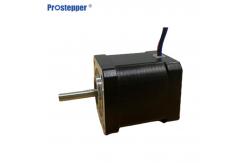
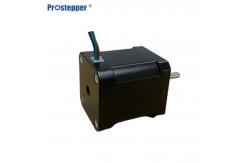
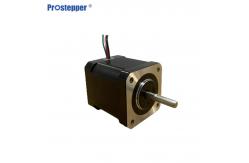
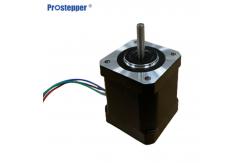
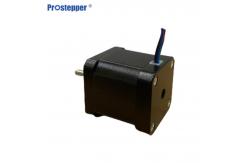
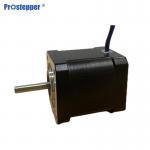
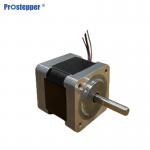
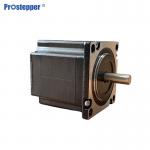
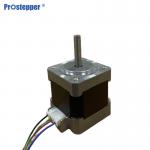
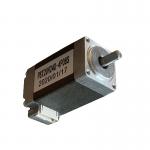
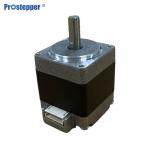
2 phase 1.8 degree 42mm hybrid NEMA17 black automatic stepper motor control for CNC Machine
Nema 17 automatic stepper motor - 1. Online testing of technical parameters to ensure the consistency
of data product parameters
- 2. Longer Life
Stepping motor is a mechanical structure,which does not need be
changed by electric brush or Hall sensor,thus reducing the
probability and increasing the motor life.Stepping motor life
usually determined by the life of the bearing. - 3. Stepper motors are economical, accurate, and easy to control,
and they can operate reliably in a variety of environments
(depending on the level of protection IP chosen) preferably in
machines with additional enclosures or in clean environments
- Forward/Reverse Rotation,Pause and Hold
- 4. Mechanical size 100% meet the requirements, to ensure that there
is no greater error in the use process
- 5. The forward /reverse rotation of the stepping motor can be
controlled by the input sequence of the controlled electric pulses.
- In the case of the a stepping motor lock(the motor winding is
energized,there is no external electric pulse command),the stepping
motor can still maintain a certain torque output.
| Mode No | PST42H231-4P06 | PST42H231-4P12
| PST42H235-4P06 | PST42H235-4P12 | | Holding Torque | 0.16N.m | 0.16N.m | 0.25N.m | 0.25N.m | | Related Current | 0.6A/Phase | 1.2A/Phase | 0.6A/Phase | 1.2A/Phase | | Resistance | 6.6 Ω/Phase | 1.8Ω /Phase | 8Ω/Phase | 2.1Ω/Phase | | Inductance | 9.5MH/Phase | 2.4MH/Phase | 15.2MH/Phase | 3.9MH/Phase | | Inertia | 23g.cm2 | 23g.cm2 | 35g.cm2 | 35g.cm2 | | Weight | 0.2kgs | 0.2kgs | 0.24kgs | 0.24kgs | | Length | 31mm | 31mm | 35mm | 35mm | | Connection | P | P | P | P | | Mode No | PST42H241-4P12 | PST42H241-4P20
| PST42H249-4P12 | PST42H249-4P20 | | Holding Torque | 0.4N.m | 0.4N.m | 0.48N.m | 0.48N.m | | Related Current | 1.2A/Phase | 2A/Phase | 1.2A/Phase | 2A/Phase | | Resistance | 2.5 Ω/Phase | 1.05Ω /Phase | 3.1Ω/Phase | 1.35Ω/Phase | | Inductance | 5.5MH/Phase | 2MH/Phase | 8MH/Phase | 2.9MH/Phase | | Inertia | 54g.cm2 | 54g.cm2 | 77g.cm2 | 77g.cm2 | | Weight | 0.3kgs | 0.3kgs | 0.36kgs | 0.36kgs | | Length | 41mm | 41mm | 49mm | 49mm | | Connection | P | P | P | P | | Mode No | PST42H261-4P12 | PST42H261-4P20 | | | Holding Torque | 0.72N.m | 0.72N.m | | | Related Current | 1.2A/Phase | 2A/Phase | | | Resistance | 2.5 Ω/Phase | 1.75Ω /Phase | | | Inductance | 11MH/Phase | 4MH/Phase | | | Inertia | 110g.cm2 | 110g.cm2 | | | Weight | 0.5kgs | 0.5kgs | | | Length | 61mm | 61mm | | | Connection | P | P | |
Specifications - Stepper Motor Control by Varying Clock Pulses
- Stepper motor control circuit is a simple and low-cost circuit,
mainly used in low power applications. The circuit is shown in the
figure,
-
- A stepper motor is an electromechanical device it converts
electrical power into mechanical power. Also, it is a brushless,
synchronous electric motor that can divide a full rotation into an
expansive number of steps. The motor’s position can be controlled
accurately without any feedback mechanism, as long as the motor is
carefully sized to the application. Stepper motors are similar to
switched reluctance motors.
-
- The stepper motor uses the theory of operation for magnets to make
the motor shaft turn a precise distance when a pulse of electricity
is provided. The stator has eight poles, and the rotor has six
poles. The rotor will require 24 pulses of electricity to move the
24 steps to make one complete revolution. Another way to say this
is that the rotor will move precisely 15° for each pulse of
electricity that the motor receives.
Applications:- Industrial Machines – Stepper motors are used in automotive gauges and machine tooling
automated production equipment.
- Security – new surveillance products for the security industry.
- Medical – Stepper motors are used inside medical scanners, samplers, and
also found inside digital dental photography, fluid pumps,
respirators, and blood analysis machinery.
- Consumer Electronics – Stepper motors in cameras for auto,matic digital camera focus
and zoom functions.
Q: How to select a suitable motor?
A:If you have motor pictures or drawings to show us, or you have
detailed specs like voltage, speed, torque, motor size, working
mode of the motor, needed lifetime and noise level etc, please do
not hesitate to let us know, then we can recommend suitable motor
per your request accordingly.
Q: Do you have a customized service for your standard motors?
A: Yes, we can customize per your request for the voltage, speed,
torque and shaft size/shape. If you need additional wires/cables
soldered on the terminal or need to add connectors, or capacitors
or EMC we can make it too.
Q: Do you have an individual design service for motors?
A: Yes, we would like to design motors individually for our
customers, but it may need some mould charge and design charge.
Q: Can I have samples for testing first?
A: Yes, definitely you can. After confirmed the needed motor specs,
we will quote and provide a proforma invoice for samples, once we
get the payment, we will get a PASS from our account department to
proceed samples accordingly.
Q: How do you make sure motor quality?
A: We have our own inspection procedures: for incoming materials,
we have signed sample and drawing to make sure qualified incoming
materials; for the production process, we have tour inspection in
the process and final inspection to make sure qualified products
before shipping.
|