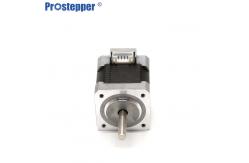
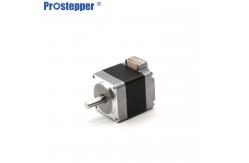
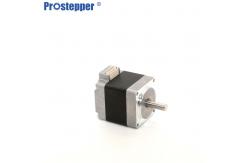
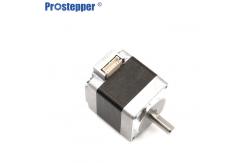
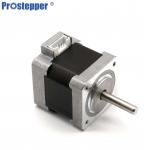
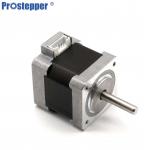
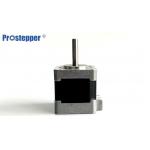
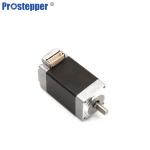
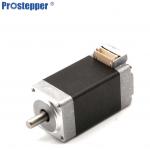
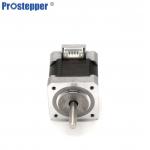
28mm 1.8 degree 2 phase NEMA11 connector stepper motor for 3D
printer - Prostepper motor use of a unique stator the chnology to ensure that
the motor stator teeth grinding and smooth high accuracy of the
hole, the work of the process of speed stability is not lose step
- Prostepper motorcoil is made of 100% pure copper enameled wire ,
advanced winding threading process, copper wire is evenly arranged,
good overall motor stability , the long time does not appear
deformation and noise and so on.
- High quality motor steel, the load on the shaft can produce high
torque the inertia ratio, and can eliminate, the system error due
to the use of reduction gears
General specifications | Specification | Motor Characteristics | | Insulation Class | Class B130°C | | Step Angle Accuracy | ±0.09° | | Withstand Voltage | AC500V (one minute) | | Insulation Resistance | 100MQ MIN. 500VDC | | Temperature Rise | 80*C MAX | | Radial Play | 0.025mm Max. (Load450g) | | Axial Play | 0.075mm Max. (Load950g) | | | Temperature | -10~+50°C (Non Condensing) | | Operating Environment | Humidity | 85%RH MAX. (Non Condensing) | | Medium | No corrosive gas or dust. Not directly in contact with water, oil,
etc. | | Storage Environment | Temperature | 0~+50°C (Non Condensing | | Humidity | 85%RH MAX. (Non Condensing) | | Life | 5000 Hours MIN. |
Radial Load&Axial Load | Motor Size | Shaft Diameter (mm) | Radial Load (N) | Axial Load (N) | | Distance from Mounting Surface (mm) | | 5 | 10 | 15 | 20 | 25 | 30 | 35 | | NEMA8 | 4 | 15 | 12 | | | — | | | 3 | | NEMA 11 | 5 | 50 | 35 | 25 | | — | | | 5 | | NEMA 14 | 5 | 50 | 35 | 25 | 20 | — | — | — | 10 | | NEMA 17 | 5 | 50 | 35 | 25 | 20 | — | — | | 15 | | NEMA 23 | 8 | 270 | 180 | 130 | 100 | 90 | | — | 20 | | NEMA 24 | 8 | 200 | 135 | 100 | 82 | 58 | — | — | 30 | | NEMA 34 | 14 | 620 | 550 | 480 | 390 | 340 | 290 | 260 | 60 |
Encoder stepper motor of Specifications Model: PEM28H251E2KzS | Holding Torque | 0.14N.m | | Related Current | 1.5A/Phase | | Resistance | 3.5Ω/Phase | | Inductance | 3.1MH/Phase | | Inertia | 18g.cm² | | Index | √ | | Output | Differental | | Encoder Resolution | 2000CPR
|
- · high precision
- · high torque
- · durable
- · medium size
- · Stepping Accuracy: ± 5%
- · Resistance Accuracy: ± 10%
- · Inductance Accuracy: ± 20%
- · Temperature Rise: 80°C Max.
- · Ambient Temperature: -20°C ... +50°C
- · Insulation Resistance: 100MOhm min. 500V DC
- · Withstand: 500V AC, 1 Minute
Product description of encoder connector stepper motor Accurate position Control The angular displacement of the stepping motor can be precise
controlled by the number of electrical pulses.Angle accuracy can be
controlled within ±0.09°without any feedback devices. High reliability, easy maintenance.Motor rotor structure accurate,
no loss of step.Rotor special material, not stuck machine. Longer Life Stepping motor is a mechanical structure,which does not need be
changed by electric brush or Hall sensor,thus reducing the
probability and increasing the motor life.Stepping motor life
usually determined by the life of the bearing. Strictly control the production of parts to improve the quality of
parts The Fulling product line is sold to major manufacturing Companies
for Industry of automation, medical andhealth care equipment,
printer machine, packing device,Information Technology,household
appliance,product, AGV and automobile.
Encoder connector stepper motor Application Computer controlled stepper motors are a type of motion-control
positioning system. They are typically digitally controlled as part
of an open loop system for use in holding or positioning
applications.
In the field of lasers and optics they are frequently used in
precision positioning equipment such as linear actuators, linear
stages, rotation stages, goniometers, and mirror mounts. Other uses
are in packaging machinery, and positioning of valve pilot stages
for fluid control systems.
Commercially, stepper motors are used in floppy disk drives,
flatbed scanners, computer printers, plotters, slot machines, image
scanners, compact disc drives, intelligent lighting, camera lenses,
CNC machines and, more recently, in 3D printers. |