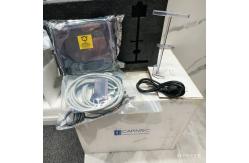
High-Accuracy Hot Cell Dose Calibrator for PET and SPECT Tracers
Product Introduction
The High-Accuracy Hot Cell Dose Calibrator is specifically
optimized for the unique demands of PET (positron emission
tomography) and SPECT (single-photon emission computed tomography)
tracer preparation. PET isotopes such as F-18 (half-life 110
minutes), Ga-68 (68 minutes), and Cu-64 (12.7 hours) require rapid,
accurate measurement because their short half-lives mean that even
brief delays result in significant decay correction calculations.
This dose calibrator combines fast response time — stable readings
in under 3 seconds — with high accuracy (±3% for PET isotopes) to
ensure that each patient receives the prescribed activity at the
time of injection. The instrument is equally capable for SPECT
tracers including Tc-99m (6 hours) and I-123 (13.2 hours), where
measurement precision directly impacts image quality and diagnostic
accuracy.
Application Range
This calibrator is designed for PET/CT departments, SPECT/CT
departments, and hybrid imaging centers that use both modalities.
Primary applications include measuring F-18 FDG doses for oncology
imaging, quantifying Ga-68 DOTATATE for neuroendocrine tumor
imaging, and verifying Cu-64 tracer activity for PET studies of
copper metabolism. For SPECT applications, the calibrator measures
Tc-99m eluates from generators, verifies Tc-99m-labeled compounds
(MDP, sestamibi, MAG3, etc.), and quantifies I-123 NaI capsules for
thyroid imaging. The instrument also supports theranostic
applications where PET isotopes are used for treatment planning
before therapy with Lu-177, Y-90, or Ac-225. Additional
applications include measuring radiolabeling yield during tracer
synthesis, verifying activity concentrations for quality control
samples, and performing decay correction calculations for
time-delayed imaging protocols.
Performance and Benefits
The High-Accuracy Hot Cell Dose Calibrator achieves measurement
stability in as little as 2 seconds for F-18 — critical for PET
workflows where each minute of measurement time reduces the
activity available for the patient due to radioactive decay. For
example, a 5-second measurement delay in an F-18 dose might seem
trivial, but over 50 doses per morning, the cumulative decay loss
could be equivalent to an entire patient dose. The fast response of
this instrument maximizes the useful activity delivered to
patients. The calibrator's accuracy for PET isotopes is enhanced by
energy-compensated electronics that correctly account for the
annihilation radiation produced by positron-emitting isotopes. Many
standard dose calibrators over-respond or under-respond to these
high-energy photons, but this instrument's optimized calibration
yields ±3% accuracy for F-18, Ga-68, and other PET emitters. The
instrument includes a built-in decay correction calculator: the
user enters the desired activity and administration time, and the
calibrator displays the required current activity. This feature
eliminates manual decay correction calculations, which are a common
source of dosing errors in busy PET centers. For SPECT isotopes,
the calibrator maintains ±5% accuracy across activities from 0.1
mCi to 10 Ci. The auto-ranging function automatically selects the
appropriate measurement range, and the nuclide-specific calibration
ensures that a Tc-99m reading of 20 mCi correctly reflects the
actual activity. The remote display shows both the current
measurement and the decay-corrected activity at the planned
administration time, allowing the technologist to confirm that the
dose will be correct for the patient's appointment slot. The
instrument includes data logging and printer output for dose
records, and its corrosion-resistant chamber withstands daily
decontamination. For nuclear medicine departments, the key benefits
are improved patient care through precise dosing, reduced waste
because less radiopharmaceutical is discarded due to measurement
errors, and faster workflow that allows more patients to be
scheduled. The calibrator's optimized performance for PET tracers
makes it particularly valuable for high-volume centers