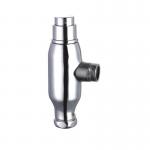
To identify a brass ball valve for water, you can follow these
steps:
Look for the material: Brass ball valves are typically made of
brass, which has a golden or yellowish appearance. Check the body
of the valve to see if it has a brass color.
Check for labeling or markings: Many brass ball valves have labels
or markings that indicate their material. Look for words such as
"brass," "brass ball valve," or "BRS" (which stands for brass).
Examine the construction: Brass ball valves consist of a spherical
brass ball with a hole in the middle and a lever or handle attached
to it. The lever or handle is used to control the flow of water by
rotating the ball inside the valve.
Consider the weight: Brass is a relatively heavy material compared
to plastic or other lightweight materials. When you hold the valve
in your hand, it should feel substantial and heavier than plastic
valves.
Consult a professional: If you're uncertain about identifying a
brass ball valve, it's always a good idea to seek advice from a
professional plumber or someone with experience in plumbing. They
can help you determine the type of valve you have.
Remember that brass ball valves are commonly used for water
applications due to their durability and resistance to corrosion.
They are often found in plumbing systems, irrigation systems, and
other water control applications.
How use brass ball valve
Familiarize yourself with the valve: Take a moment to understand
the different parts of the brass ball valve. It typically consists
of a handle or lever, a body, a ball with a bore through it, and
inlet and outlet ports.
Determine the valve position: The brass ball valve can be in either
the open or closed position. When the handle is parallel to the
pipe, it indicates that the valve is open, allowing fluid to flow.
When the handle is perpendicular to the pipe, it signifies that the
valve is closed, blocking the flow of fluid.
Open the valve: If the valve is closed, rotate the handle or lever
in a quarter-turn or 90-degree motion, aligning it parallel to the
pipe. This position opens the valve, allowing the fluid to pass
through.
Close the valve: If the valve is open, rotate the handle or lever
in a quarter-turn or 90-degree motion, aligning it perpendicular to
the pipe. This position closes the valve, stopping the flow of
fluid.
Adjust the flow: Depending on the design of the brass ball valve,
you may have the option to partially open or close the valve to
control the flow rate. You can do this by rotating the handle to a
position between fully open and fully closed.
Inspect for leaks: After opening or closing the valve, inspect the
surrounding area for any signs of leakage. If you notice any leaks,
ensure the valve is closed properly or consider replacing any
faulty components.
Brass Ball Valve Package
OEM Logo Polybag, Colour Boxs, Colour Master Carton
FAQ
Q: How long is your product guarantee period?
A: We have Two years guarantee and 24 hours full-time service.
Q: What is your MOQ?
A: Normal Each Items 3000pcs MOQ.
Q: Can you accept OEM,ODM?
A: we accpet OEM.
Q: How long is your delivery time?
A: 30-35 days After Confirm Order