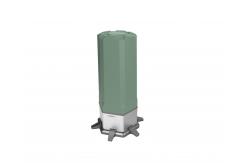
I. Fixed Deployment, Long-Term Stable Operation This fixed signal detection and blocking equipment adopts
rack-mounted or wall-mounted deployment methods, suitable for
long-term fixed scenarios such as border protection, perimeter of
important facilities, airports and ports, energy bases, and
communication support areas. The system supports 24/7 continuous
operation and features industrial-grade components and a
high-efficiency heat dissipation structure, enabling stable
operation in high-temperature, low-temperature, humid, and dusty
environments. The equipment has a built-in intelligent power
management and health monitoring module that can monitor
temperature, voltage, and operating status in real time,
automatically alarming or entering protection mode in abnormal
situations to ensure long-term operational reliability. It also
supports remote maintenance and online upgrades, reducing the
frequency of manual maintenance and improving overall system
availability and operational efficiency. II. Product Technical Parameters | Parameter Item | Technical Specifications |
|---|
| Detection Range | 300MHz-6G | | Key Detection Frequency Bands | 2.4G/5.8G/400MHz/800MHz/900MHz/1.4GHz | | Detection Range | 1-3KM | | Interference Frequency Bands | 900M1.5G2.4G5.2G5.8G | | Interference Range | > 1-2KM | | Response Time | ≤3s | | Spoofing Signal System | GPS/BDS/GLONASS/Galileo | | Spoofing Range | 1-3KM | | Product Dimensions | 450*450X*850mm | | Packaging Dimensions | 960*530*455mm | | Product Weight | 15KG | | Total Product Weight | 42KG |
III. Support for Navigation Spoofing Function The system has a built-in high-precision navigation spoofing
module, which can implement controllable signal generation and
guidance functions for mainstream satellite navigation systems. The
device analyzes target signal characteristics in real time to
generate matching pseudo-navigation information, guiding the target
terminal through path deflection, position shifting, or area
induction, thereby achieving effective control over suspicious
devices. The navigation deception function supports multiple
configuration modes, including fixed-point guidance, path traction,
and dynamic area guidance, and the deception intensity and strategy
can be flexibly adjusted according to the application scenario. The
system employs time synchronization and phase control technology to
ensure stable and reliable deception signals while avoiding
unnecessary interference with legitimate devices, improving task
execution accuracy and security. IV. Modular Structure for Easy Expansion The device adopts a modular architecture design, consisting of a
signal detection module, blocking module, navigation deception
module, control module, and power supply module. Each functional
unit is independently pluggable and quickly replaceable. Users can
flexibly configure different frequency band modules according to
task requirements to achieve functional expansion and upgrades.
Modules are connected via a high-speed backplane bus to ensure
stable data transmission and low latency. This structure not only
shortens maintenance time but also facilitates the addition of new
frequency bands or new functional modules, reducing system upgrade
costs. It also supports multi-device cascading deployment to build
a regional collaborative protection network, improving overall
coverage and system scalability. V. Integrated Signal Detection and Interception This equipment deeply integrates signal detection, identification
analysis, and active blocking functions, achieving a unified
operational process from target detection to response. The system
can automatically scan and identify target signal characteristics,
classify and prioritize abnormal signals, and automatically
activate blocking or navigation deception functions according to
preset strategies. Users can also manually intervene through the
control platform for refined management. The equipment supports
multi-channel parallel processing capabilities, enabling
simultaneous monitoring and handling of multiple targets,
significantly improving protection efficiency in complex
environments. The integrated design reduces the number of systems
deployed, lowers construction costs, and simultaneously improves
overall response speed and task execution reliability. |