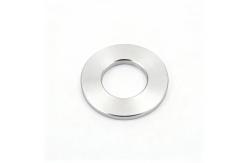
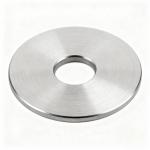
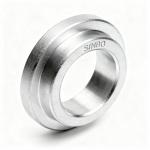
Encoder Code Disk Fixing Ring for Humanoid Robots: Precision CNC
Machining China Solution The encoder code disk fixing ring is a critical precision component in humanoid robot rotary actuators, specifically designed to securely mount and protect the encoder code disk. Within the robot joint module, this fixing
ring engages with the encoder readhead base through an interference fit method, maintaining a constant gap (typically controlled within 0.1-0.3mm range) between the code
disk and readhead, preventing displacement deviations caused by
vibration or temperature changes. Our fixing rings are manufactured
using CNC precision machining technology in China, with strict dimensional tolerance control (typically
maintained within ±0.005mm) and dynamic balance testing, ensuring
no vibration noise is introduced in high-speed rotation
environments (up to 10,000 RPM). As the core positioning element of the encoder system, the machining quality of the fixing ring
directly affects the accuracy of position feedback signals. We use aerospace-grade aluminum alloy material (7075-T6) and special surface hardening treatment processes,
enabling the product to achieve both lightweight (density only
2.8g/cm³) and high strength (tensile strength up to 572MPa)
characteristics, capable of withstanding impact loads from frequent
start-stop operations of robot joints. The product surface
undergoes anodizing treatment (black) with laser engraving of "SINBO" identification, ensuring
both aesthetics and excellent corrosion resistance. Key Features - Precision Machining with Strict Tolerances: Our encoder code disk fixing rings are manufactured using CNC precision machining technology in China, ensuring dimensional tolerances are strictly controlled
within ±0.005mm. This precision machining guarantees the
cooperation accuracy between the fixing ring and code disk,
avoiding code disk shaking or readhead gap不均匀 caused by dimensional
deviations. The fixing ring's roundness error is less than 0.003mm,
ensuring excellent dynamic balance performance during high-speed rotation, reducing vibration and noise.
- High Stability and Reliability: The fixing ring employs a thermal expansion coefficient matching design, ensuring consistent expansion rates between the metal ring and
glass/metal code disk during temperature changes, preventing
cooperation loosening or stress accumulation due to temperature
fluctuations. The product undergoes rigorous environmental adaptability testing, including temperature cycling (-40℃ to +85℃), vibration testing
(5-2000Hz frequency range), and endurance testing (over 10 million
insertion-extraction cycles), ensuring stable performance in
various harsh environments.
- Premium Materials and Surface Treatment: We select aerospace-grade aluminum alloy 7075-T6 as the base material, known for its excellent strength-to-weight
ratio (tensile strength 572MPa, density only 2.8g/cm³) and good
machinability. The surface undergoes hard anodizing treatment (thickness 25±5μm), forming a hard, wear-resistant, insulating
oxide layer with surface hardness up to HV400, significantly
improving the product's wear and corrosion resistance.
- Design Optimization and Integration Convenience: The fixing ring features a hollow lightweight design, ensuring structural strength while minimizing weight
(approximately 60% lighter than traditional stainless steel),
helping reduce the rotational inertia of robot joints and improve
dynamic response speed. The product design considers installation convenience, providing specialized installation guidance structures and
error-proofing designs, making the assembly process more efficient
and less prone to code disk damage.
- Strict Quality Control and Testing: Each fixing ring undergoes 100% full inspection, including dimensional measurement, appearance检查, dynamic balance
testing, and material verification, ensuring only qualified
products are delivered to customers. We establish a complete product traceability system, with each part having a unique batch number identifier that
traces the entire quality information process from raw materials to
finished products.
Technical Parameters | Parameter Category | Technical Specifications | Test Standard |
|---|
| Base Material | Aerospace Aluminum Alloy 7075-T6 | ASTM B209 | | Surface Treatment | Hard Anodizing (Black), Thickness 25±5μm | MIL-A-8625 | | Inner Diameter | 6mm, 8mm, 10mm, 12mm (Customization Available) | N/A | | Outer Diameter | 10mm, 12mm, 15mm, 18mm (Customization Available) | N/A | | Thickness Range | 1.5mm-3.0mm (±0.005mm) | N/A | | Weight (Typical) | 0.5-1.2g (Varies by Size) | N/A | | Operating Temperature | -40℃ to +85℃ | IEC 60068-2 | | Thermal Expansion Coefficient | 23.6*10⁻⁶/℃ (Matched to Glass Code Disk) | ASTM E228 | | Surface Hardness | ≥HV400 (Oxide Film Hardness) | ASTM E384 | | Roundness Error | ≤0.003mm | ISO 1101 | | Parallelism Error | ≤0.005mm | ISO 1101 | | Dynamic Balance Grade | G1.0 (at 10,000 RPM) | ISO 1940-1 | | Tensile Strength | 572MPa | ASTM E8 | | Yield Strength | 503MPa | ASTM E8 | | Corrosion Resistance | 500 Hours Salt Spray Test Without Corrosion | ASTM B117 |
Applications - Humanoid Robot Joint Modules: Encoder code disk fixing rings are widely used in various humanoid
robot rotary joint actuators, particularly in shoulder, hip, and wrist joints that require
precise positioning. In these applications, the fixing ring ensures
accurate positioning of joint motor encoders, providing reliable position feedback for
the robot's complex movements. Optimus humanoid robots require such
precision fixing rings in all 28 degree-of-freedom joints.
- Industrial Robot Precision Reducers: In the industrial robot field, our fixing rings are used in
encoder systems of harmonic reducers and precision planetary reducers. These reducers require extremely high positioning accuracy
(typically within ±1 arc-second), and the stable performance of
fixing rings ensures long-term reliability under high reduction
ratios. Particularly in welding, spraying, and precision assembly
robots, the performance of fixing rings directly affects final
product quality.
- Collaborative Robot Joint Modules: Collaborative robots (Cobots) require smooth movement and precise control of joints due to direct interaction with humans. Our fixing rings
are used in collaborative robot joint modules, ensuring accurate
reading of torque sensors, enabling adaptive force control and collision detection functions. The KIE series hollow absolute encoders use fixing
rings with similar structures.
- Precision Optical Encoder Systems: Beyond robotics, our fixing rings are widely used in various high-precision optical encoder systems, including CNC machine tools, semiconductor equipment,
medical instruments, and aerospace control systems. These
applications require fixing rings with exceptional temperature stability and vibration resistance, which our products achieve through special design and material
selection.
- Servo Motors and Actuators: Modern servo motors and linear actuators commonly use high-resolution encoders as position feedback devices, where our fixing rings play a key
role in encoder assembly. Particularly in frameless torque motors,
fixing rings need to meet both compact size and high precision requirements, which is exactly where our products excel.
Customization Services We provide comprehensive customization services to meet different
customers' special requirements: - Size Customization: We can perform custom production according to customer
requirements for inner/outer diameter sizes and thickness, supporting various specifications from micro sizes (minimum inner
diameter 3mm) to large sizes (maximum outer diameter 50mm). The
tolerance grade of custom products can be adjusted according to
application needs, with the highest reaching ±0.002mm
ultra-precision level.
- Material Selection: In addition to standard aerospace aluminum alloy, we also provide stainless steel series (304, 316, 17-4PH), titanium alloy (TC4), and engineering plastics (PEEK, PVDF) options to meet different application environment
needs. For example, we provide non-magnetic stainless steel
versions for ultra-high vacuum environments, and recommend 316
stainless steel or PEEK materials for strong corrosion
environments.
- Surface Treatment Options: According to different application environments, we provide
various surface treatment options, including ordinary anodizing (multiple colors available), Teflon coating (anti-adhesion), electroless nickel plating (wear resistance), and passivation treatment (stainless steel anti-rust). For applications requiring
insulation, we can provide anodized insulation treatment with surface resistance up to 10⁹Ω or higher.
- Special Function Design: For customers with special requirements, we can integrate temperature sensing elements, grounding springs, or shielding layers on the fixing ring, achieving multiple functions in one component.
We also provide anti-loosening designs, including thread locking, split pin holes, and other solutions to
ensure reliability in extreme vibration environments.
Support and Services We provide customers with comprehensive technical support and
service guarantees: - Technical Consultation and Design Support: Our engineering team provides free technical consultation to help customers select the most suitable fixing ring
specifications and materials. For complex application scenarios, we
can provide custom design services, participating in customers' encoder system design to ensure
optimal matching from the source.
- Sample Provision and Testing Verification: We provide free samples (typically 3-5 pieces) to qualified customers for testing and
verification, helping customers evaluate product performance.
Meanwhile, we can provide complete test reports, including dimensional inspection, material certification, and
environmental test data, facilitating customer quality assessment.
- Mass Production and Delivery: We have a mature supply chain and efficient production system that can guarantee on-time delivery for large-volume orders
(typically 4-6 weeks delivery cycle). We implement strict inventory management, maintaining certain safety stocks for commonly used specification
products to respond to customer emergency needs.
- Quality Assurance and After-Sales Service: All our products come with a 12-month quality guarantee period, during which any problems caused by material or manufacturing
defects can be replaced free of charge. We establish a rapid response mechanism, typically providing initial response and solutions within 24
hours for technical problems reported by customers.
|