
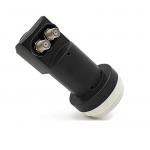
Universal KU Band LNBF ST-K21WA Satellite Single LNB 10.7 - 12.75GHz
|


Detailed Product Description
|
Universal Ku-Band LNBF Input: 10.7~12.75 GHz Technical Specifications
Frequently Asked Questions What is an LNB? An LNB (Low Noise Block, also called LNC - Low Noise Converter) is
used for broadcast satellite reception. The LNB is typically
mounted on the satellite dish and serves to collect and amplify the
satellite signal received from the dish, then down-converts the
signal to a lower, more manageable IF frequency that can be carried
over standard coaxial cabling to the receiver. LNBs are categorized
into C-Band, Ku-Band, and Ka-Band according to their operating
frequency ranges. What is a feedhorn? The feedhorn is a component of the LNB that functions as a
directional horn. It captures signals reflected from the dish and
shields the LNB from receiving extraneous radiation from other
sources. These collected signals are then passed from the horn to
the electronics within the LNB. Feedhorns are classified into
orthogonal feed, offset feed, and elliptical feed types. What is a Monoblock LNB? A Monoblock LNB design incorporates two independent LNBs in a
single housing, enabling reception of signals from two different
satellites at slightly different orbital positions using a single
dish installation. Switching between satellites is achieved via
DiSEqC signals. Monoblock LNBs are primarily available for
satellites with fixed spacing (2°, 3°, 4.3°, or 6°) and cover Ku
band with single, twin, and quad output configurations. For
example, a 2° Monoblock LNB could be used for reception at 5°W and
7°W, or a 3° version for 13°E and 16°E. What is a one cable solution LNB? This LNB type allows connection of multiple set-top boxes (STBs)
through a single RG6 cable, providing an energy-efficient,
multi-user reception solution. This configuration is sometimes
referred to as a stack LNB. What does Unicable mean? Unicable is a modern method for distributing satellite television
signals to multiple receivers (currently supporting up to 32
receivers according to standards EN 50494 & EN 50607). Unicable 1: Refers to SCR LNB, supporting only static working mode. Unicable 2: Supports both static and dynamic working modes. The LNB can be designed with separate Universal and Unicable inputs, such as 1 Universal output + 1 Unicable output, or 1 Universal output + 3 Unicable outputs. |
||||||||||||||||||||||||||||||||||||||||||||||||||
| Product Tags: Universal KU Band LNBF KU Band LNBF 10.7GHz Satellite Single LNB 12.75GHz |
Related Products
|
Universal Twin LNBF ST-K22FA for Ku-Band with 0.7dB Noise Figure, Dual Independent Outputs, and Full 10.7-12.75 GHz Coverage |

|
Universal Ku Band LNBF Single ST-K21WA with 10.7 - 12.75GHz Full Band Coverage, 0.7dB Ultra-Low Noise Figure and Universal Compatibility |

|
Universal Ku-Band Single LNBF ST-K21WN 0.7dB NF, 10.7-12.75GHz, Vertical/Horizontal |

|
Ku-Band Universal Quad LNB 4 Output ST-K24HA Satellite Receiver for Multiroom TV Freesat PVR |

|
ST-K22S PLL Twin LNB - Universal KU Band, Vertical Polarization, Dual Output, Low Noise (12.75GHz) |

|
ST-K22FA PLL Twin LNB - Vertical, Universal Ku Band up to 12.75GHz, Dual Output, High Gain, Low Noise |
Email to this supplier