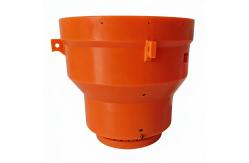
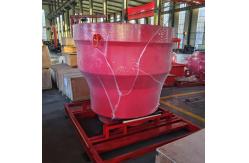
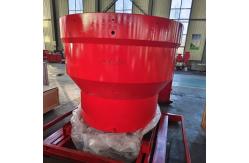
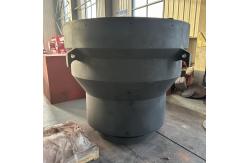
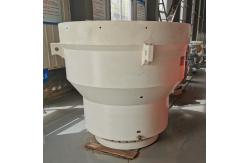
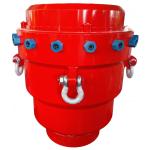
Introduction to Hydril MSP Annular BOP (Diverter) The Hydril MSP Annular Blowout Preventer (BOP) is a core pressure
control device in the drilling process, specially designed for
blowout prevention and control in oil and gas drilling operations.
Strictly complying with API Recommended Practice R.P.53 and NACE
Standard MR-01-75, it features excellent sealing performance, broad
application adaptability, and convenient operation and maintenance.
As an indispensable safety guarantee for onshore and offshore
drilling platforms, it provides reliable support for mitigating
risks such as well kicks and blowouts throughout the drilling
operation. Core Application Scenarios Onshore Drilling Operations - Compatible with various onshore drilling rigs, it can achieve
precise sealing for downhole components such as drill pipes, tool
joints, tubing, casing, and wire ropes with sizes ranging from 3
1/2" to 16". With a rated working pressure of up to 2000 psi (138
BAR), it easily meets the pressure control requirements of drilling
in both conventional and complex formations.
- Suitable for operating environments with water-based, oil-based,
and oil-additive drilling fluids. By selecting sealing units made
of corresponding materials, it can operate stably within the
temperature range of -30 °F (-35 °C) to room temperature, adapting
to onshore drilling projects under different climatic conditions.
Core Technical Features Full-Coverage Sealing Adaptability for Multiple Scenarios - It adopts a reinforced elastomer packing unit. Hydraulically driven
pistons compress the packing unit to achieve effective sealing of
downhole components with different cross-sections, including
circular, square, and hexagonal shapes. There is no need to replace
dedicated sealing parts, which greatly improves operational
flexibility.
- The packing unit has built-in steel segments with upper and lower
flanges, which can effectively restrict rubber extrusion and flow,
avoiding sealing failure under high pressure. Meanwhile, the rubber
material is treated with a special formula, featuring excellent
tear and wear resistance, which can maintain sealing integrity
during long-term dynamic operations.
Well Pressure-Assisted Sealing Design for Enhanced Reliability - Initial sealing is achieved through hydraulic actuation of the
closing chamber. As well pressure or test pressure increases, well
pressure acts on the piston from below the packing unit to further
enhance the sealing force, forming a dual-protection mechanism of
"hydraulic initial sealing + well pressure-assisted reinforcement".
- When well pressure exceeds the critical value, sealing can be
maintained solely by well pressure without additional hydraulic
supply. This not only reduces the operational load of the hydraulic
system but also provides emergency sealing protection in case of
hydraulic system failure, significantly improving safety redundancy
under extreme working conditions.
Dynamic Operation Compatibility for Balanced Efficiency and Safety - While maintaining full sealing, it supports drill pipe rotation and
tool joint stripping operations. Fine-tuning the control pressure
allows for minimal drilling fluid leakage, which not only ensures
sealing effectiveness but also provides lubrication for drill
string movement, reducing friction loss between the packing unit
and the drill string.
- For onshore high-pressure fluctuation scenarios, a buffer absorber
can be configured. Through precise pre-charging design
(pre-charging pressure is 50% of the sealing pressure for onshore
applications), it effectively suppresses impact pressure during
tool joint tripping and running, extending the service life of the
equipment.
Modular Structure Design for Convenient and Efficient Operation
& Maintenance - It offers two head designs: Screwed Head and Latched Head, both
supporting quick disassembly and assembly. The replacement process
of vulnerable parts such as packing units and sealing rings is
simplified without the need for complex special tools.
- It supports packing unit replacement with drill string in the well
during emergency situations. By smoothly cutting the packing unit
between steel segments, replacement can be completed quickly when
there is a drill pipe in the well, greatly reducing downtime and
operational losses.
Precise Material Adaptation for Strong Environmental Resistance - Two material options are available for the packing unit: Natural
Rubber (NR) and Nitrile Butadiene Rubber (NBR). NR is suitable for
water-based drilling fluids, with a minimum service temperature of
-30 °F and a longer service life; NBR is suitable for
oil-based/oil-additive drilling fluids, performing stably in
low-temperature environments below -7 °F. They can be quickly
distinguished by appearance marks (red ribbon for NR, blue ribbon
for NBR).
- The surfaces of key equipment components are anti-corrosion treated
to resist corrosive media such as hydrogen sulfide. Meanwhile,
sealing parts are made of special synthetic rubber materials, which
can effectively resist erosion by oil, gas, water, and other media,
ensuring long-term stable operation in complex drilling
environments.
Storage Specifications - Before storage, the equipment must be completely disassembled,
cleaned, and thoroughly lubricated with non-petroleum-based
lubricants such as castor oil or rapeseed oil to prevent rubber
aging. Flange faces, hub faces, and annular grooves should be
protected with wooden cover plates, and ports should be sealed to
prevent moisture.
- Rubber products (packing units, sealing rings, etc.) should be
stored in a cool, dry, and dark environment with the temperature
controlled at around 65 °F. They should be kept away from heat
sources such as heaters and motors as well as high-voltage
electrical equipment to avoid ozone erosion. During storage, they
should be kept in a natural relaxed state without stretching or
bending. Vacuum-sealed packaging is recommended, and the "first-in,
first-out" principle should be followed.
- Before commissioning after long-term storage, check rubber parts
for aging phenomena such as blooming, skinning, and cracking.
Ensure there are no hidden cracks after stretching and the hardness
meets the standard before use. Replace them directly if there is
any doubt.
| Item | Annular BOP | | Model | Model MSP 29 1/2″-500psi | | Drift diameter | 29 1/2” (749.3mm) | | Rated working pressure | 3.5MPa(500psi) | | Hydrostatic test pressure | 5.7MPa(750psi) | | Hydraulic control rated working pressure | 12MPa(1,714psi) | | Recommended hydraulic control working pressure to close open hole | Sealing of open bore is prohibited. Minimum sealing diameter is 5”
pipe | | Recommended hydraulic control working pressure to seal pipe | 8.3~10.4MPa(1,200~1,500psi) | | Max. working pressure to close open hole | Sealing of open bore is prohibited. Minimum sealing diameter is 5”
pipe | | Max. open volume | No hydraulic line connection is required for the opening chamber;
the piston opens by its own weight. | | Max. close volume | 238L | | Weight | 10820kg | | Shackle lifting weight (t) | 10t | | Temperature ratings for non-metallic materials | BGB(PR1,-18℃~+93℃) | | Temperature ratings for metallic materials | T-20/250(-29℃~+121℃) | Note: BOP should be designed and manufactured according to API Spec 16A. All metallic materials which come in contact with well fluids shall
meet the requirements of NACE MR0175 for sour service. |
|