Key Features and Structural Design
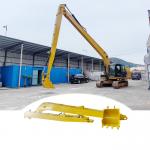
The excavator long arm, also known as a boom extension or
long-reach attachment, is a specialized modification designed to
significantly expand the operational envelope of a standard
excavator. By replacing or extending the original boom and stick,
these attachments allow machinery to achieve working radii ranging
from 10 meters to over 40 meters, depending on the configuration.
The design typically utilizes high-strength low-alloy (HSLA)
steels, such as WELDOX, to maintain structural integrity while
managing weight.
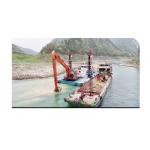
| * Dredging * River Project |
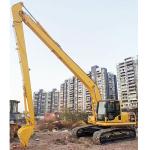
| * Carry Grab for Grabbing Wood * Long Reach |
The structural configurations are generally categorized into three
types based on application requirements:
Two-Stage: This is the most common modification for deep excavation. It
consists of an extended boom and a longer stick. It is primarily
used for slope finishing, deep foundation pit excavation, and river
dredging where horizontal reach and depth are critical.
Three-Stage: Often referred to as a "Demolition Arm," this configuration
includes an additional articulation point (a middle arm). This
allows for greater vertical reach, making it ideal for high-rise
building dismantling (up to 30 meters). It often features a fixed
or hydraulic angle adjustment for the bucket or breaker.
Sliding/Telescopic Arm: Designed for vertical precision, this type allows the arm to
extend and retract telescopically. It is frequently used with a
clamshell bucket for deep, narrow shafts or caisson excavation,
minimizing the footprint of the operation.
Manufacturing Process and Production Details
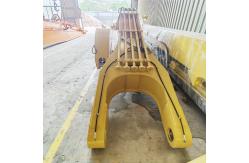
The production of a long arm is a precision engineering task that
goes far beyond simple welding. It requires advanced Computer-Aided
Design (CAD) and Finite Element Analysis (FEA) to simulate stress
distribution and prevent structural failure under load.
Material Selection and Cutting
The manufacturing process begins with the selection of high-tensile
steel plates (often 10-12mm thick for the main plates). Modern
manufacturing utilizes CNC plasma cutting machines to ensure that
the complex geometries of the side plates and internal
reinforcement ribs are cut with millimeter precision. This
precision is crucial for the proper fit-up of internal components.
Welding and Assembly
The assembly phase involves robotic or skilled manual welding. To
ensure durability, manufacturers employ submerged arc welding or
CO2 shielded arc welding for the main seams. The internal structure
is reinforced with buffer plates and box-section designs to resist
torsional forces.
Machining and Finishing
Once the main structure is welded, the boom undergoes stress-relief
treatment (often vibration aging) to eliminate internal stresses
caused by welding heat. The pin holes (bore holes) are then
precision-bored using large horizontal boring mills to ensure
perfect alignment with the excavator's hydraulic cylinders and
linkage. Finally, the unit undergoes shot blasting to remove rust
and mill scale, followed by the application of anti-corrosive
primer and topcoat.
Frequently Asked Questions (FAQ)
Q1: What are the maintenance requirements for a long arm?
A: Maintenance is critical due to the high stress on the extended
structure.
Lubrication: Greasing the pins and bushings is vital. It is
recommended to inject grease at least twice daily. If working in
muddy or submerged conditions, the pins should be cleaned before
greasing to prevent abrasive wear.
Inspection: Regular checks for cracks in the welds, especially near
the root and toe of the welds, are necessary. Any signs of
structural fatigue should be addressed immediately.
Q2: What is the typical lead time for manufacturing a long arm?
A: Depending on the complexity (2-stage vs. 3-stage) and the
specific tonnage, the manufacturing process usually takes between
15 to 30 days. This includes the time required for design
simulation, material procurement, welding, machining, and painting.