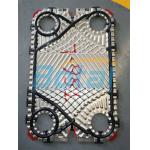
The material and steam flow channels of the equipment are formed by
the alternating assembly of plates of the same specification,
sealed by gaskets or connected by welding. Plates serve as the core
heat transfer carriers, and the flow channel design enables the
feed liquid to form a highly efficient turbulent state. According
to the application scenarios and material characteristics (such as
corrosivity and pressure requirements) in industrial production,
the equipment is available in three assembly types to precisely
meet the differentiated needs of various industries: - Detachable type: As the mainstream and core type of the equipment, it is also the
most widely used in industrial applications. It features multiple
advantages including high overall heat transfer efficiency, low
comprehensive cost, convenient operation and maintenance, flexible
adjustment of evaporation area, and reduced consumption of precious
metals.
- Semi-welded type: It balances sealing performance with partial disassembly and
maintainability, with plates partially welded and partially sealed.
This type is suitable for production scenarios with certain
corrosion or sealing requirements.
- All-welded type: There are no gaskets between plates, and sealing is achieved
through full welding. It boasts excellent sealing performance, as
well as high pressure and corrosion resistance, making it suitable
for harsh working conditions such as high-demand chemical
production and corrosive material processing.
|
Core Product Advantages- Far higher heat exchange efficiency than traditional equipment: It features a high heat transfer coefficient, 2 to 3 times that of tubular evaporators. The flow channel design of the plates enables the feed liquid to
quickly reach a vigorous turbulent state, greatly improving heat
exchange efficiency and achieving high-efficiency evaporation even
under low temperature difference conditions.
- Anti-clogging and anti-scaling, extended operation cycle: The feed liquid forms a continuous turbulent flow on the heat
exchange surface, which constantly scours the surface of the heat
exchanger, reduces fouling adhesion and effectively delays the
scaling cycle. The equipment is not prone to clogging as a whole,
lowering the maintenance costs of frequent cleaning.
- Compact structure, high space utilization: Under the working conditions of the same evaporation capacity,
the equipment occupies only 1/3 to 1/4 of the space of a tubular evaporator and its height is merely 1/10 of that of a tubular evaporator. It can effectively overcome the space limitations of industrial
sites and adapt to various installation environments.
- High convenience in maintenance and expansion: No complex procedures are required for overhaul; disassembly,
assembly, cleaning and maintenance can be completed simply by
loosening the screws of the plate heat exchanger. For expansion,
the evaporation area can be flexibly adjusted by increasing or
decreasing the number of plates without replacing the main
equipment, adapting to the dynamic adjustment of production scale.
- Low comprehensive usage cost: The overall design saves precious metal consumables and reduces
the comprehensive manufacturing cost. Meanwhile, it features low
heat loss and high heat transfer efficiency, which can effectively
reduce the consumption of heating media and bring significant
energy-saving advantages in long-term operation. In addition, its
small floor area saves the factory space cost.
Scope of ApplicationWith its multiple core advantages, the EC500-PHE plate evaporator
is widely used in the industrial evaporation market. It is suitable
for evaporation processes including material concentration, solvent
recovery and wastewater treatment in various industries such as
food, pharmaceutical, chemical, light industry, environmental
protection and metallurgy.
It is especially ideal for production scenarios with high
requirements on equipment installation space, heat exchange
efficiency and maintenance convenience.
It can handle clean feed liquids with low to medium viscosity and
performs excellently in working conditions such as low-temperature
concentration of heat-sensitive materials, concentration of
conventional aqueous solutions and treatment of high-salt
wastewater.
|