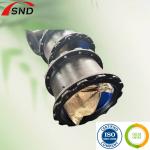
Ductile Iron Flange Fittings
Product Introduction
Ductile iron flange fittings are essential components in piping
systems, playing a vital role in connecting pipes, valves, pumps,
and other equipment. Made from ductile iron, these fittings boast
excellent mechanical properties, including high strength,
toughness, and ductility. This makes them suitable for a wide range
of applications, from water supply and drainage systems to
industrial pipelines transporting various media. The flange design
enables easy and secure connection, ensuring the stability and
reliability of the entire piping network.
Parameters
| |
|---|
| | | Parameter | Specification | | Material | Ductile Iron (e.g., ASTM A536) | | Nominal Diameter | DN25 - DN300 (customizable) | | Pressure Rating | PN10 - PN25 | | Flange Standard | ANSI, DIN, BS, GB, etc. | | Surface Treatment | Anti-corrosion coating, galvanized, etc. |
Advantages |
Ductile iron flange fittings offer several significant
advantages. Firstly, their ductile iron material provides a perfect
balance between strength and toughness, allowing them to withstand
high pressure and external impacts without easily cracking or
deforming. Secondly, they have excellent corrosion resistance,
especially when combined with appropriate surface treatments, which
extends their service life in various harsh environments.
Additionally, the standardized flange connection ensures easy
installation and maintenance, reducing labor costs and time. The
fittings also have good dimensional accuracy, ensuring a tight and
leak-free connection.
FAQ
• Q: Can ductile iron flange fittings be used for underground
pipelines?
A: Yes, they can. With proper anti-corrosion treatment, such as
epoxy coating, ductile iron flange fittings are well-suited for
underground applications, as they can resist soil corrosion and
external pressures.
• Q: How to ensure the sealing performance of ductile iron flange
fittings?
A: To ensure sealing, use high-quality gaskets that match the
flange type and pressure rating. Also, make sure the flanges are
properly aligned and the bolts are tightened evenly during
installation.
• Q: Are ductile iron flange fittings suitable for transporting
corrosive media?
A: It depends on the specific media and the level of corrosion
resistance required. For highly corrosive media, additional
anti-corrosion measures or the selection of specialized
corrosion-resistant materials may be necessary. However, for
general corrosive environments, ductile iron with appropriate
surface treatment can provide sufficient resistance.