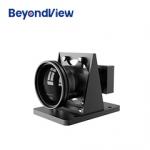
VL12R02LA1 Low Light Camera Module Sharpness Adjustment
|

Product Description:VL12R02LA1 low-light imaging core is based on a 1280x960@12μm black and white high-definition CMOS rolling shutter detector and integrates a high-performance, low-power signal processing platform. With a SWaP design, it offers optional lens and interface expansion components and supports external synchronization. In any low-light conditions, it can capture HD images with low time delay. Main Features:· Auto exposure Technical Parameters:
About BeyondView:Serving sectors such as industrial, security, law enforcement and outdoors since 2008, Beijing BeyondView Technology Co.,Ltd (BeyondView) has been providing advanced thermal imaging solutions, from IR/CMOS/Low Light modules to thermal binoculars, sights, and handheld thermal imagers. As a global innovator in infrared and visible-light technologies, BeyondView delivers cutting-edge solutions that transform how industries see, analyze, and interact with the world. At BeyondView, we engineer the future of imaging. We don't just capture images, we reveal critical truths hidden beyond human vision. We empower professionals with insights beyond visible light to improve safety, efficiency, and critical decision-making. FAQs:
Q: What is infrared thermal imaging technology? A: Infrared thermal imaging uses photoelectric technology to detect specific infrared band signals of thermal radiation from objects, converts these signals into images and graphics that can be visually distinguished by humans, and further calculates temperature values. Q: What is the wavelength range for infrared thermal imaging? A: Infrared ray, also known as infrared radiation, is an electromagnetic wave in the infrared wavelength range between visible light and microwave. Thermal infrared imaging typically refers to mid infrared imaging at 3-5μm and far-infrared imaging at 8-12μm. In these bands, the focus is on heat sources, not visible light. The human eye is sensitive to the wavelength range of about 0.4~0.7μm and cannot see longer wavelengths of thermal energy. Q: What is the classification of infrared thermal imaging wavebands? A: Generally speaking, infrared thermal imaging is divided into
three bands: short wave, medium wave, and long wave. Q: What are the applications of infrared detectors and thermal imaging modules? A: The infrared detectors and thermal imaging modules can be used in a variety of applications such as thermography, security & surveillance, intelligent industry, outdoor night vision observation, machine vision, smart driving, UAVs, and consumer infrared products. Q: Does infrared thermal imaging emit radiation? A: Infrared thermal imaging passively receives infrared signals emitted by objects and does not have radiation. As long as an object exceeds absolute zero, an infrared signal will be emitted, which is received by an infrared detector and then converted into a thermal image. |
||||||||||||||||||||||||||||||||||||||||||||||||||
| Product Tags: VL12R02LA1 Low Light Camera Module Sharpness Adjustment Low Light Camera Module | ||||||||||||||||||||||||||||||||||||||||||||||||||