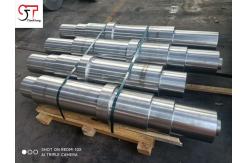
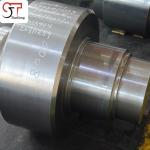
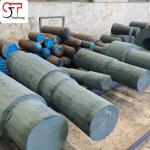
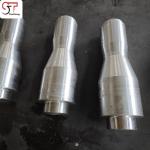
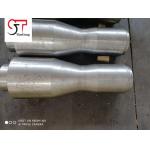
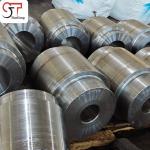
18CrNiMo7-6 Fatigue-Resistant Alloy Steel Forgings for Wind Turbine
Shafts are engineered to deliver outstanding performance under extreme
cyclic loading conditions. Utilizing the premium-grade low-carbon
alloy steel 18CrNiMo7-6, these forgings exhibit exceptional
toughness, core strength, and fatigue resistance — ideal for the
demanding load spectra found in wind turbine main shafts and rotor
hubs.
The forging process incorporates controlled open-die forging
techniques to ensure optimal grain orientation along the shaft’s
load path, significantly enhancing the fatigue life and structural
integrity of the component. Advanced quenching and tempering heat
treatments are applied to achieve a refined microstructure,
balanced mechanical properties, and uniform hardness across the
section.
Each forging undergoes rigorous non-destructive and dimensional
inspections, ensuring zero internal flaws and tight dimensional
tolerances required for precision-fit assemblies. Custom machining,
anti-corrosion surface treatments, and certified traceability can
be provided to meet specific project needs.
| Item | Details |
|---|
| Product Name | 18CrNiMo7-6 Fatigue-Resistant Alloy Steel Forgings for Wind Turbine
Shafts | | Material Grades | - Primary alloy: 18CrNiMo7-6
- Superior fatigue resistance, impact toughness, and tensile
strength
- Engineered for wind turbine shafts under extreme dynamic loading | | Forging Equipment | - Hydraulic hammers: 5T / 8T / 12T
- Large open-die forging press with core boring capability
- Near-net shape forging for long shafts with solid or bored
centers | | Manufacturing Process | Hot Forging → Intermediate Heat Treatment → Optional Core Boring /
Drilling →
Rough / Semi-Finish Machining → UT & Dimensional Inspection | | Forging Ratio | ≥ 3.0 — Promotes directional grain flow along shaft axis, ensuring
excellent
torque transmission and fatigue resistance in wind applications | | Applications | - Wind turbine main shafts and gearbox transmission shafts
- Designed to withstand extreme torsional loads, bending stresses,
and cyclical dynamic forces in wind energy systems | | Heat Treatment Options | -Annealing and tempering for fatigue-resistant microstructure
- Optional stress relief to maintain dimensional accuracy | | Testing & Inspection | - Chemical: Spectrometer-controlled composition analysis
- Mechanical: Hardness, tensile, yield, impact toughness
- Ultrasonic (UT): Multi-angle flaw detection, including bore zone
- Dimensional: Length, diameter, straightness, concentricity | | Value-Added Services | - Custom shaft geometries: shoulders, spline zones, flanges
- Pre-machined journals and stepped ends for gear integration
- Laser part marking and full traceability |
Key FeaturesMaterial Advantage: Made from 18CrNiMo7-6 alloy steel, offering high core strength,
superior toughness, and excellent hardenability. Fatigue Resistance: Optimized for high-cycle fatigue strength, making it ideal for
wind turbine applications with dynamic load demands. Directional Grain Flow: Forged to ensure continuous, longitudinal grain flow aligned with
shaft stress paths for improved durability. Heat Treatment: tempered to achieve uniform mechanical properties and increased
resistance to wear and stress. Dimensional Precision: Capable of tight tolerances for seamless integration into main
shaft assemblies. Quality Control: Full range of NDT (UT, MT) and mechanical testing to ensure
internal soundness and reliability. Customizable: Available with semi-machined or fully-machined finishes,
anti-corrosion coatings, and tailored end connections.
Application ScenariosWind Turbine Main Shafts: Designed to endure variable wind loads, torque transfer, and long
service cycles. Yaw and Pitch Drive Components: Suitable for structural parts under fluctuating torsional
stresses. Offshore Wind Installations: Proven performance in harsh marine environments requiring high
fatigue strength and corrosion tolerance. Renewable Energy Equipment: Critical rotating elements in sustainable power generation
systems requiring long-term reliability.
|