|
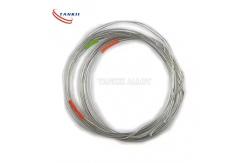
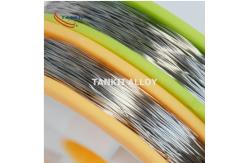
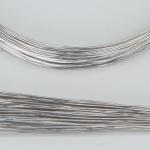
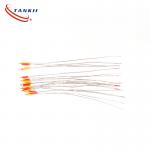
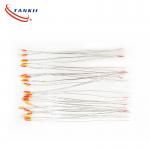
0.02-1mm 99.95% pure platinum Wire platinum bare wire Platinum-rhodium thermocou High quality S/B/R Type pure platinum thermocouple wire thermocouple bare wire High quality S/B/R Type pure platinum thermocouple wire thermocouple bare wireple wire
Non-insulated fine diameter, single wire and pair wire, ultra-high temperature resistant
Types S, R and B
R-type and S-type temperature range 1398 ~ 1482°C (2550 ~ 2700°F)
Type B is suitable for continuous use at temperatures up to 1704°C (3100°F)
To effectively prevent oxidation and corrosion at high temperatures, OMEGA offers high-quality uninsulated thermometer wires that can be applied to 3 types of "precious metal" thermocouples:
Type S: Platinum (-) and Platinum 10% Rhodium (+)
Type R: Platinum (-) and Platinum 13% Rhodium (+)
Type B: Platinum 6% Rhodium (-) and Platinum 30% Rhodium (+)
Types R and S are recommended for continuous use in oxidizing or inert atmospheres at temperatures up to 1398°C (2550°F), or short-term exposure to high temperatures up to 1482°C (2700°F). Type B is suitable for continuous use in oxidizing or inert atmospheres up to 1704°C (3100°F). When working close to the maximum temperature, it is recommended to use a larger wire diameter.
All 3 types of thermocouples can be used in a vacuum environment for short periods of time. Type B provides the best stability when applied in a vacuum environment. All 3 models are not suitable for use in reducing gases or environments containing metallic or non-metallic vapors unless a non-metallic protective sleeve is used. Never insert thermocouples directly into metal protective sleeves.
Wire diameters range from 0.025 to 0.812 mm (0.001 to 0.032"). If desired, thermocouple wires can be supplied in pairs that meet or exceed standard error limits. Special error limit wires are available on request and must be paired order. | Material | melting point | Resistivity | | Pure Rhodium(99.99%) | 1963 | 12.44 | | Pure Platinum(99.99%) | 1772 | 21.45 | | Pt-Rh6% | 1830 | 20.7 | | Pt-Rh10% | 1860 | 19.8 | | Pt-Rh20% | 1905 | 18.8 | | Pt-Rh30% | 1927 | 17.6 | | Specification: 0.015~41.2(mm) in round wire, strip: 60.1~0.5(mm) | | Application: Gas sensor. All kinds of sensors, medical components. Electric level and heating probe, etc. | Thermocouple Wire | Code | Wires component of the thermocouple | | +Positive leg | -Negative leg | | N | Ni-cr-si (NP) | Ni-si-magnesium (NN) | | K | Ni-Cr (KP) | Ni-Al(Si) (KN) | | E | Ni-Cr (EP) | Cu-Ni<constantan> (EN) | | J | Iron (JP) | Cu-Ni<constantan> (JN) | | T | Copper (TP) | Cu-Ni<constantan> (TN) | | B | Platinum rhodium-30% | Platinum rhodium-6% | | R | Platinum rhodium-13% | Platinum | | S | Platinum rhodium-10% | Platinum | Standards | ASTM | ANSI | IEC | DIN | BS | NF | JIS | GOST | | (American Society for Testing and Materials) E 230 | (American National Standard Institute) MC 96.1 | (European Standard by the International Electrotechnical Commission 584)-1/2/3 | (Deutsche Industrie Normen) EN 60584 -1/2 | (British Standards) 4937.1041, EN 60584 - 1/2 | (Norme Française) EN 60584 -1/2 - NFC 42323 - NFC 42324 | (Japanese Industrial Standards) C 1602 - C 1610 | (Unification of the Russian Specifications) 3044 | Theoretical weight per meter of precious metal wire (g/m) | Diametermm | Pt | Au | Ag | PtRh6 | PtRh10 | PtRh30 | | 3 | 151.7 | 136.4 | 74.11 | 145.2 | 141.4 | 124.5 | | 2.9 | 141.8 | 127.5 | 69.26 | 135.7 | 132.1 | 116.3 | | 2.8 | 132.1 | 108.9 | 64.57 | 126.6 | 123.1 | 108.4 | | 2.7 | 122.8 | 110.5 | 60.03 | 117.75 | 114.5 | 100.84 | | 2.6 | 114 | 102.4 | 55.67 | 109.1 | 106.2 | 93.48 | | 2.5 | 105.3 | 94.75 | 51.47 | 100.9 | 98.17 | 86.44 | | 2.4 | 97.07 | 87.32 | 47.43 | 92.96 | 90.23 | 78.66 | | 2.3 | 89.17 | 80.21 | 43.57 | 85.39 | 83.1 | 73.16 | | 2.2 | 81.56 | 73.36 | 39.86 | 78.11 | 76.02 | 66.94 | | 2.1 | 74.32 | 66.85 | 36.32 | 71.17 | 69.26 | 60.98 | | 2 | 67.43 | 60.64 | 32.95 | 64.57 | 62.84 | 55.33 | | 1.9 | 60.84 | 54.73 | 29.73 | 58.26 | 56.7 | 49.92 | | 1.8 | 54.61 | 49.11 | 26.68 | 52.29 | 50.89 | 44.8 | | 1.7 | 48.71 | 43.81 | 20.8 | 46.65 | 45.39 | 39.96 | | 1.6 | 45.41 | 38.81 | 21.08 | 41.31 | 40.21 | 35.96 | | 1.5 | 37.92 | 34.11 | 18.83 | 36.32 | 35.34 | 31.12 | | 1.4 | 33.04 | 29.72 | 16.14 | 31.63 | 30.79 | 27.11 | | 1.3 | 28.48 | 15.63 | 13.92 | 27.28 | 26.55 | 23.37 | | 1.2 | 24.28 | 21.84 | 11.86 | 23.25 | 22.62 | 19.92 | | 1.1 | 20.39 | 18.34 | 9.97 | 19.53 | 19.01 | 16.73 | | 1 | 16.86 | 15.16 | 8.24 | 16.14 | 15.7 | 13.83 | | 0.9 | 13.66 | 12.28 | 6.67 | 13.07 | 12.75 | 11.2 | | 0.8 | 10.78 | 9.7 | 5.27 | 10.33 | 10.06 | 8.85 | | 0.7 | 8.26 | 7.43 | 4.04 | 7.91 | 7.68 | 6.78 | | 0.6 | 6.07 | 5.46 | 2.96 | 5.82 | 6.65 | 4.98 | | 0.5 | 4.22 | 3.8 | 2.06 | 4.03 | 3.92 | 3.45 | | 0.4 | 2.71 | 2.43 | 1.32 | 2.58 | 2.53 | 2.21 | | 0.3 | 1.52 | 1.37 | 0.74 | 1.45 | 1.42 | 1.24 | | 0.2 | 0.675 | 0.607 | 0.33 | 0.65 | 0.63 | 0.55 | | 0.1 | 0.169 | 0.152 | 0.08 | 0.16 | 0.16 | 0.14 | | 0.09 | 0.136 | 0.123 |
|
|
|
| | 0.08 | 0.108 | 0.097 |
|
|
|
| | 0.07 | 0.083 | 0.075 |
|
|
|
| | 0.06 | 0.061 | 0.055 |
|
|
|
| | 0.05 | 0.042 | 0.038 |
|
|
|
| | 0.04 | 0.027 | 0.024 |
|
|
|
| | 0.03 | 0.015 | 0.014 |
|
|
|
| | 0.02 | 0.0068 | 0.0061 |
|
|
|
| | Resistivity | 21.46 | 19.3 | 10.49 | 20.55 | 20 | 17.61 | In coil or DIN Spool,in carton or wooden case
DIN 100, DIN 125, DIN 160, DIN 200, DIN 250, DIN 355
Make electrodes.
Thermocouple manufacture. PtPh10/Pt thermocouple is the most accurate thermocouple for temperature measurement above 300°C, and it is also the international temperature benchmark in the range of 630.74~1064.43°C. Generally, the temperature can reach 1350°C (short-term 1600°C) PtPh30/PtPh6.PtPh13/Pt.PtPh20 /PtPh5. Thermocouples such as PtPh40/PtPh20 can measure higher temperatures.
In the glass industry, it is used to make heat-resistant and corrosion-resistant devices such as crucibles, drain plates, stirrers and electrodes.
It is used as a catalyst in ammonia oxidation and many other reactions.
It can be used as a high temperature heating element. The furnace with PtPh40 alloy as the heating element can work up to 1800 ºC in an oxidizing atmosphere. 


|