
Bright CuNi44 Nicr Alloy Foil / Strip 0.05mm * 100mm High Precision ISO9001
|

|
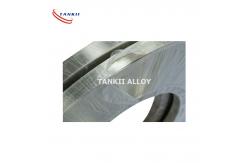
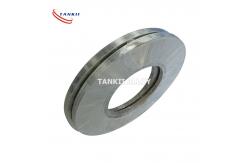
Stock Price 0.05mm*100mm CuNi44 Constantan Bright Foil/ Strip
Description A copper-nickel alloy that contains specific minor amounts of additional elements to achieve precise values for the temperature coefficient of resistivity. Constantan is a copper-nickel alloy usually consisting of 55% Copper and 45% Nickel. Its main feature is its resistance which is constant over a wide range of temperatures. Other alloys with similarly low temperature coefficients are known, such as Manganin (Cu86Mn12Ni2). Of all modern strain gauge alloys, Constantan is the oldest, and still the most widely used. This situation reflects the fact that constantan has the best overall combination of properties needed for many strain gauge applications. This alloy has, for example, an adequately high strain sensitivity, or gauge factor, which is relatively insensitive to strain level and temperature. Its resistivity is high enough to achieve suitable resistance values in even very small grids, and its temperature coefficient of resistance is not excessive. In addition, constantan is characterized by good fatigue life and relatively high elongation capability. It must be noted, however, that constantan tends to exhibit a continuous drift at temperatures above 65 °C (150 °F); and this characteristic should be taken into account when zero stability of the strain gauge is critical over a period of hours or days. Synonyms
Chemical Properties b) A-Alloy: Very importantly, constantan can be processed for self-temperature compensation to match a wide range of test material coefficients of thermal expansion. An alloy is supplied in self-temperature-compensation (S-T-C) numbers 00, 03, 05, 06, 09, 13, 15, 18, 30, 40 and 50, for use on test materials with corresponding thermal expansion coefficients, expressed in parts per million by length (or µm/m) per kelvin or degree Celsius or degree Fahrenheit. c) P-alloy: For the measurement of very large strains, 5% (50 000 microstrain) or above, annealed constantan (P alloy) is the grid material normally selected. Constantan in this form is very ductile; and, in gauge lengths of 0.125 in (3 mm) and longer, can be strained to >20%. It should be borne in mind, however, that under high cyclic strains the P alloy will exhibit some permanent resistance change with each cycle, and cause a corresponding zero shift in the strain gauge. Because of this characteristic, and the tendency for premature grid failure with repeated straining, P alloy is not ordinarily recommended for cyclic strain applications. P alloy is available with S-T-C numbers of 08 and 40 for use on metals and plastics, respectively.
|
| Product Tags: nickel alloys nichrome wire nichrome resistance wire |
|
Nicr Alloy Ni80Cr20 Nichrome Wire Offering Uniform Heat Generation and Resistance to Oxidation Scaling for Heating Performance |

|
NiCr80/20 Nickel Chromium Alloy Round Wire 0.025mm To 12mm Used For Heat Sealing Machines |

|
NiCr8020 Nickel Chromium Alloy strip 0.2*25mm 0.1*15mm Used For Heating element of heating furnace |

|
Tankii Flat Wires Made Of Nickel-Chromium Alloys Used For Home Appliance Heating Bodies |

|
0.2*5mm Nickel-Chromium 6015 / Chromel C Flat Wire Used For Planar/Strip Heating Elements |

|
High Temperature 0.1*3mm NiCrA / Alloy A /Nichrome 80 Ribbon Wire For Plastic Bag Sealing Machine Heating Strip |